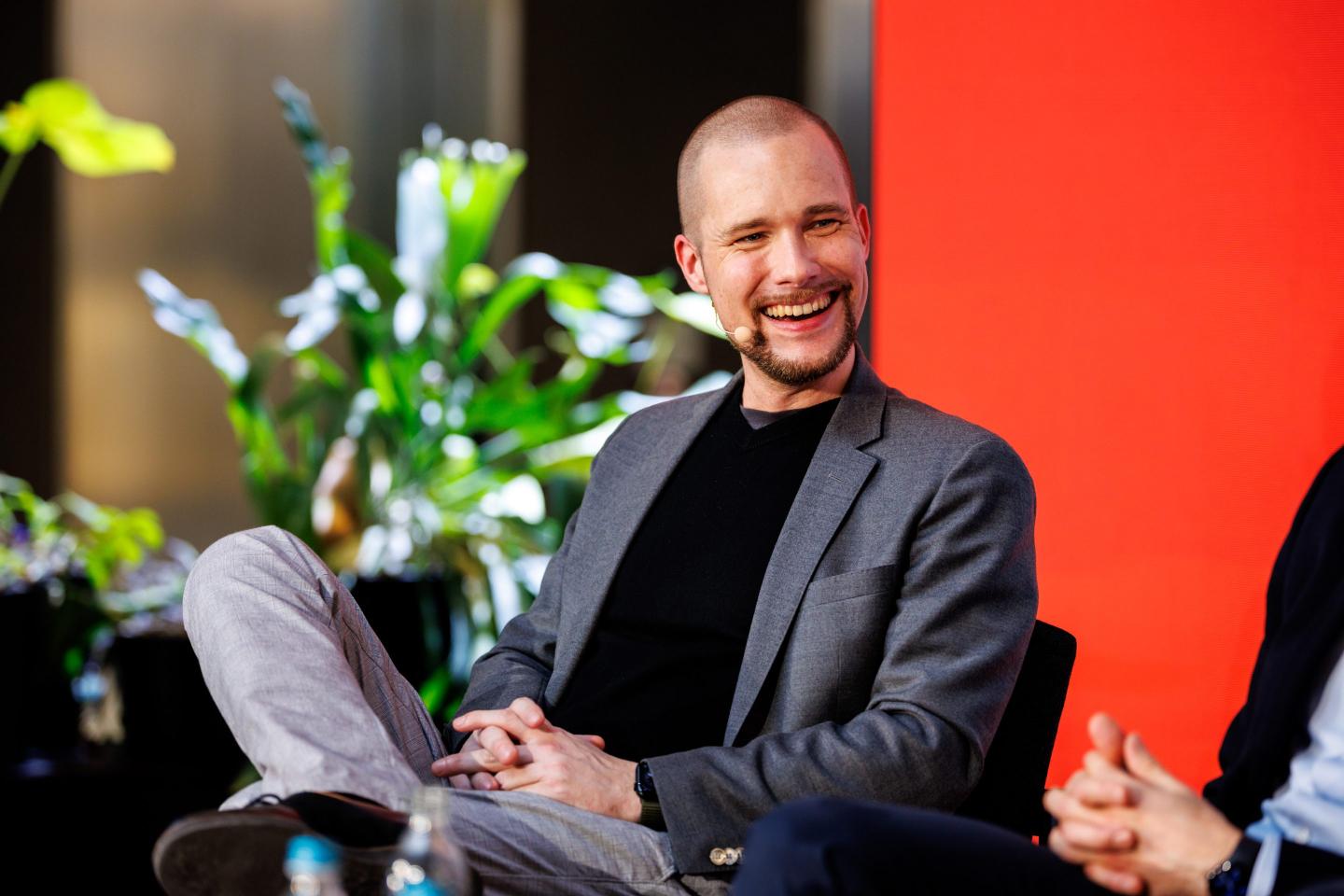
Very few startups have raised enough money to build and support powerful generative AI models. Germany’s Aleph Alpha appeared to be one of them. Late last year, it touted an investment in excess of $500 million from the country’s industrial giants and one of its richest tycoons, cementing it as Europe’s greatest hope in developing advanced AI independent of Silicon Valley.
Now, it’s exiting that race.
Last week, Aleph Alpha announced a new strategy centered around its latest product, PhariaAI, an “operating system for generative AI.” It’s effectively software to help corporate and government clients use AI chatbots and tools, regardless of whether the underlying technology was made by Aleph Alpha or one of its rivals. The startup still plans to develop large-language models, or LLMs — the systems that underpin products like ChatGPT — but they’re no longer the centerpiece of its commercial strategy. Nor is it trying to outperform models from firms such as OpenAI or Meta.
The shift makes Aleph Alpha the latest high-flying AI startup to change course in a field increasingly controlled by a few well-capitalized giants. In the US, several prominent newcomers ditched ambitious plans after their founders took jobs at Microsoft, Google and Amazon. Startups behind leading AI models — including OpenAI, Anthropic and France’s Mistral — have also formed tight partnerships with these tech giants, who they rely on for cash and computing resources.
“The world changed,” Jonas Andrulis, Aleph Alpha’s chief executive, said in an interview. “Just having an European LLM is not sufficient as a business model. It doesn’t justify the investment.” He pointed to the consolidation of the field, and the expensive computing contest this set off, as factors behind his company’s “evolution.”
The shift means Aleph Alpha can grow its business without having to spend the monumental sums needed to maintain leading AI models. Yet Silicon Valley’s clout may not be the only reason behind Aleph Alpha’s pivot. Others close to the startup say it has been hobbled in the fast-moving AI market because of slow decision-making and difficulty living up to the unique pressures associated with being a national champion.
“As a founder, of course I think we should be moving faster,” Andrulis said, before adding that his company’s strategy was more developed than those of other generative AI rivals. “Nobody knows how to build business models that make any sense. We are certainly a step ahead there.”
Founded in 2019 by veterans of Apple Inc. and Deloitte LLP, Aleph Alpha pitched itself as a cutting-edge AI upstart committed to upholding “European values” like transparency, autonomy and regulatory compliance. In April 2022, the startup released Luminous, an AI model designed to parse and generate images and text in five languages. After ChatGPT launched seven months later — transforming AI from a niche research field into a top priority for investors and governments — everybody wanted in, including Germany.
“That attention needed a target,” Ludwig Ensthaler, a founding partner with 468 Capital, said in July. “And Aleph Alpha was it.”
Suddenly, Andrulis was meeting frequently with German Chancellor Olaf Scholz and appearing with Robert Habeck, Germany’s economy minister, to stress the importance of “AI made in Europe.” Last November, Habeck and Andrulis stood side-by-side to announce that Aleph Alpha’s latest fundraise had exceeded $500 million, and included German industry titans SAP SE and Bosch.
The outsized attention shocked even the small startup’s biggest boosters. After the 2023 round, when the company had around 60 employees, German business newspaper Handelsblatt put Andrulis on its cover with the headline, “All of Europe should hope that this entrepreneur is successful.” Ensthaler, who was Aleph Alpha’s first investor, recalled doing a double-take upon seeing it. “Is this a joke?”
The investor was impressed with the startup’s progress in a daunting field, but didn’t feel as if it had earned such breathless coverage. Behind the scenes, several Aleph Alpha insiders described the period around the fundraise as turbulent, with leadership debating the launch of a chatbot, expanding outside of Germany and bringing on Intel Corp. as a backer. At one point, investors weighed the idea of finding a new CEO before settling on hiring a chief operating officer, according to people familiar with the matter who asked not to be identified discussing private matters. (Andre Retterath, chair of the startup’s board, said directors did not consider replacing Andrulis.) Critical stories about the company in German media would later detail missed sales targets, product delays, customer complaints and senior staff turnover.
Scrutiny also centered on the startup’s unconventional financing, which the company only confirmed well after the fact. The bulk of its fundraise, €300 million, came as a 10-year research grant from the Dieter Schwarz Foundation, an institution formed by the German billionaire behind the retail conglomerate Schwarz Group. Only €110 million of the investment arrived as equity, while the remainder came from revenue guarantees from the startup’s investors. The company has never disclosed its valuation.
Normally, valuations serve as indicators of potential equity to investors, and this omission caused some outsiders to question whether Aleph Alpha was inflating its size with an eye-catching investment sum. Retterath noted that the deal’s unusual structure made a valuation difficult to calculate, but described it as “the most attractive” he had seen within the generative AI sector.
The arrangement, which tethered the company’s research efforts to the Schwarz Group, suited Andrulis’s unspoken strategy of prioritizing domestic growth above all else. The company walked away from a financing offer from Intel Corp. to instead focus primarily on domestic investors, according to people familiar with the plans who could not discuss financing deliberations publicly. Two other people who worked at the company who did not want to be identified speaking about internal strategies also said that Andrulis concentrated his sales efforts on German businesses and government agencies despite an internal push to expand internationally.
Germany’s tech market is relatively small. IDC, a market research firm, estimated that spending on computing and software in German-speaking countries would reach $330 billion by 2026, accounting for less than a third of Europe’s total projected spending.
Andrulis declined to comment on Intel’s offer, but he said he preferred a deal without any requirements to buy computing resources from investors. He described the financing round as oversubscribed and said that Aleph Alpha opted for backers that did not impose “strategic limitations” on the startup. (A spokesperson for Intel also declined to comment.)
Andrulis also said that while the company’s “road map” includes eventually expanding beyond its home country, “we cannot disappoint our German partners.”
As Aleph Alpha doubled down on Germany, another national rival was rising. A month after Aleph Alpha’s big announcement, Paris-based Mistral sealed a €385 million round to build its own large-language models. In the months that followed, Mistral brought in more money — hitting a $6 billion valuation in June — and released multiple new versions and models. Aleph Alpha’s model, meanwhile, languished without any notable updates.
Ten months after the height of its media attention, Aleph Alpha now has roughly 200 employees and is booking around €20 million in annual recurring revenue, according to two people familiar with the finances who asked not to be identified discussing private information. The company told investors it would net €20 million in total revenue in 2024 and reach €70 million next year, according to documents viewed by Bloomberg News. In 2023, it projected €5.9 million in sales but delivered shy of €1 million.
Andrulis wouldn’t comment on sales figures beyond saying the startup is on track to beat its targets this year. A spokesperson for Aleph Alpha said it will reach a “solid double-digit million figure” in revenue this year. Andrulis noted that Aleph Alpha currently has “30 to 40” customers, with 90 to 95% of its business in Germany. The startup’s joint venture with the German unit of PricewaterhouseCoopers LLP, formed this summer, will be announcing several prominent deals later this fall, Andrulis said.
Thomas Odenwald, a German executive who spent four months as vice president at Aleph Alpha before leaving in April, said many of the nation’s businesses show little aptitude for taking risks and making swift decisions. “This concept of ‘fail fast’ — you need to internalize that as a startup,” said Odenwald, who lives in California. “It goes against the traditional German mindset.”
Still, Ensthaler, the early investor, noted that businesses looking to use AI in Germany must conform to particular data privacy and regulatory requirements. Aleph Alpha, he said, is “best positioned to cater to those needs.” Other observers have also suggested that Europe’s AI startups are better suited to compete outside the costly LLM race. Adrian Locher, a general partner with Merantix, a venture capital firm in Berlin, said offering “highly specialized” AI applications for particular industries could be a model that would flourish in Europe. “That doesn’t necessarily mean Aleph Alpha has to be the ‘OpenAI of Europe’ to be a success,” he said.
For now, Aleph Alpha is settling into its new strategy. In July, it announced that government employees in its home state of Baden-Württemberg would soon start using the system now called PhaidraAI. During an interview, Andrulis briefly showed it off — an interface that lets public employees tap AI tools to do tasks like manage files, sift through documents or write emails.
The government is using Aleph Alpha’s model to run part of that system. For another part, it’s using an LLM built by Mistral.