• Home
  • News
  • Fortune 500
  • Tech
  • Finance
  • Leadership
  • Lifestyle
  • Rankings
  • Multimedia
TechTesla

Tesla is hiring workers for $48 an hour to wear motion-capture suits to train its humanoid robots

Sasha Rogelberg
By
Sasha Rogelberg
Sasha Rogelberg
Reporter
Down Arrow Button Icon
Sasha Rogelberg
By
Sasha Rogelberg
Sasha Rogelberg
Reporter
Down Arrow Button Icon
August 19, 2024, 1:29 PM ET
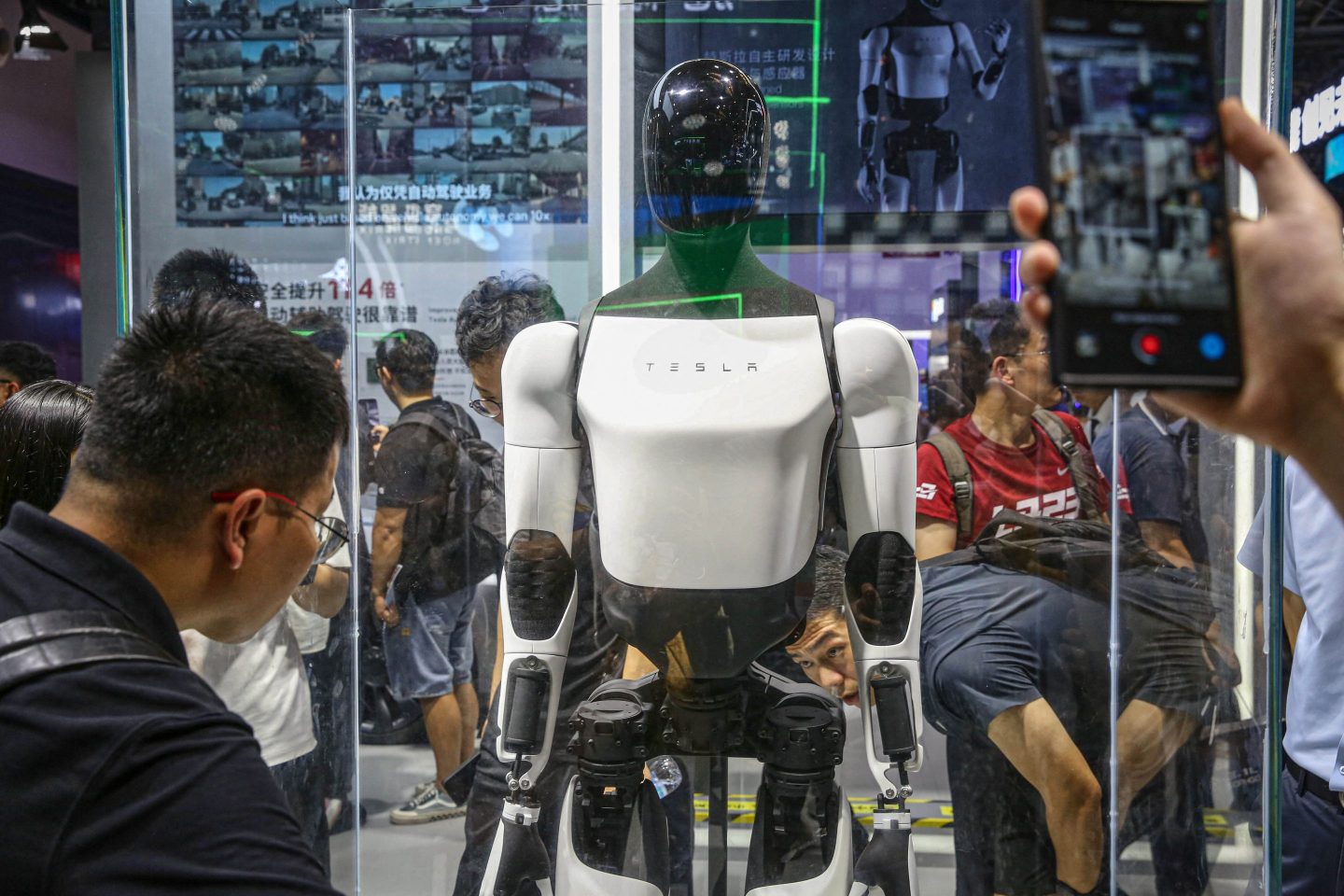
People look at an Optimus bot, which is standing in a clear glass box.
Tesla announced the development of its humanoid robot Optimus in 2021.STR/AFP—Getty Images

Tesla is taking the next steps in developing its humanoid Optimus robots—or at least it’s hiring workers to take those literal steps. For up to $48 an hour, you could help collect data to train Tesla’s AI-powered robots, designed to automate work in company factories.

Recommended Video

According to job listings on LinkedIn, Indeed, and Tesla’s website, Elon Musk’s electric-vehicle company is hiring “data collection operators” to gather movement information and provide equipment feedback on the Optimus robots. Workers are required to wear motion-capture suits and virtual reality headsets to simulate the movements and actions of the bots. Per the job listing, applicants must be able to walk for over seven hours a day and should be between 5-foot-7 and 5-foot-11 in order to operate the motion-capture suits. Payment ranges from $25.25 to $48 per hour.

In a video shared across Tesla’s social media in May, dozens of teleoperations workers wear motion-capture and VR equipment and stand alongside the Optimus bots. Standing on a black mat in a large white room, workers mimic lifting and placing items slowly and mechanically, while Optimus bots complete that same motion, but with real items in front of them. In the same space, the robots practice walking and completing other tasks like folding laundry, unaccompanied by human workers.

Tesla announced its Optimus project in 2021, with the goal of using it to complete factory tasks that were “unsafe, repetitive, or boring.” The initiative aligns with greater industrywide investment in automation, spurred by pandemic-era labor shortages. As of 2016, 10% of warehouses reported using meaningful automation technology, according to Westernacher Consulting, with robot shipments expected to increase by up to 50% each year until 2030, per McKinsey data.

But Tesla’s automation efforts have not yet come to fruition. Like Musk’s other ambitions, Optimus’s timeline has overpromised and under-delivered. In 2022, Musk suggested Optimus production could begin as early as 2023. Optimus was initially met with disappointment from roboticists, who, after seeing the 2022 Bumble C prototype of the machine, found it largely underwhelming. 

“While there’s absolutely nothing wrong with the humanoid robot that Musk very briefly demonstrated on stage, there’s nothing uniquely right, either,” Evan Ackerman, robotics editor for technology magazine IEEE Spectrum, wrote for the publication. “We were hoping for (if not necessarily expecting) more from Tesla.”

Since then, the Optimus project has made strides. The most recent iteration of the robot saw it perform its first autonomous task of handling batteries at one of Tesla’s facilities, according to its 2024 second-quarter earnings. Musk said in July the robots will be in production for internal use as early as next year, with the goal of being sold to other companies in 2026. Tesla did not respond to Fortune’s request for comment.

Optimus optimism

The Tesla CEO has been bullish on the impact of Optimus on Tesla’s operations, confident the robots could drive the EV company to a $25 trillion valuation. That’s over 36 times its current valuation of $692.94 billion, and over seven times that of Apple’s $3.41 trillion market cap. Musk estimated the eventual production of over 20 billion units, arguing the planet’s 8 billion people will want the product, alongside the growing industrial demand.

But competition for task-automating robots is heating up. In February, Figure, another AI-powered robotics firm, announced $675 million in its latest funding round, giving it a valuation of $2.6 billion. At the beginning of the year, the company—backed by OpenAI’s startup fund, Microsoft, Nvidia, and Jeff Bezos’s Bezos Expeditions—minted a commercial agreement with BMW to assist the carmaker in vehicle manufacturing. After identifying the best uses for the technology, Figure and BMW will implement the bots at the auto company’s Spartanburg, S.C., factory.

If Tesla wants to put up a fight against competing AI robotics companies, it has its work cut out for it. Optimus robots will require constant updates and new prototypes, argued Animesh Garg, robotics professor at Georgia Institute of Technology and senior researcher at Nvidia Research. Each component and upgrade is custom to the bots, and early research in the worker-powered efforts of gathering data on its functioning is a steep investment—and risk.

“It [is] extremely difficult to produce robots at scale,” Garg told Business Insider. “The amount of data collection you’d need would easily be half-a-billion dollars, and the real question is, ‘Even if you do that, do you succeed?’ Because there is no guarantee of success.” 
Fortune Brainstorm AI returns to San Francisco Dec. 8–9 to convene the smartest people we know—technologists, entrepreneurs, Fortune Global 500 executives, investors, policymakers, and the brilliant minds in between—to explore and interrogate the most pressing questions about AI at another pivotal moment. Register here.
About the Author
Sasha Rogelberg
By Sasha RogelbergReporter
LinkedIn iconTwitter icon

Sasha Rogelberg is a reporter and former editorial fellow on the news desk at Fortune, covering retail and the intersection of business and popular culture.

See full bioRight Arrow Button Icon

Latest in Tech

Elon Musk
Big TechSpaceX
SpaceX to offer insider shares at record-setting $800 billion valuation
By Edward Ludlow, Loren Grush, Lizette Chapman, Eric Johnson and BloombergDecember 6, 2025
4 hours ago
Big TechApple
Apple rocked by executive departures, with chip chief at risk of leaving next
By Mark Gurman and BloombergDecember 6, 2025
6 hours ago
Nvidia CEO Jensen Huang said China is better equipped for an AI data center buildout than the U.S.
AITech
Nvidia CEO says data centers take about 3 years to construct in the U.S., while in China ‘they can build a hospital in a weekend’
By Nino PaoliDecember 6, 2025
9 hours ago
Arts & EntertainmentMedia
Former Amazon Studios boss warns the Netflix-Warner Bros. deal will make Hollywood ‘a system that circles a single sun’
By Jason MaDecember 6, 2025
10 hours ago
Jay Clayton
LawCrime
25-year DEA veteran charged with helping Mexican drug cartel launder millions of dollars, secure guns and bombs
By Dave Collins, Michael R. Sisak and The Associated PressDecember 6, 2025
10 hours ago
Elon Musk
LawSocial Media
Elon Musk’s X fined $140 million by EU for breaching digital regulations
By Kelvin Chan and The Associated PressDecember 6, 2025
11 hours ago

Most Popular

placeholder alt text
Big Tech
Mark Zuckerberg rebranded Facebook for the metaverse. Four years and $70 billion in losses later, he’s moving on
By Eva RoytburgDecember 5, 2025
1 day ago
placeholder alt text
Success
Nvidia CEO Jensen Huang admits he works 7 days a week, including holidays, in a constant 'state of anxiety' out of fear of going bankrupt
By Jessica CoacciDecember 4, 2025
2 days ago
placeholder alt text
Economy
Two months into the new fiscal year and the U.S. government is already spending more than $10 billion a week servicing national debt
By Eleanor PringleDecember 4, 2025
3 days ago
placeholder alt text
AI
Nvidia CEO says data centers take about 3 years to construct in the U.S., while in China 'they can build a hospital in a weekend'
By Nino PaoliDecember 6, 2025
9 hours ago
placeholder alt text
Success
‘Godfather of AI’ says Bill Gates and Elon Musk are right about the future of work—but he predicts mass unemployment is on its way
By Preston ForeDecember 4, 2025
2 days ago
placeholder alt text
Asia
Despite their ‘no limits’ friendship, Russia is paying a nearly 90% markup on sanctioned goods from China—compared with 9% from other countries
By Jason MaNovember 29, 2025
7 days ago
Rankings
  • 100 Best Companies
  • Fortune 500
  • Global 500
  • Fortune 500 Europe
  • Most Powerful Women
  • Future 50
  • World’s Most Admired Companies
  • See All Rankings
Sections
  • Finance
  • Leadership
  • Success
  • Tech
  • Asia
  • Europe
  • Environment
  • Fortune Crypto
  • Health
  • Retail
  • Lifestyle
  • Politics
  • Newsletters
  • Magazine
  • Features
  • Commentary
  • Mpw
  • CEO Initiative
  • Conferences
  • Personal Finance
  • Education
Customer Support
  • Frequently Asked Questions
  • Customer Service Portal
  • Privacy Policy
  • Terms Of Use
  • Single Issues For Purchase
  • International Print
Commercial Services
  • Advertising
  • Fortune Brand Studio
  • Fortune Analytics
  • Fortune Conferences
  • Business Development
About Us
  • About Us
  • Editorial Calendar
  • Press Center
  • Work At Fortune
  • Diversity And Inclusion
  • Terms And Conditions
  • Site Map

© 2025 Fortune Media IP Limited. All Rights Reserved. Use of this site constitutes acceptance of our Terms of Use and Privacy Policy | CA Notice at Collection and Privacy Notice | Do Not Sell/Share My Personal Information
FORTUNE is a trademark of Fortune Media IP Limited, registered in the U.S. and other countries. FORTUNE may receive compensation for some links to products and services on this website. Offers may be subject to change without notice.