
Sometimes it takes removing oneself from the familiar context of the current day to realize just how much the world has evolved.
Each year, Fortune publishes its flagship Fortune 500 list (U.S. companies only) approximately two months prior to its Global 500. (This timing is largely determined by when companies report their financial performance following the end of their fiscal years.) Given that many of the world’s largest companies by revenue are American, the upper echelons of the Global list often echo the American domestic list published a few weeks prior. Most recently, Walmart has been No. 1 on both lists, year after year, and U.S. companies on the Global list appear in largely the same order as they do on the domestic list, with non-U.S. companies scattered in between. Trends such as which sectors dominate are similarly parallel.
Still, there are always shifts and surprises, which is why Fortune runs each of these lists annually. And the further you look back in time, the more interesting those shifts become.
When Fortune published the first list with the title “Global 500” in 1990, West and East Germany were still two separate nations. China, now regularly in competition with the U.S. for the highest total number of Global 500 companies, was not even among the top 10 countries in 1990 by that measure. There were 167 U.S. companies on the 1990 list, 111 Japanese companies, and in a distant third was Britain, with 43.
Fortune began publishing an international list of the largest companies by revenue in 1976, but U.S. and non-U.S. companies didn’t occupy the same list until the Global 500 debuted in 1990. Then in 1995, as I discussed in my July 2 edition of this newsletter, Fortune intermingled industrial and service corporations on both of the 500 lists for the first time. To see how the Global 500 has changed over time, let’s peek back into the archives at the pages of Fortune that detailed the Global 500 in both 1990 and 1995.
The numbers to know
14… The number of industries, out of 25 total industries, in which the highest-ranking Global 500 company in 1990 was a U.S. company. IBM (No. 5) led computers, General Electric (No. 7) led electronics, and Boeing (No. 45) led aerospace.
$126.97 billion… the revenue for the 1989 fiscal year (as published in 1990) of General Motors, No. 1 on the first Global 500, compared to $171.84 billion for GM today (not inflation-adjusted).
167… the number of U.S. companies on the 1990 Global 500, compared with 111 from Japan.
151… the number of U.S. companies on the 1995 Global 500, compared with 149 from Japan. The addition of service corporations led many Japanese companies to qualify for the list for the first time, and six occupied the top 10.
40… the number of Japanese companies on the 2024 Global 500, compared with 139 from the U.S. and 133 fromfno Greater China.
728,944… the number of people employed by the U.S. Postal Service 30 years ago, causing it to earn the designation of “biggest employer” on the 1995 Global 500, on which it ranked No. 33. Today, the USPS has 582,781 employees; Walmart, the biggest employer on the 2024 list, has 2.1 million.
$6.2 billion… the profits of Royal Dutch/Shell (1994 dollars) which made it the most profitable Global 500 company on the 1995 list. Today, another oil company, Saudi Aramco, is most profitable, having netted $121 billion in the past year.
$2.48 billion… the revenue of the No. 500 company on the 1990 list (DAF Trucks, 1989 dollars), compared to $7.84 billion on the 1995 list (Toyo Seikan Kaisha, Ltd., 1994 dollars), and $32.08 billion on the 2024 list (Samsung C&T, 2023 dollars).
The big picture
“Now that the global village is truly upon us, it looks more like a global industrial park,” wrote Fortune reporters Jung Ah Pak and Sally Solo in their accompanying essay to the inaugural Global 500 in the July 30, 1990, issue. “We live in an expansive new world of economic interconnections where business roars through borders and time zones.” These characterizations seem quaint and cliché today, but to Fortune staff at that time, it was the dawn of a new era. The globalization of business had finally arrived, the end of the Cold War would soon give way to the foundation of the European Union and the dissolution of the Soviet Union, and the dotcom boom was nigh.
Companies themselves were becoming more global not only in terms of trade and manufacturing but by expanding through mergers and acquisitions. By 1995, associate editor Rahul Jacob would assert that that year’s list was “probably the most global 500” to date, pointing to the fact that one in seven Boeing planes was sold to Chinese airlines as an example.
Deeper takeaways
Mixed performance for Japan
While the U.S. economy was surging in the mid-90s, with a GDP growth rate of 4.1% in 1994, Japan’s economy grew sluggishly, by just 0.6%. At the time, Japan was in the early years of a slump that would eventually last for decades. Still, Japanese companies ranked among the highest sales-generating in the world that year, carried by the momentum they’d built during a boom in the 1970s and ‘80s. There were nearly as many Japanese companies on the 1995 Global 500 as U.S. companies, and they made up more than half of the top 10.
Mitsubishi, No. 1 in 1995, is No. 65 on the 2024 list. Citing its “huge revenues but puny earnings,” an article in the Aug. 7, 1995, issue of Fortune asked in its headline whether Mitsubishi even had a future, saying that analysts thought of it as a “lumbering, prehistoric beast that has outlived its epoch.” The article painted Mitsui (No. 2), Itochu (No. 3), Sumitomo (No. 4), Marubeni (No. 6), Nissho Iwai (No. 9) in the same light.
Exchange rates also made Japanese companies appear more successful than they were at the time. “Thirty-eight companies that actually had revenue decreases in yen registered increases when their results were expressed in dollars for our list,” Fortune’s Jacob explained.
A different time for automakers
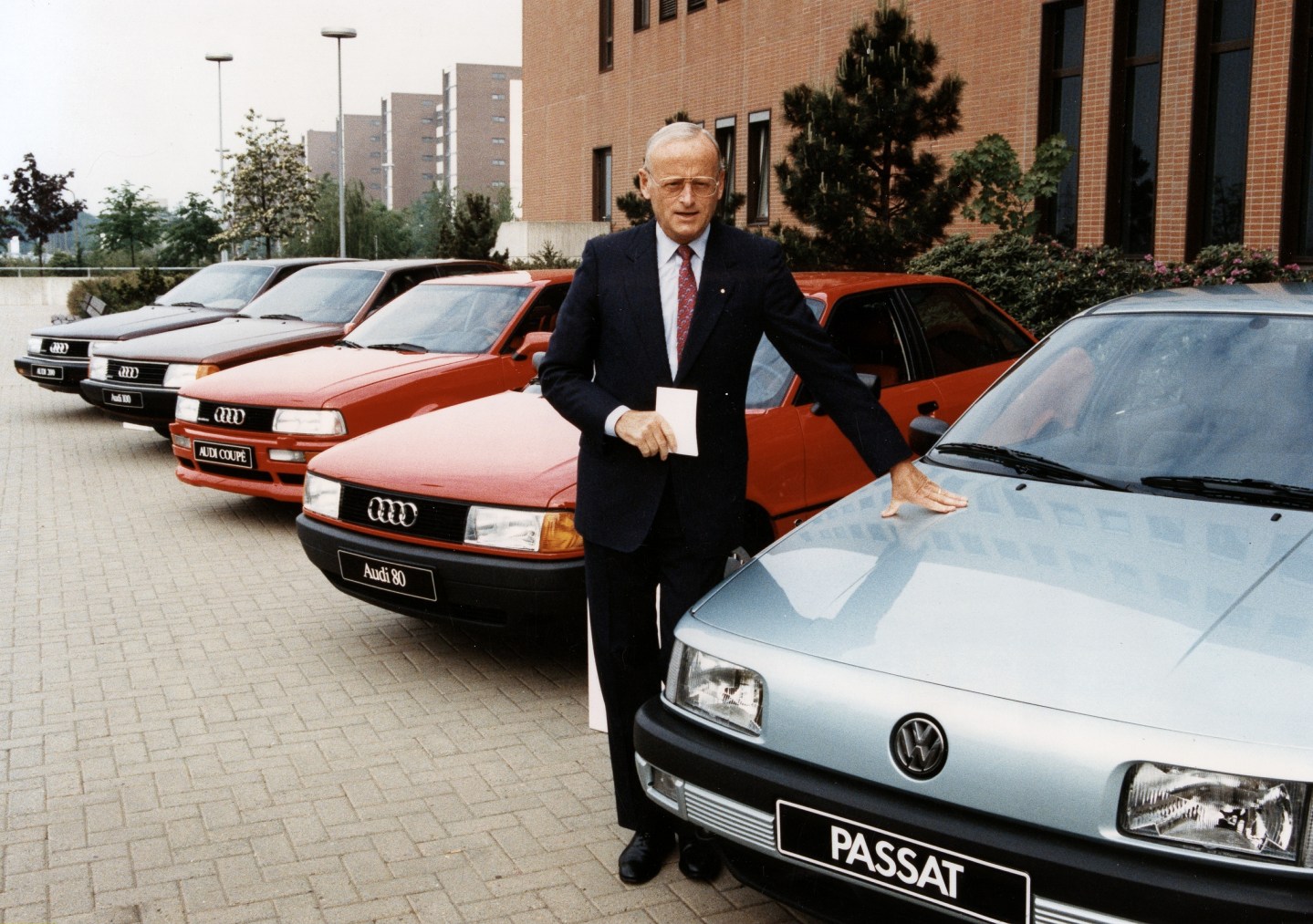
Volkswagen earned the title of “biggest carmaker” on the 2024 Global 500, ranking No. 11 and earning the company the cover treatment for the Europe edition of Fortune’s August/September 2024 issue. But on the 1990 list, Volkswagen ranked No. 21, and there were seven other companies in the motor vehicles and parts industry that ranked ahead of it.
General Motors was No. 1 on the original Fortune 500 in 1955, and it upheld that rank in 1990. Ford Motor was No. 2 in 1990. A few notches lower on the list, Japanese rivals made notable gains that fueled high placement on the inaugural Global 500. Toyota Motor ranked No. 6, Nissan Motor ranked No. 17, and Honda ranked No. 30 in 1990. They specifically capitalized on the sports car market at home and in the U.S., with Nissan’s revenues increasing by 23% year over year, and Toyota and Honda’s by 19%. By 1995, Nissan (No. 23) had surpassed Chrysler (No. 29).
Fast-forward to 2024, and the biggest three are Volkswagen, with Toyota Motor at No. 15 and what’s now known as Stellantis at No. 28, after many mergers (bringing together Italy’s Fiat, Chrysler, and the French PSA group). Nissan has tumbled to No. 136, while Honda sits at No. 57, General Motors is No. 39, and Ford is No. 36.
Lydia Belanger
Director of Production, Fortune
lydia.belanger@fortune.com