
• Home
  • Latest
  • Fortune 500
  • Finance
  • Tech
  • Leadership
  • Lifestyle
  • Rankings
  • Multimedia
FinanceInflation

Fed president throws doubt onto September rate cut Wall Street is desperate for

Eleanor Pringle
By
Eleanor Pringle
Eleanor Pringle
Senior Reporter, Economics and Markets
Down Arrow Button Icon
Eleanor Pringle
By
Eleanor Pringle
Eleanor Pringle
Senior Reporter, Economics and Markets
Down Arrow Button Icon
August 9, 2024, 6:33 AM ET
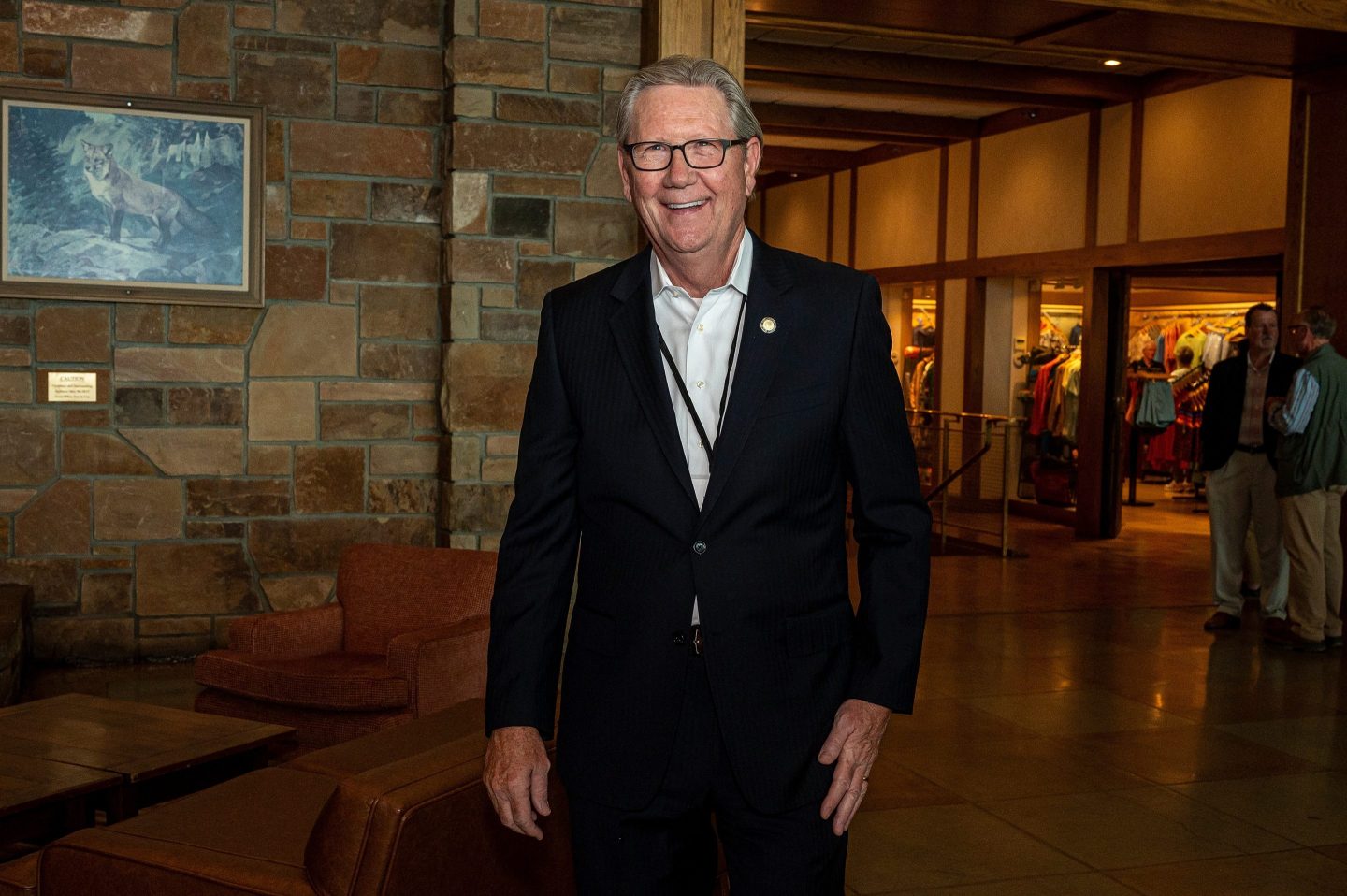
Jeffrey Schmid, president and chief executive officer of the Federal Reserve Bank of Kansas City,
Jeffrey Schmid, president and chief executive officer of the Federal Reserve Bank of Kansas City, isn't completely convinced inflation has come down far enough for a cut.David Paul Morris—Bloomberg/Getty Images

The markets might be panicking about last week’s jobs report but Jeffrey Schmid, president of the Federal Reserve Bank of Kansas City, certainly isn’t. In fact, he believes the labor market is healthy.

Speaking at the Kansas Bankers Association annual meeting Thursday, Schmid didn’t drop any of the hints Wall Street analysts might be hoping for.

Namely, they want to see a growing sense of confidence among Federal Open Market Committee (FOMC) members that inflation is firmly on track down to the 2% benchmark, meaning the base rate will soon be cut.

And while the consensus on the Street is that September will mark the first cut, bringing the base rate down from a two-decade high, FOMC insiders are determinedly noncommittal.

During his speech this week, Schmid, who is an alternate member of the 2024 committee, made optimistic but reserved observations about the current state of inflation.

With inflation currently sitting at 3%—a point ahead of the Fed’s target—Schmid said, “We are close, but we are still not quite there.”

Schmid, who will have his first voting rotation on the FOMC next year, added that recent monthly price numbers have been “encouraging” and thus have made him “more confident that inflation is on a path to return to our target.”

But he’s not convinced just yet.

“Price data can be volatile, and it is standard practice to look at inflation over longer periods of time to smooth through the monthly ups and downs,” Schmid explained. “Given the multi-decade shock to inflation that we have experienced, we should be looking for the worst in the data rather than the best.”

His take could change, he added—though whether a shift in his stance will occur before September remains to be seen.

“If inflation continues to come in low, my confidence will grow that we are on track to meet the price stability part of our mandate, and it will be appropriate to adjust the stance of policy,” Schmid added.

Employment questions economic resilience

While FOMC members are determinedly independent from politics, analysts and markets, they do have two indicators they are charged with overseeing: both inflation and stable employment.

It is the latter part of this dual mandate which has caused upset in the past week. Last Friday’s jobs report from the Labor Department threw an unexpected spanner in the works when it revealed unemployment had risen to 4.3%, ahead of expectations.

A domino effect of a weaker jobs report led to questions about America’s economic resilience—a fact Schmid is not blind to.

But he countered: “At the Kansas City Fed, we combine information from 26 labor market indicators into what we call the KC Labor Market Conditions Indicator (or LMCI). Looking much broader than the unemployment rate alone, the labor market still appears to be quite strong by this measure.”

Variables included in the LMCI are factors such as quits rate, hires rate, announced job cuts, part-time work for economic reasons, job losers and more.

“At this point, the cooling of the labor market can be viewed as a necessary condition for the easing of inflation that we have experienced,” Schmid continued.

“Imbalances in the labor market were a key factor keeping inflation high, and a looser market was needed to bring inflation down.”

For analysts who view the spike in unemployment as a sign the U.S. may be headed for recession owing to a drop in GDP, this is unwelcome news.

Optimistic on growth

Schmid pushed back on such worries, noting that he also remains optimistic on growth. “Real GDP increased over 3% last year, faster than any year but one in the decade prior to the pandemic, notwithstanding the low interest rates of that era,” he said.

“More recently, real GDP increased a further 2.75% in the second quarter, supported by the continued strength of consumer demand and solid investment spending… while it is admittedly early, indicators for the third quarter show these trends continuing.

“Even more important, as I talk to contacts in the region, I continue to hear a general tone of optimism and resilience.”

Schmid also echoed the position the Fed is taking with regarding pressure from outside sources—be it from Wall Street or White House hopefuls.

“Following recent sharp movements in financial markets, it is important to stress that all discussions of monetary policy must be rooted in Congress’s instruction that the Fed pursue a dual mandate of price stability and full employment,” he said.

While financial conditions can reveal important importation about the economy’s trajectory, he added, “the Fed has to remain focused on achieving its dual mandate, and in recent years we have had our work cut out for us.”

Join us at the Fortune Workplace Innovation Summit May 19–20, 2026, in Atlanta. The next era of workplace innovation is here—and the old playbook is being rewritten. At this exclusive, high-energy event, the world’s most innovative leaders will convene to explore how AI, humanity, and strategy converge to redefine, again, the future of work. Register now.
About the Author
Eleanor Pringle
By Eleanor PringleSenior Reporter, Economics and Markets
LinkedIn icon

Eleanor Pringle is an award-winning senior reporter at Fortune covering news, the economy, and personal finance. Eleanor previously worked as a business correspondent and news editor in regional news in the U.K. She completed her journalism training with the Press Association after earning a degree from the University of East Anglia.

See full bioRight Arrow Button Icon

Latest in Finance

InvestingSports
Big 12 in advanced talks for deal with RedBird-backed fund
By Giles Turner and BloombergDecember 13, 2025
20 minutes ago
Spanish Prime Minister Pedro Sánchez often praises the financial and social benefits that immigrants bring to the country.
EuropeSpain
In a continent cracking down on immigration and berated by Trump’s warnings of ‘civilizational erasure,’ Spain embraces migrants
By Suman Naishadham and The Associated PressDecember 13, 2025
2 hours ago
EconomyAgriculture
More financially distressed farmers are expected to lose their property soon as loan repayments and incomes continue to falter
By Jason MaDecember 13, 2025
3 hours ago
InvestingStock
There have been head fakes before, but this time may be different as the latest stock rotation out of AI is just getting started, analysts say
By Jason MaDecember 13, 2025
6 hours ago
Politicsdavid sacks
Can there be competency without conflict in Washington?
By Alyson ShontellDecember 13, 2025
7 hours ago
Investingspace
SpaceX sets $800 billion valuation, confirms 2026 IPO plans
By Loren Grush, Edward Ludlow and BloombergDecember 13, 2025
8 hours ago

Most Popular

placeholder alt text
Economy
Tariffs are taxes and they were used to finance the federal government until the 1913 income tax. A top economist breaks it down
By Kent JonesDecember 12, 2025
2 days ago
placeholder alt text
Success
Apple cofounder Ronald Wayne sold his 10% stake for $800 in 1976—today it’d be worth up to $400 billion
By Preston ForeDecember 12, 2025
1 day ago
placeholder alt text
Success
40% of Stanford undergrads receive disability accommodations—but it’s become a college-wide phenomenon as Gen Z try to succeed in the current climate
By Preston ForeDecember 12, 2025
1 day ago
placeholder alt text
Economy
The Fed just ‘Trump-proofed’ itself with a unanimous move to preempt a potential leadership shake-up
By Jason MaDecember 12, 2025
1 day ago
placeholder alt text
Economy
For the first time since Trump’s tariff rollout, import tax revenue has fallen, threatening his lofty plans to slash the $38 trillion national debt
By Sasha RogelbergDecember 12, 2025
1 day ago
placeholder alt text
Success
Apple CEO Tim Cook out-earns the average American’s salary in just 7 hours—to put that into context, he could buy a new $439,000 home in just 2 days
By Emma BurleighDecember 12, 2025
1 day ago
Rankings
  • 100 Best Companies
  • Fortune 500
  • Global 500
  • Fortune 500 Europe
  • Most Powerful Women
  • Future 50
  • World’s Most Admired Companies
  • See All Rankings
Sections
  • Finance
  • Leadership
  • Success
  • Tech
  • Asia
  • Europe
  • Environment
  • Fortune Crypto
  • Health
  • Retail
  • Lifestyle
  • Politics
  • Newsletters
  • Magazine
  • Features
  • Commentary
  • Mpw
  • CEO Initiative
  • Conferences
  • Personal Finance
  • Education
Customer Support
  • Frequently Asked Questions
  • Customer Service Portal
  • Privacy Policy
  • Terms Of Use
  • Single Issues For Purchase
  • International Print
Commercial Services
  • Advertising
  • Fortune Brand Studio
  • Fortune Analytics
  • Fortune Conferences
  • Business Development
About Us
  • About Us
  • Editorial Calendar
  • Press Center
  • Work At Fortune
  • Diversity And Inclusion
  • Terms And Conditions
  • Site Map

© 2025 Fortune Media IP Limited. All Rights Reserved. Use of this site constitutes acceptance of our Terms of Use and Privacy Policy | CA Notice at Collection and Privacy Notice | Do Not Sell/Share My Personal Information
FORTUNE is a trademark of Fortune Media IP Limited, registered in the U.S. and other countries. FORTUNE may receive compensation for some links to products and services on this website. Offers may be subject to change without notice.