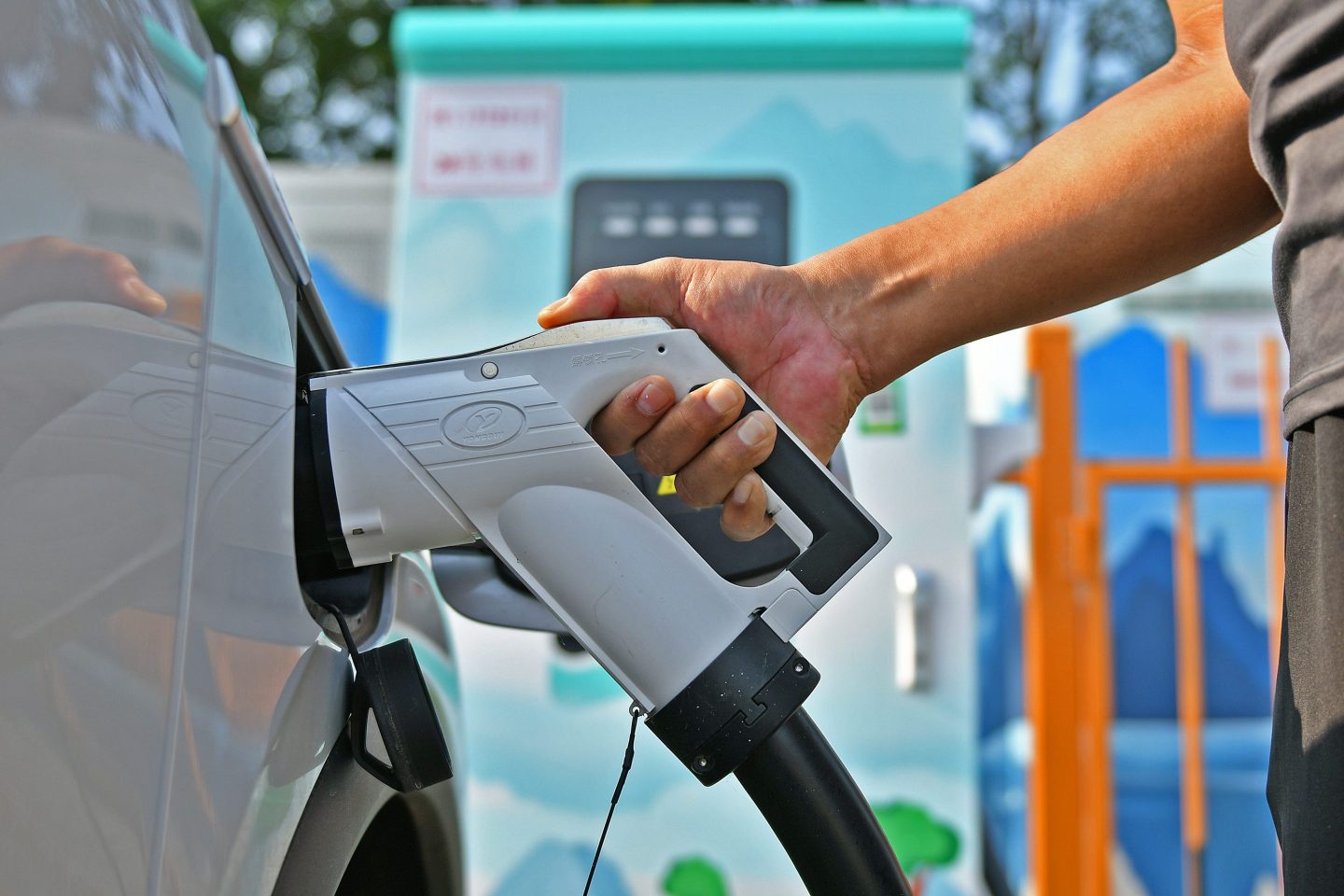
Electrify America, one of the leading charging companies in the U.S., is trying to encourage drivers to get what they need and get out, or else pay a fee.
The idea is to increase turnover at busy stations, improving availability and reducing the odds that drivers will have to wait for someone else spending extra time to “top off” their EVs.
Electrify America has implemented a pilot program at 10 Southern California stations where charging will stop after a car’s battery is 85% full . Once a vehicle hits the threshold and after a 10-minute grace period, the driver will be charged 40 cents a minute until they unplug and clear out for the next customer.
In an interview with CNN, CEO Robert Barrosa said that the general scarcity of plugs has led some drivers to hog outlets for longer than they really need them.
“Once you’re at a charger, it’s like ‘Oh, yeah. I’m filling all the way,’” he said.
Electrify America did not respond to Fortune’s request for comment. But according to a press release, the 10 locations selected for the program were chosen for their high-utilization rate and because they were in areas that had plenty of nearby charging locations. Stations on highway corridors were specifically not selected to ensure that drivers on long trips would have access to plugs that provide a full charge.
With more EVs on the road, many charging stations have just recently begun making money.
In December, the average utilization rate for fast charging, non-Tesla stations in the U.S. hit 18%, according to Stable Auto, a San Francisco startup that helps companies price and place EV plugs. That’s double the rate at the start of the year and surpasses the critical 15% threshold Stable Auto estimates most stations need to turn a profit.
But with increased demand comes a new problem: congestion. While more and more outlets are becoming profitable, Stable Auto still estimates that around 80% of charging activity occurs at just 30% of stations.
For those few outlets getting the brunt of demand, too much use may actually end up producing diminishing returns. Brendan Jones, CEO of the charging operator Blink Charging Co., told Bloomberg earlier this year that once a station hits 30% utilization, customers might actually start avoiding it in favor of less crowded locations.
“[When] you get to 30, you start worrying about whether you need another charger,” he said. “You start to get complaints.”
Joel Levin, executive director at the EV advocacy group Plug in America, expects Electrify America’s new rule will only affect a small percentage of drivers who stop at their plugs.
Unless drivers are making long trips that will push the range of their EVs, trying to squeeze every last ounce of juice out of a fast charger is actually pretty impractical. Level 3 chargers, as they’re known, reduce the power they’re sending to a car battery once it goes above 80% to protect the battery from damage.
So while they can get an EV to 80% fairly quickly, sticking around for the final 20% can be a waste of time.
“I don’t think that this rule is going to make a huge difference, because most people don’t charge above 85%,” Levin told Fortune. “This will maybe affect a little bit on the margin, but I don’t think it’s an unreasonable rule and it’ll only affect a handful of people.”
A lack of charging stations in the U.S. has become one of the biggest roadblocks to wider adoption of EVs, and many consumers still have concerns about charging access. Less than half of U.S. adults are at least somewhat likely to go electric for their next car, according to a recent AP-NORC poll. When asked what was holding them back, respondents cited range, the time it took to charge, and not knowing of any nearby stations.
“The infrastructure is not up to par in the U.S. It remains a challenge,” Tyson Jominy, vice president in J.D. Power’s data and analytics division, told Fortune earlier this year. “That really has been the weak link for EVs in this country.”
Recently, the number of charging stations coming online has been accelerating. In 2023, 2,018 public fast-charging stations were added in the U.S., a more-than 50% increase from the year prior, according to a Bloomberg analysis.
But that rate of growth trails well behind the anticipated demand of a successful transition to EVs. By 2030, the National Renewable Energy Laboratory predicts the U.S. will need 28 million charging ports to support—a far cry from the current number of 183,000 public ports reported in May.
What’s more, federal support for charging infrastructure has moved at glacial pace. More than two years after Congress allocated $7.5 billion for EV charging, the program had yielded just 38 up-and-running stations, according to a March report by the Washington Post.
So while Electrify America’s plan may help reduce congestion at a few outliers, it won’t do much to address the big issue, according to Levin.
“If the stations are congested, people have got to build more stations,” he said. “That’s kind of the bottom line.”