• Home
  • Latest
  • Fortune 500
  • Finance
  • Tech
  • Leadership
  • Lifestyle
  • Rankings
  • Multimedia
CommentaryDonald Trump

The ‘Trump Dump’ is back—and the stocks that he targets are crashing

By
Jeffrey Sonnenfeld
Jeffrey Sonnenfeld
,
Whitney Tilson
and
Steven Tian
Steven Tian
Down Arrow Button Icon
July 30, 2024, 12:36 PM ET
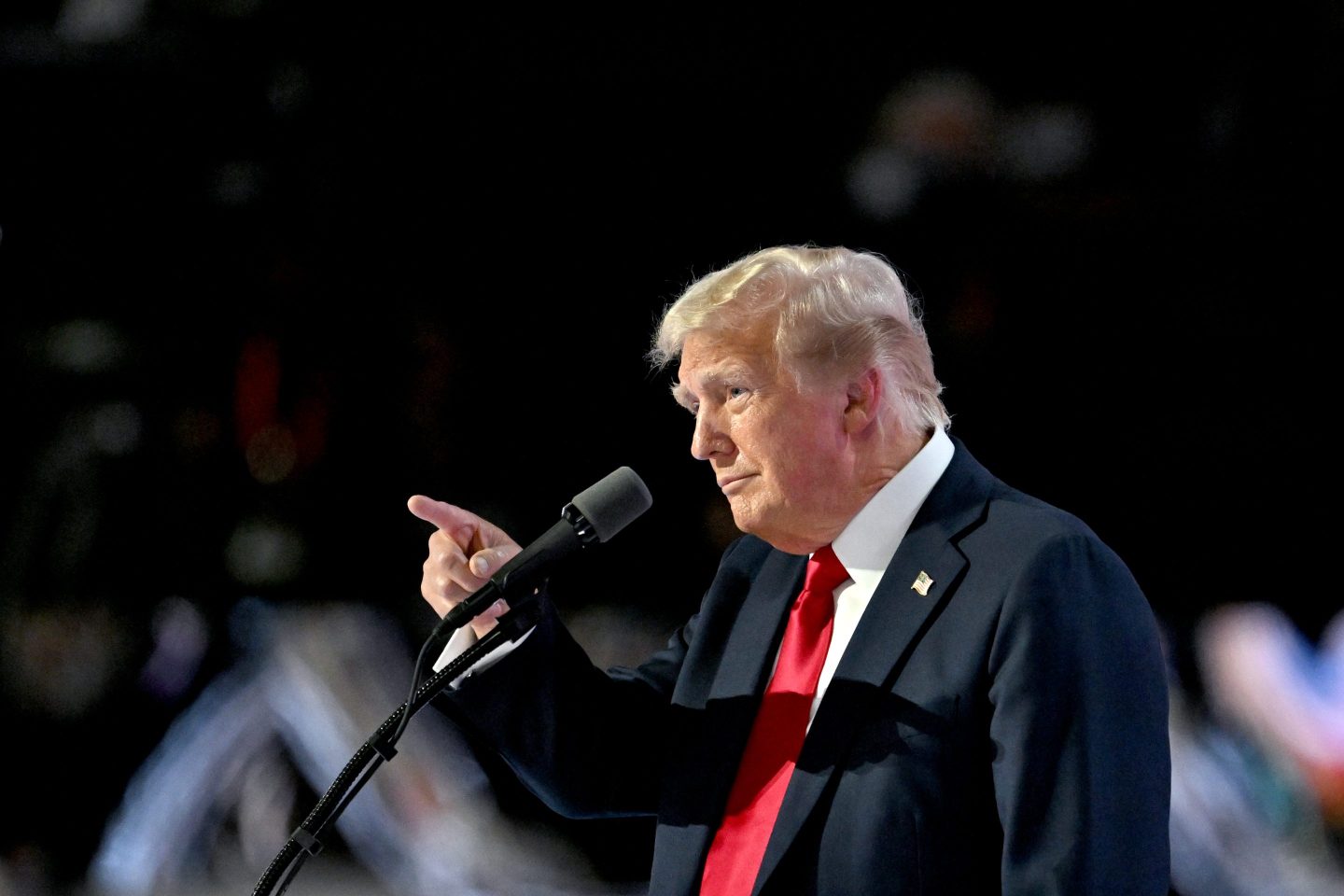
Former president Donald Trump speaks at the Republican National Convention (RNC) in Milwaukee on July 18.
Former president Donald Trump speaks at the Republican National Convention (RNC) in Milwaukee on July 18.David Paul Morris - Bloomberg - Getty Images

Former President Donald Trump has long regarded the stock market as a barometer for success, constantly touting record highs during his time in office and still bragging incessantly about the “beautiful” stock market on his watch.

However, what many commentators miss is not just the 40 record highs the stock market has hit under the Biden-Harris administration—but also that while Trump does hold significant sway over pockets of the stock market, much of his impact is profoundly negative, particularly for individual companies and industries that draw his ire.

Trump’s tantrums are nothing new

Stock price moves are rarely attributable to a single factor—but there is substantial evidence suggesting that Trump’s tantrums often appear to catalyze market dislocations, especially in the companies or sectors he targets politically.

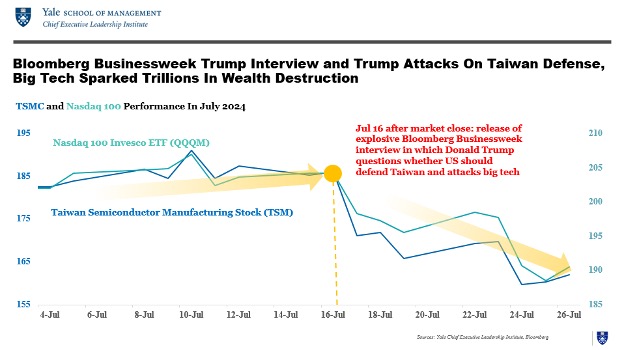
For example, consider what happened after Trump attacked Taiwan’s semiconductor manufacturers, which account for ~90% of the world’s production, and questioned whether the U.S. should defend Taiwan militarily in an interview with Bloomberg Businessweek. In the immediate aftermath, U.S.-founded Taiwan Semiconductor (TSMC) plummeted ~15%, and the broader semiconductor index plunged 10%. Charts clearly show that July 16—the date on which the Bloomberg Businessweek interview was published—was an unmistakable turning point.

In the same interview, Trump also aggressively took aim at large U.S. tech companies, exacerbating a tech sell-off, with the Nasdaq 100 falling by nearly 10% in the days after, erasing over $1.7 trillion in wealth.
Trump’s attacks on green/renewable/clean energy companies similarly sparked a rout in those specific sectors, with market commentators quipping “Trump storm batters wind and solar stocks.”

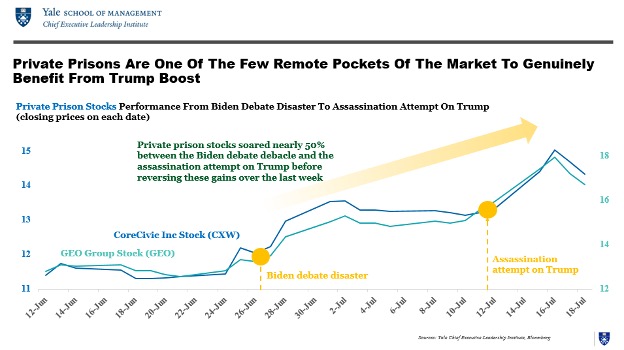
The losses in market value from Trump’s attacks dwarf the few isolated pockets of the market that have benefited significantly from the prospect of a Trump win, in what some have dubbed the “Trump Trade”—sectors that have been heavily regulated under the Biden administration, such as private prisons, predatory lenders, and gun manufacturers. In any case, initial gains in these sectors in the days following Biden’s debate disaster and the assassination attempt on Trump have largely been reversed over the last couple of weeks.
Trump crashing the stocks of companies and industries he capriciously targets is not a new phenomenon. There’s a long trail of cases dating back to his first term, when his abrupt social media pronouncements, offhand remarks, or unexpected policy shifts sank the stocks of his unfortunate targets. After all, markets generally crave predictability—the antithesis of Trump’s modus operandi.

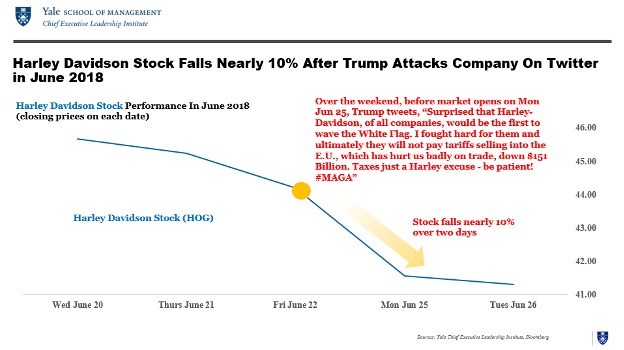
For example, Harley-Davidson dropped nearly 10% over two days in June 2018 after Trump abruptly tweeted threats to increase taxes on the company for supposedly outsourcing (which was later shown to be untrue).
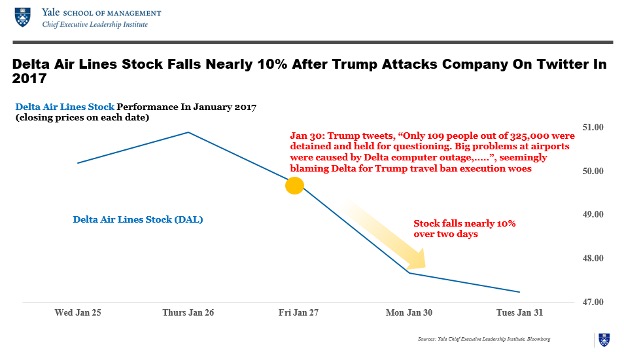
Similarly, days into his first term, the stock of Delta Airlines dropped nearly 10% over the span of two days after bizarre Trump tweets implying that the airline was to blame for the botched implementation of Trump’s travel ban and associated long delays at airports.
In other instances, companies—and their investors—were hurt by Trump’s weaponization of government to punish political enemies and help political friends.

For example, when Trump took offense at CNN’s coverage of him, he seemingly retaliated by holding up the merger between CNN’s then-parent company, Time Warner, and AT&T, for two years, hurting both badly.

And it wasn’t just individual companies or sectors. Sometimes Trump rattled the entire market with his ravings. For instance, the S&P fell 4% in two days in 2019 after Trump suddenly tweeted that he would slap tariffs on $500 billion worth of imports from China. In another case, the market lost $500 billion in value in a single day after Trump, out of nowhere, attacked Fed Chairman Jay Powell.

A Barron’s study even found that the stock market tended to fall on days when the keywords “tariffs,” “Powell,” or “Fed” showed up in Trump’s tweets. Evidently, markets did not welcome Trump’s protectionist pivots or attempts to undermine the Fed’s independence. Another study by Merrill Lynch during Trump’s first term noted that days on which Trump tweeted a lot (in the 90th percentile, defined as more than 35 tweets) were associated with statistically significant negative stock market returns.

Perilous times for the stock market

As bad as turbulence has been, a second Trump term promises to be even more perilous for the stock market. He has promised 10% tariffs on all imports and picked a running mate known for pro-antitrust, anti-corporate rhetoric. At recent rallies, Trump has started attacking the record-high stock market as just making “rich people richer,” reflecting a level of hardcore economic populism that makes even the conservative Wall Street Journal’s Editorial Board shudder. In short, a second Trump term would likely be very different from the corporate-friendly deregulatory agenda that largely defined his first.

Most importantly, the ties between Trump and America’s CEOs have frayed badly—an ominous sign given Trump’s propensity to hold personal grudges. As Bloomberg Businessweek recently reported, “Trump is highly attuned to his standing with America’s corporate chieftains… he bristles when it’s pointed out to him that no Fortune 100 CEO has publicly contributed to his campaign, according to Jeffrey Sonnenfeld in the New York Times.”

The only silver lining is that the Trump Dump usually had only a passing impact, as the targets of his taunts rebounded quickly—with the multinational firms he’s attacked as “woke” even far outperforming the “alt-right” economy and “anti-woke” startups rallying around the MAGA agenda. 

However, Trump is likely to carry out his anti-corporate vendettas more efficiently and ruthlessly if he wins a second term. As Businessweek noted, “Trump believes he understands the levers of power much more deeply now…saying, ’Now, I know everybody. Now, I am truly experienced’.”

Unfettered by electoral constraints and emboldened by an improbable comeback, second-term Trump would likely extract a far steeper price on the companies that find themselves in his crosshairs—and that cost will be borne by their unfortunate shareholders.

This kind of unchecked, personalized targeting of individual companies is more typical of foreign authoritarians than anything seen in our long history. And it is no coincidence that businesses have never prospered under capricious authoritarian regimes. As one prominent GOP-supporting CEO told me, “Businesses invest where there is the rule of law, not the law of rulers.”

Trump has often tried to bend individual stocks and sectors to his will by vindictively singling them out. Investors—and all Americans—should be concerned that all the evidence points to him going even further if he wins a second term.

More must-read commentary published by Fortune:

  • Forget the pundits and polls—internet prediction markets anticipated Biden’s withdrawal weeks ago
  • Private equity is devouring the economy as boomer entrepreneurs exit—but a new approach to employee ownership can change that
  • Gen Z’s enthusiasm for all things touchable is resurrecting the analog economy—and costing parents
  • Nokia CEO: Europe shouldn’t be afraid to back its innovation champions

The opinions expressed in Fortune.com commentary pieces are solely the views of their authors and do not necessarily reflect the opinions and beliefs of Fortune.

Join us at the Fortune Workplace Innovation Summit May 19–20, 2026, in Atlanta. The next era of workplace innovation is here—and the old playbook is being rewritten. At this exclusive, high-energy event, the world’s most innovative leaders will convene to explore how AI, humanity, and strategy converge to redefine, again, the future of work. Register now.
About the Authors
By Jeffrey Sonnenfeld

Jeffrey Sonnenfeld is the Lester Crown Professor in Management Practice and Senior Associate Dean at Yale School of Management.

See full bioRight Arrow Button Icon
By Whitney Tilson
See full bioRight Arrow Button Icon
By Steven Tian

Steven Tian is the director of research at the Yale Chief Executive Leadership Institute.

See full bioRight Arrow Button Icon

Latest in Commentary

Finance
Lorem ipsum dolor sit amet, consectetur adipiscing elit, sed do eiusmod tempor incididunt ut labore et dolore magna aliqua. Ut enim ad minim veniam
By Fortune Editors
October 20, 2025
Finance
Lorem ipsum dolor sit amet, consectetur adipiscing elit, sed do eiusmod tempor incididunt ut labore et dolore magna aliqua. Ut enim ad minim veniam
By Fortune Editors
October 20, 2025
Finance
Lorem ipsum dolor sit amet, consectetur adipiscing elit, sed do eiusmod tempor incididunt ut labore et dolore magna aliqua. Ut enim ad minim veniam
By Fortune Editors
October 20, 2025
Finance
Lorem ipsum dolor sit amet, consectetur adipiscing elit, sed do eiusmod tempor incididunt ut labore et dolore magna aliqua. Ut enim ad minim veniam
By Fortune Editors
October 20, 2025
Finance
Lorem ipsum dolor sit amet, consectetur adipiscing elit, sed do eiusmod tempor incididunt ut labore et dolore magna aliqua. Ut enim ad minim veniam
By Fortune Editors
October 20, 2025
Finance
Lorem ipsum dolor sit amet, consectetur adipiscing elit, sed do eiusmod tempor incididunt ut labore et dolore magna aliqua. Ut enim ad minim veniam
By Fortune Editors
October 20, 2025

Most Popular

Finance
Lorem ipsum dolor sit amet, consectetur adipiscing elit, sed do eiusmod tempor incididunt ut labore et dolore magna aliqua. Ut enim ad minim veniam
By Fortune Editors
October 20, 2025
Finance
Lorem ipsum dolor sit amet, consectetur adipiscing elit, sed do eiusmod tempor incididunt ut labore et dolore magna aliqua. Ut enim ad minim veniam
By Fortune Editors
October 20, 2025
Finance
Lorem ipsum dolor sit amet, consectetur adipiscing elit, sed do eiusmod tempor incididunt ut labore et dolore magna aliqua. Ut enim ad minim veniam
By Fortune Editors
October 20, 2025
Finance
Lorem ipsum dolor sit amet, consectetur adipiscing elit, sed do eiusmod tempor incididunt ut labore et dolore magna aliqua. Ut enim ad minim veniam
By Fortune Editors
October 20, 2025
Finance
Lorem ipsum dolor sit amet, consectetur adipiscing elit, sed do eiusmod tempor incididunt ut labore et dolore magna aliqua. Ut enim ad minim veniam
By Fortune Editors
October 20, 2025
Finance
Lorem ipsum dolor sit amet, consectetur adipiscing elit, sed do eiusmod tempor incididunt ut labore et dolore magna aliqua. Ut enim ad minim veniam
By Fortune Editors
October 20, 2025
Rankings
  • 100 Best Companies
  • Fortune 500
  • Global 500
  • Fortune 500 Europe
  • Most Powerful Women
  • Future 50
  • World’s Most Admired Companies
  • See All Rankings
Sections
  • Finance
  • Leadership
  • Success
  • Tech
  • Asia
  • Europe
  • Environment
  • Fortune Crypto
  • Health
  • Retail
  • Lifestyle
  • Politics
  • Newsletters
  • Magazine
  • Features
  • Commentary
  • Mpw
  • CEO Initiative
  • Conferences
  • Personal Finance
  • Education
Customer Support
  • Frequently Asked Questions
  • Customer Service Portal
  • Privacy Policy
  • Terms Of Use
  • Single Issues For Purchase
  • International Print
Commercial Services
  • Advertising
  • Fortune Brand Studio
  • Fortune Analytics
  • Fortune Conferences
  • Business Development
About Us
  • About Us
  • Editorial Calendar
  • Press Center
  • Work At Fortune
  • Diversity And Inclusion
  • Terms And Conditions
  • Site Map
Jeffrey Sonnenfeld is Lester Crown Professor in the Practice of Leadership at the Yale School of Management and the founder and president of the Yale Chief Executive Leadership Institute. He has served as a personal, informal advisor to four U.S. presidents, two Democrats and two Republicans. Whitney Tilson, a renowned value investor, founded Kase Capital Management, encompassing three value-oriented hedge funds and two mutual funds. He is the editor of Stansberry Research, a leading source of market commentary and informed analysis; and founded Kase Learning, through which he teaches value investing across the world. Steven Tian is the Research Director of the Yale Chief Executive Leadership Institute who was previously a quantitative investor with the Rockefeller Global Family Office. This article was written with the research assistance of Stephen Henriques, a senior fellow at the Yale Chief Executive Leadership Institute

© 2025 Fortune Media IP Limited. All Rights Reserved. Use of this site constitutes acceptance of our Terms of Use and Privacy Policy | CA Notice at Collection and Privacy Notice | Do Not Sell/Share My Personal Information
FORTUNE is a trademark of Fortune Media IP Limited, registered in the U.S. and other countries. FORTUNE may receive compensation for some links to products and services on this website. Offers may be subject to change without notice.


Most Popular

placeholder alt text
Economy
The $38 trillion national debt is to blame for over $1 trillion in annual interest payments from here on out, CRFB says
By Nick LichtenbergDecember 17, 2025
2 days ago
placeholder alt text
AI
Meta’s 28-year-old billionaire prodigy says the next Bill Gates will be a 13-year-old who is ‘vibe coding’ right now
By Eva RoytburgDecember 19, 2025
16 hours ago
placeholder alt text
Success
As graduates face a ‘jobpocalypse,’ Goldman Sachs exec tells Gen Z they need to know their commercial impact 
By Preston ForeDecember 18, 2025
1 day ago
placeholder alt text
Economy
‘This is a wacky number’: economists cry foul as new government data assumes zero housing inflation in surprising November drop
By Eva RoytburgDecember 18, 2025
1 day ago
placeholder alt text
Success
Billionaire who sold two companies to Coca-Cola says he tries to persuade people not to become entrepreneurs: ‘Every single day, you can go bankrupt’
By Dave SmithDecember 19, 2025
12 hours ago
placeholder alt text
Future of Work
LinkedIn CEO says it's 'outdated' to have a five-year career plan: It's a 'little bit foolish' considering the pace AI is changing the workplace
By Sydney LakeDecember 18, 2025
2 days ago

Latest in Commentary

Thomas “Tom” McInerney is President, CEO and a Director of Genworth Financial
CommentaryCaregiving
I’m a CEO who’s spent nearly 40 years talking to presidents, lawmakers and leaders about our long-term care crisis. They knew this moment was coming
By Thomas McInerneyDecember 19, 2025
11 hours ago
Kristin Olson
Commentaryinvesting advice
I lead Goldman Sachs’ alternatives for wealth globally. Around the world, investors want to know more 
By Kristin OlsonDecember 19, 2025
13 hours ago
unemployed
CommentaryLayoffs
The AI efficiency illusion: why cutting 1.1 million jobs will stifle, not scale, your strategy
By Katica RoyDecember 18, 2025
1 day ago
Muddu
CommentaryIT
IT service is reaching its breaking point. At Salesforce, we see 3 tipping points
By Muddu SudhakarDecember 18, 2025
2 days ago
small business
CommentaryLayoffs
Our data shows that companies of 500 and fewer workers mostly avoided the AI layoffs. They’re making AI work for them
By Gabby BurlacuDecember 18, 2025
2 days ago
Sophia Romee is the General Manager of the GenAI Studio at the College Board
CommentaryEducation
Gen Z is on the fence about AI in the classroom. That’s a good thing
By Sophia RomeeDecember 18, 2025
2 days ago