• Home
  • Latest
  • Fortune 500
  • Finance
  • Tech
  • Leadership
  • Lifestyle
  • Rankings
  • Multimedia
Environmentgreen energy

A rare endangered plant is at the center of a brewing battle in Nevada, which could supercharge the transition away from fossil fuels

By
Scott Sonner
Scott Sonner
and
The Associated Press
Down Arrow Button Icon
By
Scott Sonner
Scott Sonner
and
The Associated Press
Down Arrow Button Icon
July 18, 2024, 11:24 AM ET
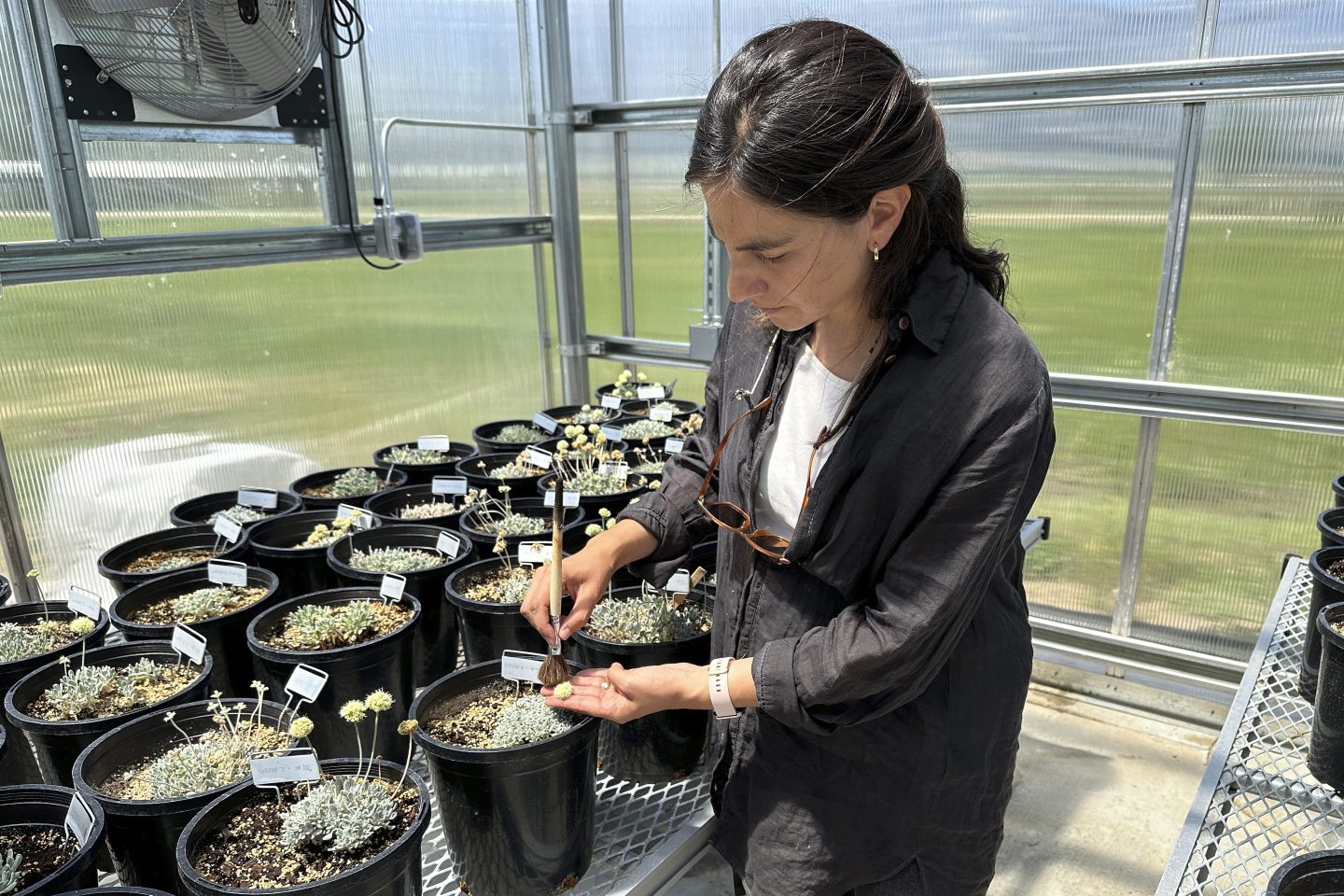
A botanist works in her greenhouse to save an endangered plant
Botanist Florencia Peredo Ovalle works in her greenhouse in Gardnerville, Nevada, Tuesday, May 21, 2024. Ovalle, who works for mining company Ioneer, cares for specimens of Tiehm's buckwheat as part of an experiment aimed at helping to keep the extremely rare desert plant from going extinct while still allowing the company to dig for lithium on land where it grows.AP Photo—Scott Sonner

GARDNERVILLE, Nev. (AP) — A botanist gently strokes the pollen of endangered wildflowers with a paintbrush as she tries to reenact nature inside a small greenhouse in the shadow of the Sierra Nevada.

Recommended Video

It’s part of a lithium mining company’s grand experiment intended to help keep an extremely rare desert plant from going extinct in a yearslong battle that has set one green agenda against another: clean energy versus native biodiversity.

Australia-based Ioneer says the mine it wants to dig in the Nevada desert would more than quadruple U.S. production of lithium needed to speed production of electric vehicles and build the batteries needed for other clean electricity projects.

Conservationists proclaim their support for world leaders who are trying to tackle climate change by curbing global emissions. But they’re fiercely fighting the mine because it would dig deep into the world’s only known patch of land where the endangered Tiehm’s buckwheat grows.

So far, the U.S. Bureau of Land Management has endorsed the company’s latest strategy, which includes propagating and transplanting the buckwheat, as its preferred alternative in a draft environmental impact statement, one of the last steps toward final approval of the mine. The plan still must be reviewed by the Fish and Wildlife Service, which has raised concerns about earlier versions.

Conservationists contend that mining would eradicate the plant from its current habitat and that the efforts to transplant the greenhouse-grown specimens to reclaimed mined areas are unproven.

It could take centuries, they say, to know if researchers have successfully found the delicate balance of pollinators, climate, soil conditions and minerals to make propagated Tiehm’s buckwheat permanently viable in the wild.

“This latest plan for Rhyolite Ridge Mine is just greenwashing extinction,” said Patrick Donnelly, the Center for Biological Diversity’s Great Basin director, suggesting supporters are being deceptive about how environmentally friendly the plan is.

“The destruction of habitat is guaranteed whereas the success of the mitigation is dubious at best,” he said, pledging legal challenges if the mine is approved.

Ioneer has been exploring the mineral deposit on Rhyolite Ridge since 2016.

The scientist the plant is named after, Arnold Tiehm, first suggested in 1994 the site be declared a special botanical area and made off-limits to mining. But it wasn’t until 2022 that conservationists successfully secured its endangered status along with a designation of critical habitat for the plant.

The Biden administration has made clear with funding commitments and permit approvals for similar projects its intent to strengthen the nation’s battery supply chain, electrify the transportation sector and cut reliance on fossil fuels and foreign supplies of raw materials.

The mine would produce enough lithium carbonate annually over its 26-year life to make 370,000 electric vehicle batteries a year. While experts are working to perfect alternative batteries that don’t require lithium, demand for the material is expected to remain high for the foreseeable future.

“Ioneer is confident in our ability to quadruple the nation’s supply of lithium while protecting Tiehm’s buckwheat,” company Vice President Chad Yeftich said.

There are nearly 25,000 of the plants in the wild on federal land near the mine site along the Nevada border with California. They were discovered only in the mid-1980s and resemble a scrawny dandelion during the few weeks of the year when they bloom.

South of Carson City, Ioneer botanist Florencia Peredo Ovalle cares for about 350 specimens in pots at a greenhouse that lacks the bees, beetles and other creatures that normally pollinate the buckwheat in nature.

“Because this is an enclosed area, I use the brush in order to pollinate the flowers … to move the pollen from the male parts to the female parts,” Ovalle told The Associated Press during a recent tour of the greenhouse.

Delicate root systems make propagating the plants a challenge. A previous study produced disappointing results. But company officials say they’ve made progress, and that their efforts could represent the best way to ensure the buckwheat’s long-term survival, which they argue was tenuous even before the mine plans.

Unlike most mining operations, Ioneer plans to backfill sections of ground and restore habitat as the mining moves laterally along what it says is an unusually horizontal seam of lithium.

“As you’re digging up other areas, you can use the material or waste material that you’re digging up to backfill the pit,” creating spots to grow the buckwheat, Ioneer’s Managing Director Bernard Rowe said during a recent interview.

Rowe maintains that if not for the money they’re pumping into the propagation and mitigation plan, the plant won’t survive.

“Someone’s got to step up to the plate. It costs money to come up with the protection conservation plan,” Rowe said, noting that voluntary efforts by the company have cost about $2 million over the last few years.

The company plans to spend about $1 million a year to ensure the long-term viability of the species.

Ioneer cites the transplanting of a member of the rose family, Robbins’ Cinquefoil, in New Hampshire that helped lead to its removal from the endangered species list in 2002. But critics say not enough time has passed to know if that recovery effort will work.

Conservationists say they support lithium mining — just not in fragile places. Dozens of university scientists from across the U.S. said in a recent letter to federal land managers that they oppose the Ioneer project in its current form, and that it would destroy more than one-fifth of the designated critical habitat.

They said the 960-foot-deep (290-meter-deep) open pit mine — along with 1,200 acres (485 hectares) of waste rock dumps, a sulfuric acid processing plant and ancillary facilities — would come within a few dozen to a few hundred feet (less than 100 meters) of most of the wild population.

Though transplanting species has been used sparingly to help those that are no longer viable in the wild, the Center for Biological Diversity insists that doing so with a species that otherwise would be self-sustaining would be illegal under the Endangered Species Act.

Naomi Fraga, director of conservation for the California Botanic Garden in Claremont, California, is a chief opponent of the mine who co-signed the petition to list the buckwheat as endangered. At her botanical garden’s nursey, they’ve often succeeded in growing different kinds of plants in non-native soils, she said.

“However, that is a far cry from transplanting those plants back into the wild. It would be absurd to think that we could take those potted plants and translocate them wherever we wished,” she said.

Fraga believes that in order for the flowers and the mine to truly coexist, there needs to be a buffer three times larger than what already has been designated as critical habitat. She said moving the mine far enough away from the critical habitat would resolve the greatest threat to Tiehm’s buckwheat.

“You cannot research and engineer your way out of that magnitude of impact,” she said.

Rowe said the mine’s footprint already has been adjusted to remove roads, storage areas and related infrastructure from critical habitat areas.

“The only thing that we left was the one thing that we can’t move, and that’s the deposit itself,” he said.


The Fortune 500 Innovation Forum will convene Fortune 500 executives, U.S. policy officials, top founders, and thought leaders to help define what’s next for the American economy, Nov. 16-17 in Detroit. Apply here.
About the Authors
By Scott Sonner
See full bioRight Arrow Button Icon
By The Associated Press
See full bioRight Arrow Button Icon

Latest in Environment

Finance
Lorem ipsum dolor sit amet, consectetur adipiscing elit, sed do eiusmod tempor incididunt ut labore et dolore magna aliqua. Ut enim ad minim veniam
By Fortune Editors
October 20, 2025
Finance
Lorem ipsum dolor sit amet, consectetur adipiscing elit, sed do eiusmod tempor incididunt ut labore et dolore magna aliqua. Ut enim ad minim veniam
By Fortune Editors
October 20, 2025
Finance
Lorem ipsum dolor sit amet, consectetur adipiscing elit, sed do eiusmod tempor incididunt ut labore et dolore magna aliqua. Ut enim ad minim veniam
By Fortune Editors
October 20, 2025
Finance
Lorem ipsum dolor sit amet, consectetur adipiscing elit, sed do eiusmod tempor incididunt ut labore et dolore magna aliqua. Ut enim ad minim veniam
By Fortune Editors
October 20, 2025
Finance
Lorem ipsum dolor sit amet, consectetur adipiscing elit, sed do eiusmod tempor incididunt ut labore et dolore magna aliqua. Ut enim ad minim veniam
By Fortune Editors
October 20, 2025
Finance
Lorem ipsum dolor sit amet, consectetur adipiscing elit, sed do eiusmod tempor incididunt ut labore et dolore magna aliqua. Ut enim ad minim veniam
By Fortune Editors
October 20, 2025

Most Popular

Finance
Lorem ipsum dolor sit amet, consectetur adipiscing elit, sed do eiusmod tempor incididunt ut labore et dolore magna aliqua. Ut enim ad minim veniam
By Fortune Editors
October 20, 2025
Finance
Lorem ipsum dolor sit amet, consectetur adipiscing elit, sed do eiusmod tempor incididunt ut labore et dolore magna aliqua. Ut enim ad minim veniam
By Fortune Editors
October 20, 2025
Finance
Lorem ipsum dolor sit amet, consectetur adipiscing elit, sed do eiusmod tempor incididunt ut labore et dolore magna aliqua. Ut enim ad minim veniam
By Fortune Editors
October 20, 2025
Finance
Lorem ipsum dolor sit amet, consectetur adipiscing elit, sed do eiusmod tempor incididunt ut labore et dolore magna aliqua. Ut enim ad minim veniam
By Fortune Editors
October 20, 2025
Finance
Lorem ipsum dolor sit amet, consectetur adipiscing elit, sed do eiusmod tempor incididunt ut labore et dolore magna aliqua. Ut enim ad minim veniam
By Fortune Editors
October 20, 2025
Finance
Lorem ipsum dolor sit amet, consectetur adipiscing elit, sed do eiusmod tempor incididunt ut labore et dolore magna aliqua. Ut enim ad minim veniam
By Fortune Editors
October 20, 2025
Fortune Secondary Logo
Rankings
  • 100 Best Companies
  • Fortune 500
  • Global 500
  • Fortune 500 Europe
  • Most Powerful Women
  • Future 50
  • World’s Most Admired Companies
  • See All Rankings
Sections
  • Finance
  • Fortune Crypto
  • Features
  • Leadership
  • Health
  • Commentary
  • Success
  • Retail
  • Mpw
  • Tech
  • Lifestyle
  • CEO Initiative
  • Asia
  • Politics
  • Conferences
  • Europe
  • Newsletters
  • Personal Finance
  • Environment
  • Magazine
  • Education
Customer Support
  • Frequently Asked Questions
  • Customer Service Portal
  • Privacy Policy
  • Terms Of Use
  • Single Issues For Purchase
  • International Print
Commercial Services
  • Advertising
  • Fortune Brand Studio
  • Fortune Analytics
  • Fortune Conferences
  • Business Development
  • Group Subscriptions
About Us
  • About Us
  • Editorial Calendar
  • Press Center
  • Work At Fortune
  • Diversity And Inclusion
  • Terms And Conditions
  • Site Map
  • About Us
  • Editorial Calendar
  • Press Center
  • Work At Fortune
  • Diversity And Inclusion
  • Terms And Conditions
  • Site Map
  • Facebook icon
  • Twitter icon
  • LinkedIn icon
  • Instagram icon
  • Pinterest icon

Latest in Environment

iran
EnergyFood and drink
A global food emergency: Why the closed Strait of Hormuz puts half the world’s calories at risk
By Aya S. Chacar and The ConversationApril 9, 2026
6 hours ago
xi jinping
EnergyChina
Deutsche Bank says China is energy ‘winner’ in age of war
By Ishika Mookerjee and BloombergApril 9, 2026
7 hours ago
sheinbaum
EnergyMexico
Claudia Sheinbaum wants Mexico to start fracking to get away from Trump’s natural gas. But she won’t call it that
By María Verza and The Associated PressApril 9, 2026
9 hours ago
data centers
EnergyData centers
Data centers are destroying states’ clean energy dreams
By Jessica Hill and The Associated PressApril 9, 2026
10 hours ago
heat
Environmentclimate change
U.S. just had its hottest March ever, in records dating back 132 years
By Seth Borenstein and The Associated PressApril 9, 2026
10 hours ago
The U.S. just had its hottest March in 132 years. Scientists say to buckle up for the rest of the year
EnvironmentWeather and forecasting
The U.S. just had its hottest March in 132 years. Scientists say to buckle up for the rest of the year
By Seth Borenstein and The Associated PressApril 8, 2026
1 day ago

Most Popular

The U.S. government is spending $88 billion a month in interest on national debt—equal to spending on defense and education combined
Economy
The U.S. government is spending $88 billion a month in interest on national debt—equal to spending on defense and education combined
By Fortune EditorsApril 9, 2026
12 hours ago
The U.S. had a national debt ‘home run’ in its grasp, says Jamie Dimon. But the government did nothing, and now its best option is crisis management
Economy
The U.S. had a national debt ‘home run’ in its grasp, says Jamie Dimon. But the government did nothing, and now its best option is crisis management
By Fortune EditorsApril 8, 2026
2 days ago
2 years ago, Saudi Arabia quietly canceled the ‘petrodollar’ deal with America that wired the world economy for 50 years. Then war broke out in Iran
Energy
2 years ago, Saudi Arabia quietly canceled the ‘petrodollar’ deal with America that wired the world economy for 50 years. Then war broke out in Iran
By Fortune EditorsApril 7, 2026
2 days ago
Self-made billionaire MrBeast says his work-life balance is nonexistent and calls it a ‘miracle’ if he works less than 15-hour days: ‘I live to work’
Success
Self-made billionaire MrBeast says his work-life balance is nonexistent and calls it a ‘miracle’ if he works less than 15-hour days: ‘I live to work’
By Fortune EditorsApril 8, 2026
1 day ago
Gen Z workers are so fearful AI will take their job they’re intentionally sabotaging their company’s AI rollout
AI
Gen Z workers are so fearful AI will take their job they’re intentionally sabotaging their company’s AI rollout
By Fortune EditorsApril 8, 2026
1 day ago
Gen Z doesn't want your full-time job. They want several part-time roles, and it's reshaping the entire workforce
Success
Gen Z doesn't want your full-time job. They want several part-time roles, and it's reshaping the entire workforce
By Fortune EditorsApril 9, 2026
15 hours ago

© 2026 Fortune Media IP Limited. All Rights Reserved. Use of this site constitutes acceptance of our Terms of Use and Privacy Policy | CA Notice at Collection and Privacy Notice | Do Not Sell/Share My Personal Information
FORTUNE is a trademark of Fortune Media IP Limited, registered in the U.S. and other countries. FORTUNE may receive compensation for some links to products and services on this website. Offers may be subject to change without notice.