• Home
  • News
  • Fortune 500
  • Tech
  • Finance
  • Leadership
  • Lifestyle
  • Rankings
  • Multimedia
Politicsfederal regulators

Senate confirms 2 new energy regulators, extending Biden’s grip on renewables-backing panel beyond the end of his first term

By
Matthew Daly
Matthew Daly
and
The Associated Press
Down Arrow Button Icon
By
Matthew Daly
Matthew Daly
and
The Associated Press
Down Arrow Button Icon
June 13, 2024, 3:56 AM ET
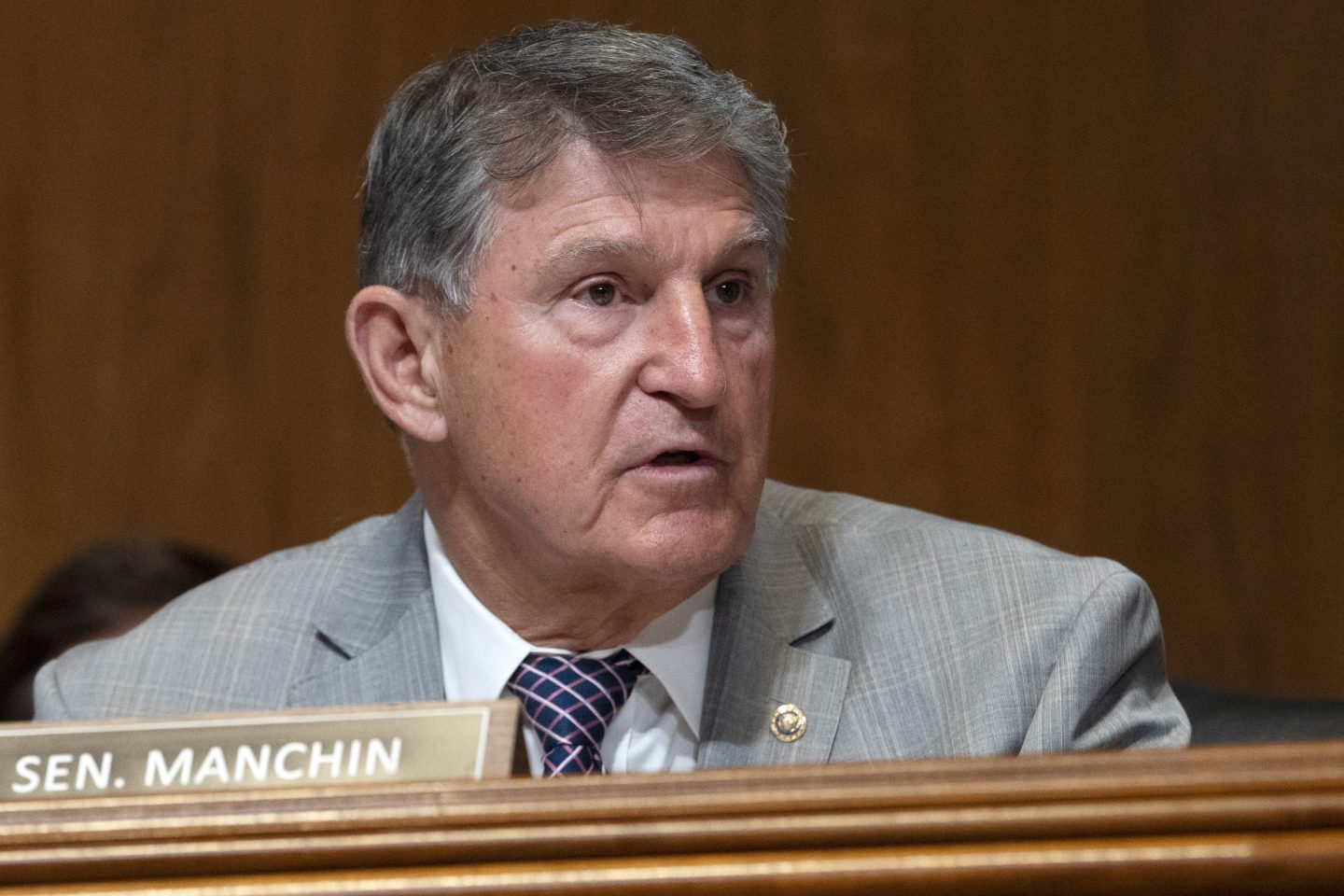
Sen. Joe Manchin, I-W.Va., listens as Treasury Secretary Janet Yellen responds to a question by Sen. John Kennedy, R-La., during a Senate Appropriations Subcommittee on Financial Services and General Government hearing, on June 4, 2024, on Capitol Hill in Washington.
Sen. Joe Manchin, I-W.Va., listens as Treasury Secretary Janet Yellen responds to a question by Sen. John Kennedy, R-La., during a Senate Appropriations Subcommittee on Financial Services and General Government hearing, on June 4, 2024, on Capitol Hill in Washington.Jacquelyn Martin—AP

President Joe Biden’s grip on a key federal energy commission will last beyond his first term, giving a boost to the Democrat’s push for renewable energy regardless of the election results in November.

Recommended Video

The Senate moved to ensure that political reality as lawmakers approved two new members of the Federal Energy Regulatory Commission and set up a vote on a third new panelist as soon as Thursday.

Senate Majority Leader Chuck Schumer, D-N.Y., said confirmation of the three nominees would allow FERC to “keep its quorum and continue its mission of providing Americans with affordable, reliable, safe energy.”

The five-member commission oversees natural gas pipelines and other energy infrastructure, including transmission of electricity across state lines. The panel approved a long-awaited rule last month making it easier to transmit renewable energy such as wind and solar power to the electric grid — a key part of Biden’s goal to eliminate greenhouse gas emissions economy-wide by 2050. The rule is aimed at boosting the nation’s aging power grid to meet surging demand fueled by huge data centers, electrification of vehicles and buildings, artificial intelligence and other uses.

Earlier this week, the agency approved a request by the nearly $8 billion Mountain Valley Pipeline to begin sending natural gas across rugged mountainsides in West Virginia and Virginia, despite longstanding objections from environmental groups, landowners and some elected officials.

On Wednesday, the Senate approved the nominations of Democrat David Rosner and Republican Lindsay See for three and four-year terms, respectively, on the commission. Senators also limited debate on Democrat Judy Chang’s nomination to a five-year term. A final vote on Chang’s nomination to replace Democrat Allison Clements could occur as soon as Thursday.

If approved as expected, the vote would give Democrats a working majority on the commission until at least June 2026, when the term of Democratic Chairman Willie Phillips is set to expire.

“A fully seated, bipartisan FERC provides more opportunity for advancing long-lasting, sensible energy infrastructure policy,” said West Virginia Sen. Joe Manchin, a Democrat-turned-independent who chairs the Senate Energy and Natural Resources Committee.

“When it comes to fairly assessing all interests, five heads are better than one,” Manchin said Wednesday. “Bringing together five different people, with five different life experiences and perspectives, helps ensure that all affected interests will be heard and fairly considered and assessed” by the energy commission.

Rosner, See and Chang “are very different people, from very different backgrounds,” said Manchin, who supported all three nominees. “What matters most is their willingness to work with one another, to consider and assess fairly different interests and points of view, and to put partisan passions aside in favor of the public interest.”

Rosner, a former FERC staffer, has spent the past two years on Manchin’s Democratic staff on the energy committee. See, who serves as solicitor general for the state of West Virginia, argued the state’s case challenging a major U.S. Environmental Protection Agency rule on power plant pollution before the Supreme Court. Chang, of Massachusetts, is a former undersecretary of energy and climate solutions for the state government.

Manchin said he knows Rosner well: “I have seen firsthand his expert knowledge on energy issues, his fairness, his nonpartisan approach to every problem we’ve had, and his ability to work with both sides on these issues, and he’s done that tremendously.”

Manchin, a political moderate who plays a crucial role on energy issues, called See “a very capable and experienced lawyer” who is “well-qualified to serve on the commission.”

Chang, who now teaches at Harvard’s Kennedy School, led energy policy under Republican Gov. Charlie Baker. “I can think of no better preparation for serving on a bipartisan commission than working for a Republican administration in a very blue state,” Manchin said.

Rosner’s nomination was approved, 67-27, while See won approval, 83-12.

Democratic Sen. Tim Kaine of Virginia opposed both nominations, saying he continued to be unhappy about federal approval of the Mountain Valley Pipeline, a longtime Manchin priority.

“I voted no on rubber-stamping the same old people to FERC,” Kaine said in a statement.

Fortune Brainstorm AI returns to San Francisco Dec. 8–9 to convene the smartest people we know—technologists, entrepreneurs, Fortune Global 500 executives, investors, policymakers, and the brilliant minds in between—to explore and interrogate the most pressing questions about AI at another pivotal moment. Register here.
About the Authors
By Matthew Daly
See full bioRight Arrow Button Icon
By The Associated Press
See full bioRight Arrow Button Icon

Latest in Politics

AIMeta
It’s ‘kind of jarring’: AI labs like Meta, Deepseek, and Xai earned some of the worst grades possible on an existential safety index
By Patrick Kulp and Tech BrewDecember 5, 2025
1 hour ago
Schumer
Politicsnational debt
‘This is a bad idea made worse’: Senate Dems’ plan to fix Obamacare premiums adds nearly $300 billion to deficit, CRFB says
By Nick LichtenbergDecember 5, 2025
2 hours ago
Trump
PoliticsWhite House
Trump finally got his peace prize—from a soccer federation widely known for corruption
By Seung Min Kim, Nick Lichtenberg and The Associated PressDecember 5, 2025
2 hours ago
Trump
PoliticsImmigration
4 times in 7 seconds: Trump calls Somali immigrants ‘garbage’
By Laurie Kellman and The Associated PressDecember 5, 2025
2 hours ago
Robert F. Kennedy
PoliticsHealth
Robert F. Kennedy Jr. turns to AI to make America healthy again
By Ali Swenson and The Associated PressDecember 5, 2025
7 hours ago
Trump
Personal FinanceHealth Insurance
Trump wants more health savings accounts. A catch: they can’t pay insurance premiums
By Amanda Seitz and KFF Health NewsDecember 5, 2025
9 hours ago

Most Popular

placeholder alt text
Economy
Two months into the new fiscal year and the U.S. government is already spending more than $10 billion a week servicing national debt
By Eleanor PringleDecember 4, 2025
1 day ago
placeholder alt text
Success
‘Godfather of AI’ says Bill Gates and Elon Musk are right about the future of work—but he predicts mass unemployment is on its way
By Preston ForeDecember 4, 2025
1 day ago
placeholder alt text
Success
Nearly 4 million new manufacturing jobs are coming to America as boomers retire—but it's the one trade job Gen Z doesn't want
By Emma BurleighDecember 4, 2025
1 day ago
placeholder alt text
Success
Nvidia CEO Jensen Huang admits he works 7 days a week, including holidays, in a constant 'state of anxiety' out of fear of going bankrupt
By Jessica CoacciDecember 4, 2025
1 day ago
placeholder alt text
Real Estate
‘There is no Mamdani effect’: Manhattan luxury home sales surge after mayoral election, undercutting predictions of doom and escape to Florida
By Sasha RogelbergDecember 4, 2025
1 day ago
placeholder alt text
Economy
Tariffs and the $38 trillion national debt: Kevin Hassett sees ’big reductions’ in deficit while Scott Bessent sees a ‘shrinking ice cube’
By Nick LichtenbergDecember 4, 2025
1 day ago
Rankings
  • 100 Best Companies
  • Fortune 500
  • Global 500
  • Fortune 500 Europe
  • Most Powerful Women
  • Future 50
  • World’s Most Admired Companies
  • See All Rankings
Sections
  • Finance
  • Leadership
  • Success
  • Tech
  • Asia
  • Europe
  • Environment
  • Fortune Crypto
  • Health
  • Retail
  • Lifestyle
  • Politics
  • Newsletters
  • Magazine
  • Features
  • Commentary
  • Mpw
  • CEO Initiative
  • Conferences
  • Personal Finance
  • Education
Customer Support
  • Frequently Asked Questions
  • Customer Service Portal
  • Privacy Policy
  • Terms Of Use
  • Single Issues For Purchase
  • International Print
Commercial Services
  • Advertising
  • Fortune Brand Studio
  • Fortune Analytics
  • Fortune Conferences
  • Business Development
About Us
  • About Us
  • Editorial Calendar
  • Press Center
  • Work At Fortune
  • Diversity And Inclusion
  • Terms And Conditions
  • Site Map

© 2025 Fortune Media IP Limited. All Rights Reserved. Use of this site constitutes acceptance of our Terms of Use and Privacy Policy | CA Notice at Collection and Privacy Notice | Do Not Sell/Share My Personal Information
FORTUNE is a trademark of Fortune Media IP Limited, registered in the U.S. and other countries. FORTUNE may receive compensation for some links to products and services on this website. Offers may be subject to change without notice.