Brad Lander is the New York City Comptroller.
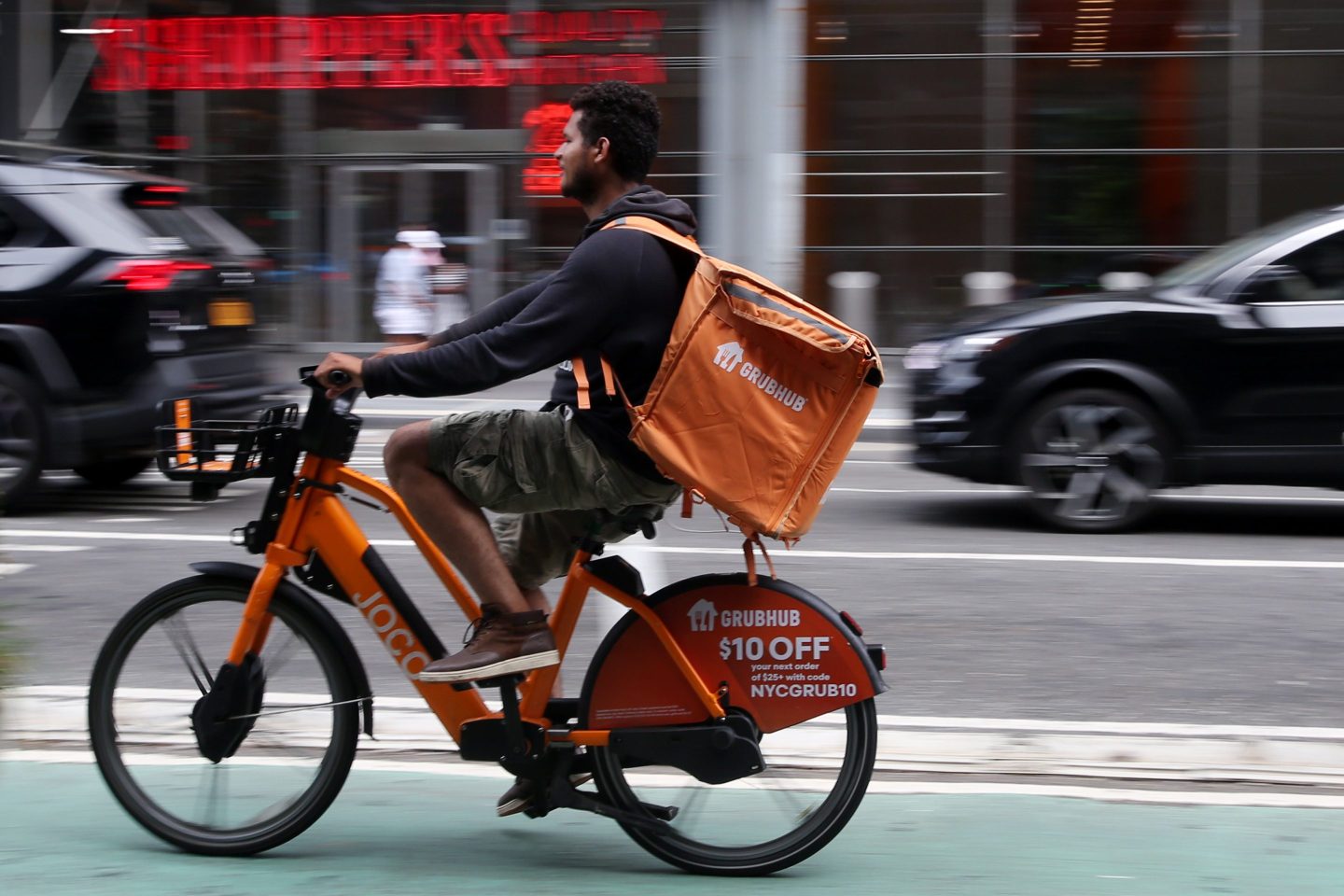
When New Yorkers order late-night Chinese food or a salad for lunch on their delivery apps, the meal appears just a few minutes later. But it isn’t magic, technology, or a billion-dollar app company that brings it. It’s a human being.
Unfortunately, despite riding through rain, snow, heat, and NYC traffic, these delivery workers, or deliveristas, are often treated as barely human by the companies that rely on them. Some restaurants deny them the use of the bathroom during long shifts. The apps’ payment algorithms pressure them to deliver meals on opposite ends of Manhattan in mere minutes—so the fatality rate has become one of the highest for any job here.
And until recently, delivery workers earned less than the minimum wage—sometimes as low as $6 per hour. So last year, New York City became the first place in the country to do something about it. I was proud to be the City Council sponsor of the minimum pay bill, which raised the minimum pay floor for deliveristas to $17.96 an hour.
No one gets rich at that rate, just above New York’s minimum wage; but at least these hard workers can be assured a bare minimum.
Unfortunately, Uber, DoorDash, and Grubhub are doing everything in their power to undermine even that. They threw up losing lawsuits and lobbied City Hall relentlessly. Next, they made it more confusing for customers to tip.
That’s no surprise. They did the same back in 2018 when we passed a law—which I also sponsored in the City Council—guaranteeing minimum pay for Uber and Lyft drivers. The companies assailed the law through lobbying, public relations campaigns, and lawsuits. They sent push notifications to drivers and customers to spread falsehoods—including the threat that they would shut down. Just like they are doing now in Minneapolis, where the City Council recently passed a similar bill.
But the law works. Six years later, Uber and Lyft are going strong in NYC. As of March 2024, New Yorkers and tourists took 686,475 Uber and Lyft trips per day—an all-time high since the pandemic. We estimate that app companies are making more than a million dollars a day here.
The difference for drivers has been huge. An analysis found: “Drivers in New York have made more per hour and for each trip on average, people haven’t been significantly discouraged from riding with Uber or Lyft, and even the companies have most likely done better.”
Similarly, there’s no evidence that the minimum wage for delivery workers is negatively affecting customers. Uber Eats, DoorDash, and Grubhub together average about 2.6 million deliveries a week, both before and after the rate increase.
So for their next argument, the apps are blaming these marginal wage increases for inflation. You might have thought it was supply chain disruption, pandemic stimulus, or greedflation. But no, according to some, it’s your deliverista or Uber driver’s fault for demanding to be treated like a human being.
It’s a classic argument by some out-of-touch billionaires to blame the minimum wage for inflation. But it’s baloney.
As New York City comptroller, I analyze the city’s economic landscape, and here’s what the data says: a higher minimum wage for our lowest-paid workers raises many boats. That’s what happened when New York phased the minimum wage up to $15 an hour between 2013 and 2019.
Employment in sectors with a high percentage of minimum wage workers—like fast food—grew by 31% in New York City, much faster than the 20% in the average of 12 cities across the nation that did not raise their minimum wage at that time.
Minimum wage household incomes grew by 50%, and the poverty rate among those households declined by 7%. As employment and incomes rose, so did the opening of new restaurants and hotels.
Increasing the minimum wage to $15 gave hundreds of thousands of low-wage New Yorkers some economic security. Our 2018 law did the same for Uber drivers. And our new law is doing the same for deliveristas who were a vital lifeline during the pandemic and continue to provide an essential service.
It’s no surprise that the app companies would peddle ridiculous agreements blaming their own low-wage workers for inflation. They are out to extract every penny they can from the delivery workers whose labor they rely on to pad their bottom line. That’s the gig business model. And they’re coming for more and more of us.
But the data is clear: Enabling low-wage workers to earn enough to get by is good for the economy. Don’t buy the divide-and-conquer nonsense that argues otherwise.
The workers who put food on our tables should be able to put food on theirs.
More must-read commentary published by Fortune:
- Jamie Dimon is right. The number of U.S. public companies is plummeting—and that’s bad news for the democratic component of the economy
- Trade and investment data in the last two years dispel the deglobalization and decoupling myths as U.S.-China competition ignites ‘reglobalization’
- Big Tech employees missed out on $5.1 billion in 401(k) gains over the last decade because of fossil fuels, new research finds
- ‘As quick as 5 minutes in California or as grueling as 11 hours in Texas’: Research reveals new post-Dobbs map of abortion access driving times
The opinions expressed in Fortune.com commentary pieces are solely the views of their authors and do not necessarily reflect the opinions and beliefs of Fortune.











