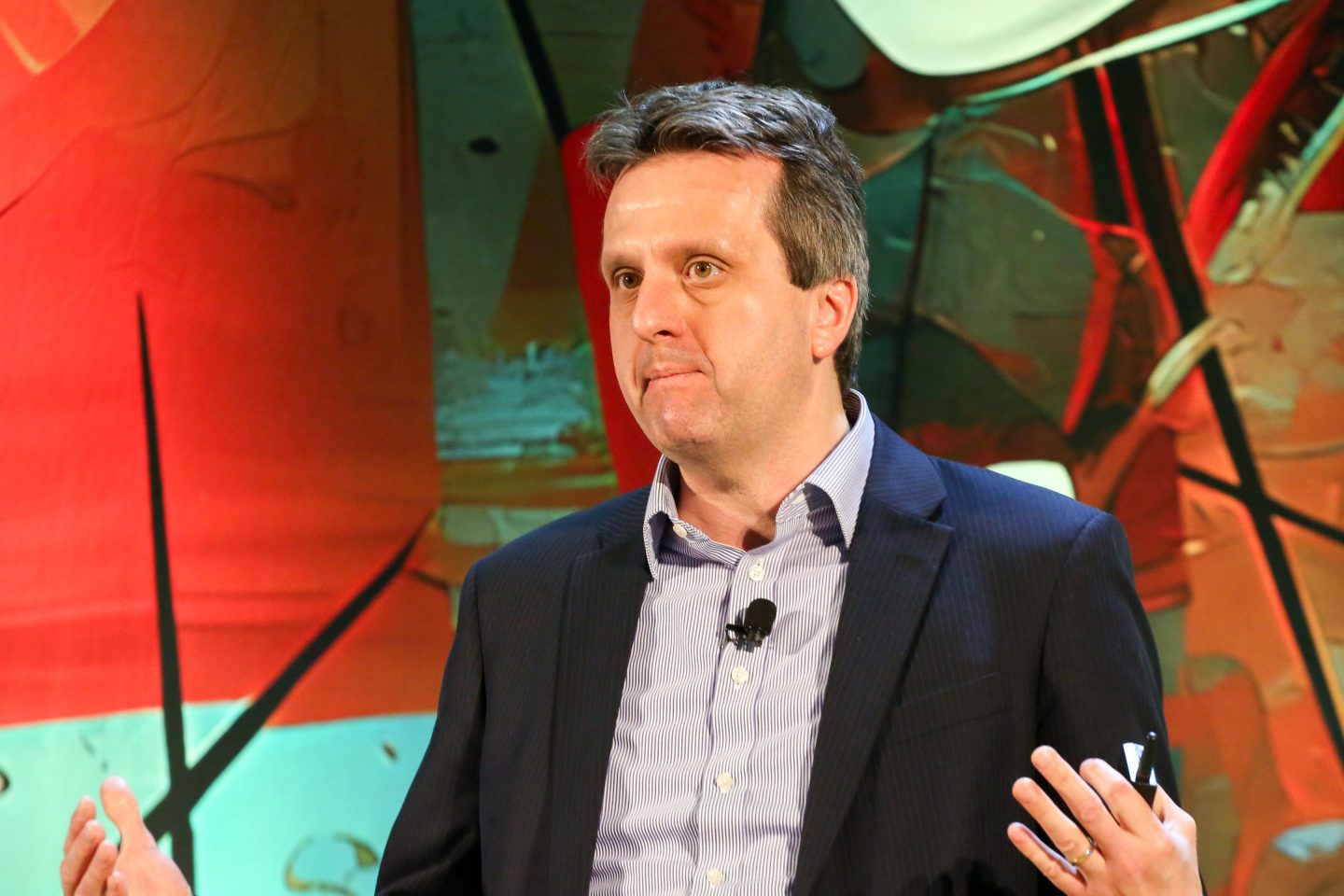
At the Fortune Future of Finance conference, Tomasz Piskorski, Edward S. Gordon Professor of Real Estate, Finance Division, Columbia Business School, tackled the subject of much of his recent research: the collapse of Silicon Valley Bank and its after-effects on the banking industry. Last year, Piskorski was one of several academics to look at the sector. Their paper found a “more than $2 trillion decline in banks’ asset values following the monetary tightening of 2022.”
Below is a transcript of Piskorski’s presentation to the conference on his research.
Tomasz Piskorski: Welcome everybody. Glad to be here. I’m a professor at Columbia Business School. I do a lot of work on financial intermediation, banking, fintech, and real estate. And recently, along with my colleagues, I have done quite a lot of work on financial stability.
And drawing lessons from the recent bank failures such as the Silicon Valley Bank, I would like to tell you a little bit about it. So, let me tell you our view—what we think is one of the main sources of risk currently in the U.S. financial system.
From our perspective, it’s really the fact that banks have very high leverage. If you look at a typical bank in the United States, there is really very little variation, whether you’re a small bank, whether you’re a large bank. Banks are essentially about 90% debt-funded, and only 10% of equity. So think about what it means: Consider, for example, a situation when there is a modest decline in the value of bank assets, let’s say 10%. That already potentially puts this institution at the brink of insolvency, because the value of the assets will be less than the face value of the liabilities. And if you look at the banking sector as a whole, this is $24 trillion worth of assets.
On the asset side, banks take a lot of duration risk and credit risk. They give a lot of assets like securities, long-term treasuries, long-term mortgage-backed securities. In addition, they have real estate loans, including commercial real estate loans, and other loans like corporate loans with a credit risk. And the way they finance it is essentially with short-term debt. Most of these debts are deposits. About 18 trillion of them and about half are insured by FDIC and half are uninsured. These deposits are both $250,000. And in addition to that, the banks have firmly seen equity caution. So, you can see this is a pretty fragile system with very little equity financing and a lot of debt financing.
And in that sense, the recent monetary tightening illustrates this point: the Fed raised interest rates very aggressively, essentially, in a matter of a year, they went from zero to 5%. What that means to the value of long duration assets: There has been a very big decline in value, including U.S. Treasuries and so on. If you look at long duration assets, long-term bonds, they declined by, in the order of 30%. So, when you take this decline, the market-implied decline in the value of assets and apply it to bank balance sheets, what you will find is that, in the aggregate, the value of the bank assets right now is about $2 trillion less relative to where it was at the beginning of the Fed tightening cycle.
And in fact, there’s quite a few banks in the U.S. right now–and Silicon Valley Bank was one of them–that currently have the value of the assets, the market value, of being less than the face value of the debt. So, in principle, if the depositors would show up, this bank would fail, unless of course regulators step in.
Now, I’m not trying to say that all these banks will fail—it depends on your funding. And in particular, it depends what portion of your funding is unstable, especially uninsured deposits. Because uninsured depositors can lose money if the bank fails. And, you know, in that sense, Silicon Valley Bank was an outlier in that 80% of its assets were financed with uninsured deposits. Essentially, Silicon Valley Bank had just uninsured deposit funding. So, it was very fragile in that sense.
The mechanism is as follows: The interest rates go up, you can add to this credit risk, bank asset values decline like they did, and insured depositors get spooked, they see this big declines in asset values, they worry about solvency of the bank, they start withdrawing money, and then you can end up with a run equilibrium.
The key question that I was talking a lot with regulators about that is, how special is a Silicon Valley Bank? Are there other banks like that? And the short answer is, yes, there are quite a few banks in the United States right now that have very similar risk characteristics, not as extreme as Silicon Valley Bank, but they are actually at the risk of a run.
And this is just the duration effect. If you add to this credit risk, remember that for midsize banks, about 25 to 30% of the assets are commercial real estate loans. We did an analysis loan by loan 14% of these loans are underwater, meaning the property value is less worth less currently than the face value of debt. If you look at office loans, it’s 44%. So, in addition to this duration risk, there is also a credit risk that will enlarge the set of banks that could potentially fail.
So, the obvious question is—talking all the time with regulators—what to do about it? And one natural answer is, well, let’s raise the bank capital requirements. Maybe not right now. Once things come down a bit. That would make the system more safe, but the obvious question is how much leverage financial institutions really need to provide efficient functions like originating loans, and doing other things. And in fact, we have a window in it: We compare the leverage of banks, to non-bank lenders. The dark black curve shows you the non-bank lenders. These are the institutions that make loans like banks, this is in the mortgage market, but don’t have access to insure deposit funding, and are lightly regulated. And guess what? In this private market benchmark, without access to insure deposit funding, these institutions have much less leverage and much more equity funding. And the lesson we draw from this is you can be a pretty good lender with much lower leverage.
And what’s interesting is the biggest discrepancy is actually for smaller and midsize banks. What it means is that, let’s say JPMorgan, their leverage is pretty close to what they would have been levered, even if they didn’t have access to ensure deposit funding. It’s precisely the smaller and midsize banks, including banks like Silicon Valley Bank, that will deliver much more. And because of these implicit and explicit guarantees, Silicon Valley Bank did not have much insured deposits funding, but there’s a lot of other banks that do and take advantage of that.
One thing is that if you talk to bank CEOs, they will tell you, “Hey, if you raise bank capital requirements, the lending will collapse, and we’re gonna have a contraction of economic activity, we just really cannot do it.” Of course, the answer to this question depends on how important are banks in financing credit to households and firms. And let me just tell you, they’re not as important as commonly thought. In the 1970s, a bank balance sheet financed 60% of lending to households. So in other words, in the 1970s, banks were very important. Nowadays, banks finance only about a third of credit to house concerns. The rest is financed with debt securities, private credit, and so on, and so forth. So in the aggregate, the banks are much less important than they were a few decades ago. And what it means it has interesting implications for capital regulation.
We actually did a simulation: if you would raise capital requirements on U.S. banks, while the amount of bank balance sheet lending will drop substantially, and so will the bank profits. So, it’s kind of understandable why some bank CEOs might not like it. But the aggregate decline in lending would actually be quite modest. What would simply happen is that the bank would still make loans, but instead of keeping them on the balance sheet, they would sell them, and there would be expansion of non-bank and private credit.
So, let me just conclude with some thoughts on where I’m thinking it will go going forward.
First, I think the banks are continuing to become increasingly less relevant, and especially smaller and midsize banks will have ongoing consolidation in the banking industry. I predict in a few years, we’ll have much fewer smaller and midsize banks. I also think that we’ll see a growing rise of debt securities and private credit. Private credit is rapidly increasing right now. And of course, who’s going to finance a lot of that, you know, vehicles like money market funds, exchange, traded funds, and so on.
On the asset side, the traditional banks already lost a lot of edge. Think about mortgage finance, which is a very important debt market. Now, banks account for less than half of the lending there. And the biggest lender is Quicken Loan, currently called Rocket Mortgage, and they just have the platform, they don’t have deposits, it’s a non-bank.
And the impact of AI is likely to make things potentially worse for banks. As we just heard a little bit in an earlier session, I expect these non-bank financial institutions to possibly be more able to innovate in this space, especially because they are like more lightly regulated. And so essentially, the main value that banks currently derive is on the liabilities side: It’s this access to ensure deposit funding allows them this cheap debt which they can recycle into loans, but also into securities and other vehicles. So in some ways, survival of especially midsize and smaller banks critically depends on continued access to these implicit and explicit subsidies. And if the regulators decide to crack it down, we will see further contraction of smaller and midsize banks. Bigger banks, of course, will have to innovate harder and harder to stay relevant, but they have a scale, so they probably will be able to continue operating. And the last thing even on the liabilities side, there are many innovations that threaten banks. Think about Central Bank digital currency or alternative payment systems. If this takes the deposit role from the banks, they will be really in a precarious state because, you know, on the assets side it is already very difficult for them to make money. Once they lose these deposit advantages, it will be a difficult position for them. So, thank you very much and thanks for your attention.