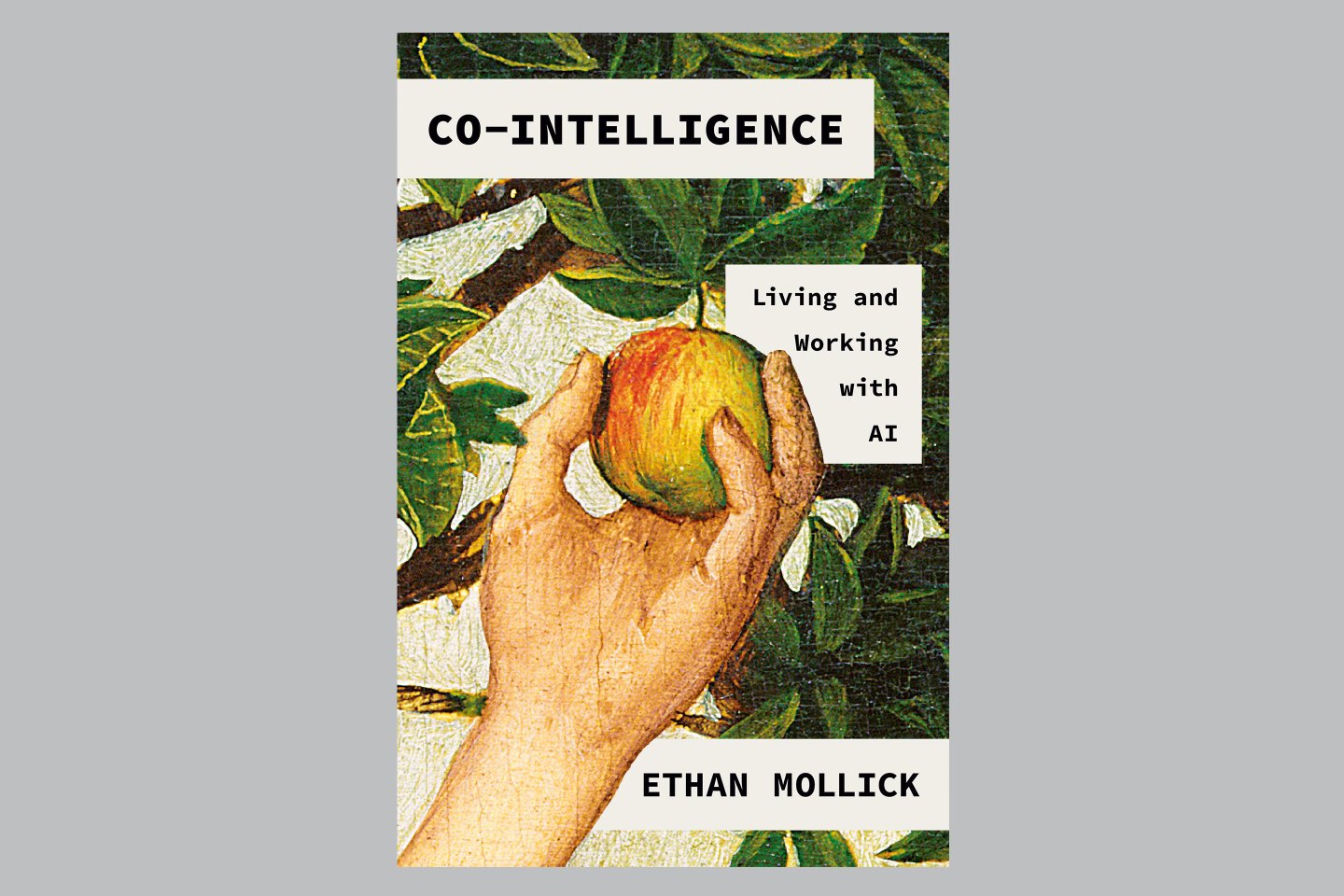
The following is an excerpt from Ethan Mollick’s book Co-Intelligence: Living and Working with AI.
Soon, every major office application and email client will include a button to help you create a draft of your work. It deserves capital letters: The Button.
When faced with the tyranny of the blank page, people are going to push The Button. It is so much easier to start with something than nothing. Students are going to use it to start essays. Managers will use it to start emails, reports, or documents. Teachers will use it when providing feedback. Scientists will use it to write grants. Concept artists will use it for their first draft. Everyone is going to use The Button.
The implications of having AI write our first drafts (even if we do the work ourselves, which is not a given) are huge. One consequence is that we could lose our creativity and originality. When we use AI to generate our first drafts, we tend to anchor on the first idea that the machine produces, which influences our future work. Even if we rewrite the drafts completely, they will still be tainted by the AI’s influence. We will not be able to explore different perspectives and alternatives, which could lead to better solutions and insights.
Another consequence is that we could reduce the quality and depth of our thinking and reasoning. When we use AI to generate our first drafts, we don’t have to think as hard or as deeply about what we write. We rely on the machine to do the hard work of analysis and synthesis, and we don’t engage in critical and reflective thinking ourselves. We also miss the opportunity to learn from our mistakes and feedback and the chance to develop our own style.
AI can do it
There is already evidence that this is going to be a problem. A recent MIT study found that ChatGPT mostly serves as a substitute for human effort, not a complement to our skills. In fact, the vast majority of participants didn’t even bother editing the AI’s output. This is a problem I see repeatedly when people first use AI: they just paste in the exact question they are asked and let the AI answer it.
A lot of work is time-consuming by design. In a world in which the AI gives an instant, pretty good, near universally accessible shortcut, we’ll soon face a crisis of meaning in creative work of all kinds. This is, in part, because we expect creative work to take careful thought and revision, but also that time often operates as a stand-in for work. Take, for example, the letter of recommendation. Professors are asked to write letters for students all the time, and a good letter takes a long time to write. You have to understand the student and the reason for the letter, decide how to phrase the letter to align with the job requirements and the student’s strengths, and more. The fact that it is time-consuming is somewhat the point. That a professor takes the time to write a good letter is a sign that they support the student’s application. We are setting our time on fire to signal to others that this letter is worth reading.
Or we can push The Button.
And the problem is that the letter the AI generates is going to be good. Not just grammatically correct, but persuasive and insightful to a human reader. It is going to be better than most letters of recommendation that I receive. This means that not only is the quality of the letter no longer a signal of the professor’s interest, but also that you may actually be hurting people by not writing a letter of recommendation by AI, especially if you are not a particularly strong writer. So people now have to consider that the goal of the letter (getting a student a job) is in contrast with the morally correct method of accomplishing the goal (the professor spending a lot of time writing the letter). I am still doing all my letters the old-fashioned way, but I wonder whether that will ultimately do my students a disservice.
Now consider all the other tasks whose final written output is important because it is a signal of the time spent on the task and of the thoughtfulness that went into it—performance reviews, strategic memos, college essays, grant applications, speeches, comments on papers. And so much more.
Reconstructing meaning
Then The Button starts to tempt everyone. Work that was boring to do but meaningful when completed by humans (like performance reviews) becomes easy to outsource—and the apparent quality actually increases. We start to create documents mostly with AI that get sent to AI-powered inboxes, where the recipients respond primarily with AI. Even worse, we still create the reports by hand but realize that no human is actually reading them. This kind of meaningless task, what organizational theorists have called mere ceremony, has always been with us. But AI will make a lot of previously useful tasks meaningless. It will also remove the facade that previously disguised meaningless tasks. We may not have always known if our work mattered in the bigger picture, but in most organizations, the people in your part of the organizational structure felt it did. With AI-generated work sent to other AIs to assess, that sense of meaning disappears.
We are going to need to reconstruct meaning, in art and in the rituals of creative work. This is not an easy process, but we have done it before, many times. Where musicians once made money from records, they now depend on being excellent live performers. When photography made realistic oil paintings obsolete, artists started pushing the bounds of photography as art. When the spreadsheet made adding data by hand unneeded, clerks shifted their responsibilities to bigger-picture issues. This change in meaning is going to have a large effect on work.
Excerpted with permission from Co-Intelligence: Living and Working with AI, by Ethan Mollick, in agreement with Portfolio, an imprint of Penguin Publishing Group, a division of Penguin Random House LLC. Copyright © Ethan Mollick, 2024.
Read more:
- Are we getting dumber? How AI affects critical thinking
- I won an AI image award with a real photo to show we’re not adapting to the technology fast enough. Then it was my turn to be surprised
- AI changes not just the ‘how’ but also the ‘who’ for certain types of work—and that’s reshaping entire fields: Photoroom CEO
- Sam Altman warned OpenAI will ‘steamroll’ AI startups. I run one. Here’s why I’m not worried