Taiwanese semiconductor manufacturer TSMC is riding high. A day after winning an $11.6 billion grant and loan package from the Biden administration’s CHIPS Act, its stock price surged on reports of a 16.5% increase in quarterly revenue.
Driven by booming demand from chip designers, TSMC—which has a near monopoly on global semiconductor manufacturing—is riding the AI wave that has pushed the stock market to record highs.
The global semiconductor industry’s ecosystem is widespread and fragile, largely relying on teamwork between a handful of design and manufacturing firms across continents to produce the chips behind everything from lawnmowers to large language models (LLMs). But TSMC has built up a dominant position in fabrication, the part of the process where semiconductors are actually constructed.
The reason TSMC makes some 92% of the world’s advanced chips is that it’s one of the only firms that can. Unlike other companies that handle chip production from design to sale, TSMC functions only as a manufacturer (also known as a foundry, or fab). Companies designing cutting-edge AI chips, such as Nvidia and Intel, rely on foundries with extremely specialized tools to build their designs—and for them, TSMC is the only game in town.
As demand for AI chips continues to boom, TSMC is facing more competition from peers such as Intel, which is also opening new fabs in Arizona, and New York–based GlobalFoundries. But semiconductor demand is expected to increase by double digits this year, and TSMC’s massive head start means it’s poised to stay on top of the market for years.
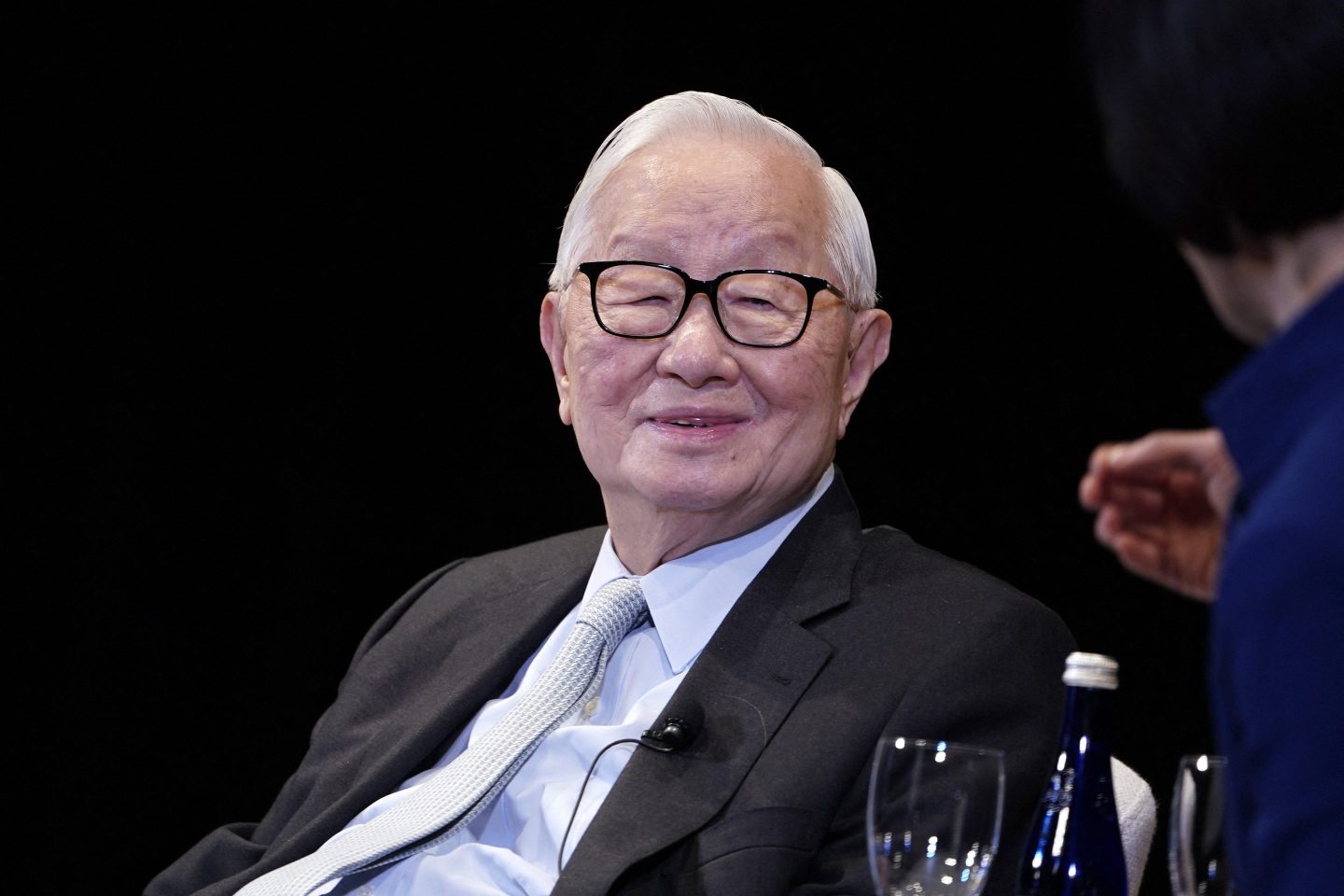
TSMC was founded by Morris Chang in 1987. Born in China in 1931, Chang left the country during the Chinese Civil War and studied engineering at Harvard and MIT before taking a job at Texas Instruments, a leading company in the then nascent semiconductor industry. Chang rose through the ranks at Texas Instruments—earning a Ph.D. at Stanford along the way—and eventually coming to run the entire semiconductor division, but quit in 1983.
Chang was 55 when he moved to Taiwan and founded TSMC, and already had decades of experience in the semiconductor industry. His vision for TSMC was for a new approach to chip manufacturing: Whereas other semiconductor companies controlled every step of the production process in-house—from design to shipment—TSMC was set up solely as a foundry, taking orders from chip designers and focusing only on the highly technical process of assembling chips.
The idea wasn’t universally popular from the start.
“There were two barriers to entry. One was the capital cost. But the other was the concept, which was not widely accepted,” Georgetown global innovation policy professor Charles Wessner told Fortune. “Most people, including those in Taiwan, did not believe this would work—the idea of setting up fabs that just produce chips for other people. That’s a very novel approach.”
TSMC grew slowly, landing contracts with Dutch firm Philips and benefiting from Taiwanese government support. Over time, as its operations grew and chip technology designers began to ask for newer, innovative manufacturing functions, TSMC’s fabrication capabilities—unencumbered by time spent designing or marketing chips—far outpaced its competitors’.
“The basic idea is you get multiple customers who are providing you with the resources to produce their chips, and all you have to do is concentrate on the fabrication—you don’t have to do design, and you don’t have to sell,” Wessner said. “You focus on that central node. And the more volume you get, the more skilled you get in the production.”
Semiconductor fabrication is one of the most technically demanding manufacturing processes out there. The most advanced transistors, the electronic components that make up semiconductors, are incredibly small—just 50 nanometers, more than a thousand times smaller than the width of a human hair.
To build the most advanced chips, TSMC fits billions of these transistors onto silicon wafers. That process requires expensive tools, such as lithography machines, and ultrapure water filtration. TSMC is one of the few companies in the world that has them, and also has decades of experience in supply chain management and navigating supplier relationships required to do business in the semiconductor industry.
“One of the interesting things about this industry is how much of it relies on tacit knowledge: that is, know-how,” Wessner said. “It’s much more artisanal than most people realize.”
One of TSMC’s biggest worries is environmental: Its Taiwan headquarters is located right along a fault line. Last week, it suffered a 7.4-magnitude earthquake, the largest in 25 years. The earthquake didn’t significantly disrupt business or affect TSMC’s operations, but left industry watchers wary of the possible effects of a more serious catastrophe.
More than 80% of the world’s earthquakes occur on the rim of the Pacific Ocean, including Taiwan. Taiwanese authorities detect around 20,000 earthquakes a year, although most of them are barely perceptible.
“It sits on top of an earthquake fault —the Pacific Rim of fire,” Wessner said of TSMC. “I am quite unaware of any agreement with the earthquake gods.”