Dani Coco would never, ever date a coworker. Not again.
In her second post-college job as a talent manager in 2019, Coco began dating a coworker in the same position as hers. The company had a relatively lax policy regarding office romances, but her coworker was adamant that no one else could know. Six months later, he ghosted her.
He stopped responding to her texts and blocked her phone number without any explanation—and started ignoring her in the office. He even got a taller computer monitor for his desk and angled it in front of his face, blocking himself from Coco’s eyeline.
“I was like, message received,” Coco, now 25, told Fortune.
They ignored each other, “as much as you can pretend someone doesn’t exist while you work in the same office,” said Coco, who lives in San Diego. A few months after the breakup, Coco found out that her coworker had a long-term, long-distance girlfriend the entire time she was seeing him.
“Just because you feel like [you know] a coworker really well doesn’t mean that you know them really well,” she said. “And in fact, I think sometimes people are so good at hiding their personal life at work that that’s actually scarier.”
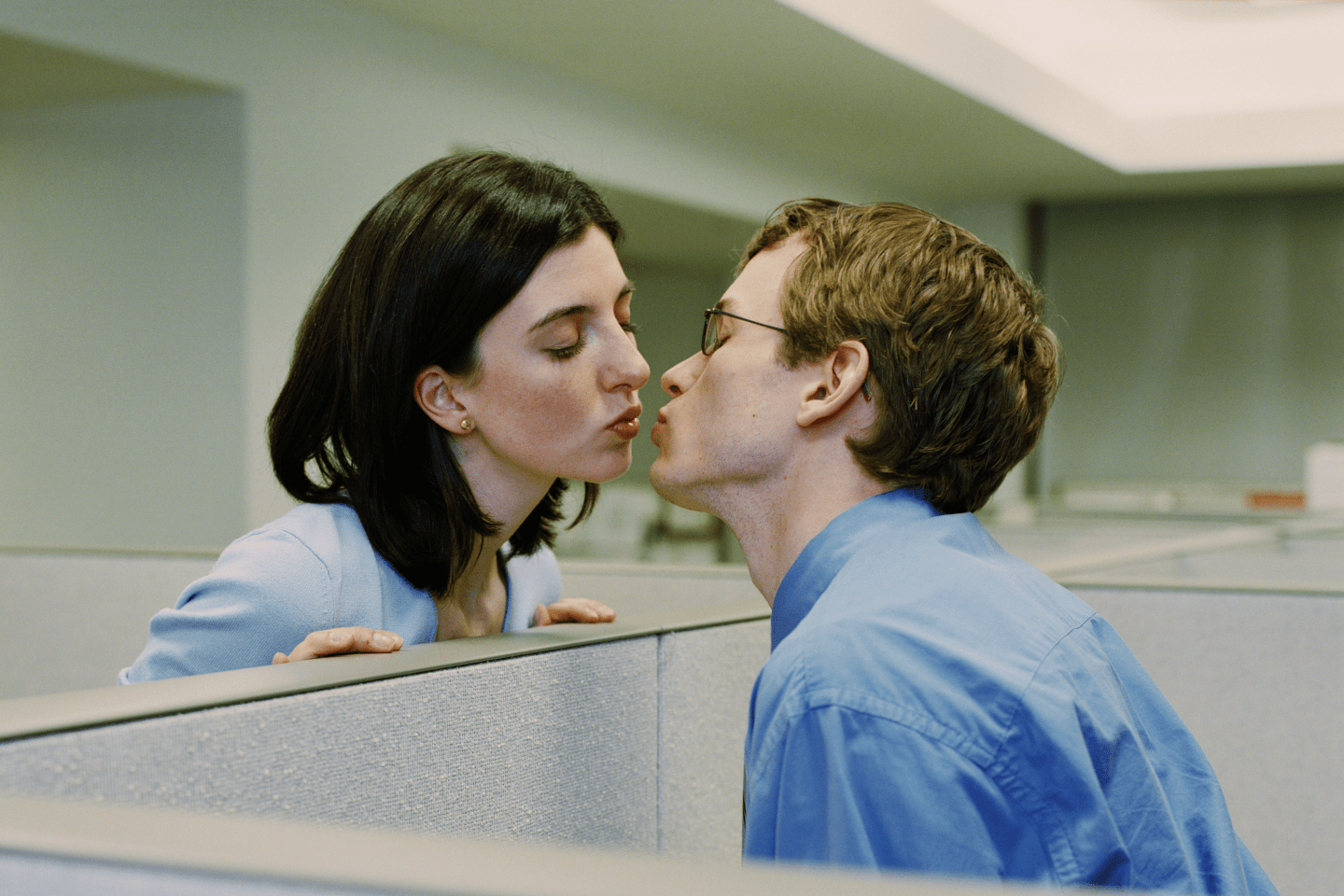
Adages like “don’t dip your pen in the company ink” failed to stop one in five Americans from meeting their significant other at work in the 1990s. (A Reddit thread on the different phrases for this across the world surfaces one from Japan: “If you want to play, go outside.”) And though the #MeToo movement and the pandemic drove Americans to hit pause on workplace romances, a February survey from the Society of Human Resources shows that some things are eternal—and young people are down to date their coworkers once again after a hiatus of what seems like years.
According to SHRM research released Feb. 14, 33% of younger millennial and Gen Z workers said they would be open to a workplace romance, compared to older millennials (15%), Gen X (27%), and boomers and traditionalists (23%). The survey also found that 17% of U.S. workers are currently in a relationship with a coworker, and 49% have had a crush on a coworker.
The return to office romance coincides with a period of slow growth for the dating apps once popular with young people. In the past year, Bumble’s stock price declined 40.32%, while Match Group’s declined by roughly 5%—not too bad, relatively, but it has lost 66% of its value since going public. As app fatigue creeps in and real-life meet-cutes become fashionable again, Gen Z and millennials are acting on their office crushes—and some are learning tough lessons along the way.
No longer taboo?
People have always dated their coworkers—but it’s only in recent years that it’s become “fully normalized,” SHRM president and CEO Johnny C. Taylor Jr. told Fortune.
In the 1990s, when Taylor worked as an employment lawyer and as the vice president of HR at Blockbuster, “we strongly discouraged such dating,” he said. Many companies would terminate an employee for dating a coworker—but that was also the decade when the most couples met in the workplace, according to a 2017 Stanford University study.
“So much for our policies, right?” Taylor said. “No one was following them. And we knew it; with the number of CEOs’ wives who used to be their secretaries, we knew this was occurring.”
From the employers’ standpoint, some companies are growing more lax with office romance rules amid the “war for talent” where workers have the upper hand, Taylor said. Policies banning workplace romances can make potential employers unattractive to candidates, he said, and softening such rules can help companies reach a wider talent pool.
“These decisions are largely being driven by our consumer,” he said. “And our consumer is an applicant from an HR perspective.”
Risky business
Dating a coworker could be a high-risk, high-reward romance. Katrina Gao, 28, met her fiancé in 2019 while they both worked at the fashion brand Aritzia’s corporate offices in Vancouver. A slow-burn romance commenced through workday lunches and after-work happy hours, and Gao and her now fiancé became an official couple when the pandemic hit.
Gao thinks meeting a love interest through work is “100%” better than on a dating app.
“With dating apps…you have to go through a lot of bad dates before you find a good one,” she told Fortune. “With work, at least you can inspect and see the person from afar, and get to know them a little bit, before going on a date.”
If using dating apps feels like kissing countless frogs to find the one, developing a workplace romance can be like assessing one’s princely qualities from afar before taking the leap. But for the less lucky, an office sweetheart could turn out to be just another frog—one whose ribbits haunt them amid the drone of office chatter.
Michelle, a 23-year-old associate at a Fortune 500 company who requested to use a pseudonym, grew close to a coworker after they both participated in a young talent program last summer.
They began going on dates, and got to the point where they were together “in everything but the title,” Michelle told Fortune. “He would get me flowers, he would get me Squishmallows,” she said—but her coworker later told her he wasn’t ready for a serious relationship.
“Now, things are very, very awkward at work,” she said. “He won’t look me in the eye sometimes.”
Michelle was hurt by the experience—so much so that she considered quitting her job. But she’s since settled for ignoring him as much as possible. “I’ll purposefully go to a different floor that’s not my assigned floor, just so I can avoid him,” she said.
And though Michelle says she would never date a coworker again, when compared to meeting someone on a dating app, “I will unfortunately say [meeting at work is] a lot better,” she said.
“If you’re meeting someone online, there is truly no shared experience that connects you two,” she said. “With me and this coworker, we both happened to be in the same place, same environment, spending a lot of time together.”
Is Slack the new Tinder?
The rise of workplace romances is coinciding with Gen Zers’ and millennials’ dating app fatigue—and growing desire to meet love interests in person.
“If you look at the metrics across the entire online dating app ecosystem, it’s been in decline since 2021,” Ygal Arounian, director of internet equity research at Citibank, told Fortune. “There’s been almost no growth since 2019, so we’re looking at a five-year period where collectively, users and time spent on dating apps hasn’t seen any real level of growth.”
In addition to a decline in stock price, Match Group, the conglomerate that owns Tinder, Hinge, The League, and more, reported in Q4 of 2023 that paying users had declined by 5% year over year. The decline was steepest for Tinder in particular, with paying subscribers dropping by 8%.
“It all goes back to this point about being self-expressive,” Arounian said. “The whole quick connection, swiping on a profile picture just based on what someone looks like—that doesn’t resonate with younger audiences anymore.”
Dating apps like Hinge and Tinder are adding new features to user profiles that highlight not only their appearance but their interests as well. But with paid users making up almost all of these apps’ revenue, “it’s going to be hard to offset that with other revenue streams right now,” Arounian said.
“The pendulum is swinging back in the other direction a little bit,” Arounian said, but dating apps “aren’t going anywhere.”
“It’s not like we’re going to move back into a world that’s completely offline. People are going to meet digitally,” he said. “Maybe you’re not gonna get to a place where literally everyone is dating online, but it’s going to be an integral part of how people meet going forward.”
In her search for love, Dani Coco, the San Diego–based talent manager, has been in an on-and-off relationship with dating apps.
“If you’re using dating apps as your primary method of meeting people, you’re 100% going to be frustrated,” said Coco. “Because to me, dating apps are a supplement to your dating life—not your entire dating life.”
She now pays for two apps, while meeting potential matches in person through pickleball mixers, singles events, and a matchmaker—anywhere but the workplace.