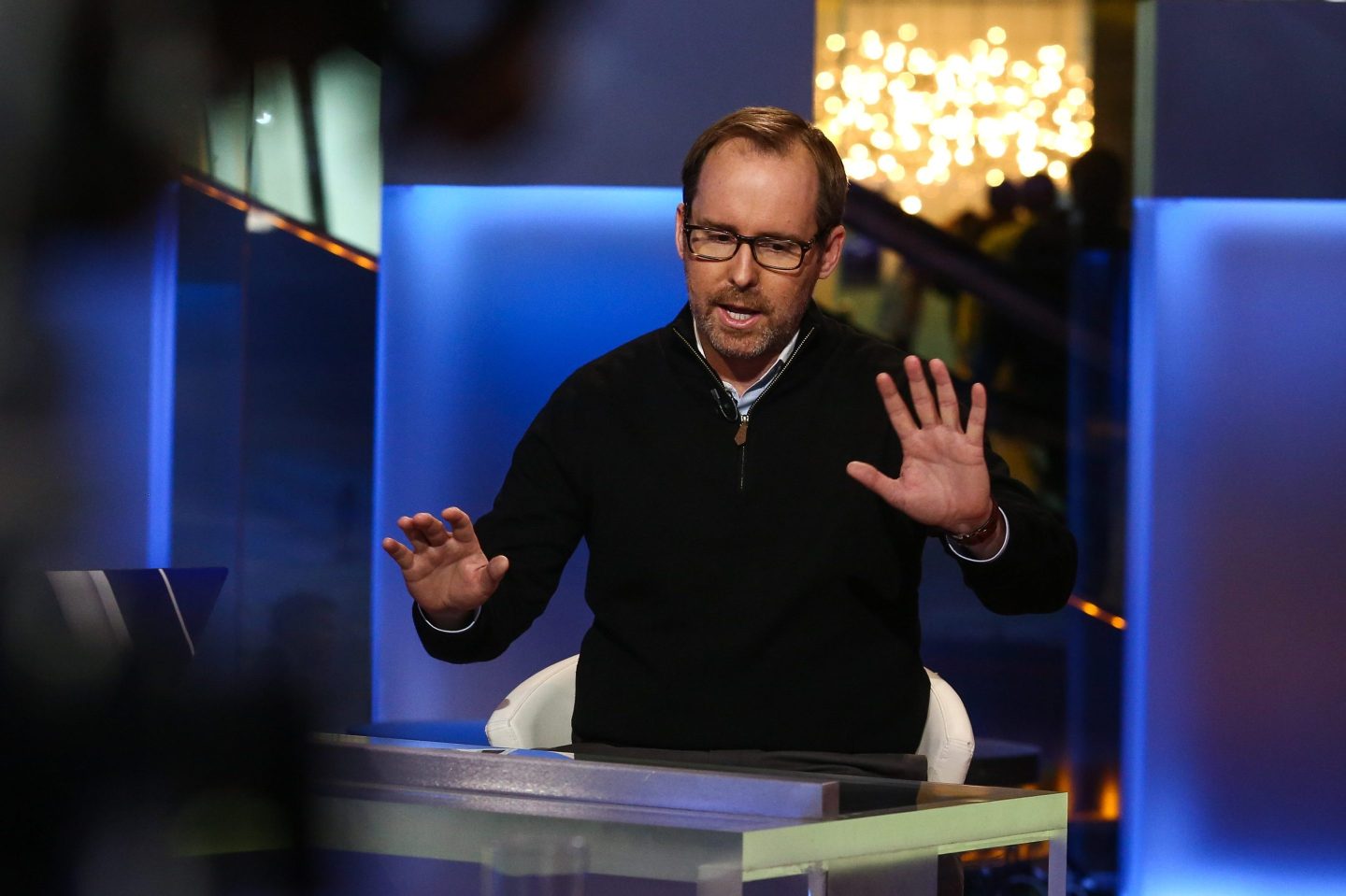
Mark Spitznagel, cofounder and CIO of the private hedge fund Universa Investments, is known for making juicy returns for wealthy investors with his patented tail-risk hedging strategy, a form of market “insurance” that pays handsomely during times of economic and market turmoil. But when it comes to his generation’s debt obsession, Spitznagel sounds more like a social activist than a hard-nosed money manager.
For years, the 53-year-old has warned that the national debt—which recently surged over $34.5 trillion—is unsustainable. He argues that, when that rising debt combines with decades of loose monetary policy that lifted asset prices ever higher, growing piles of consumer debt, and businesses’ penchant for leaning on credit during times of stress, it creates a “tinderbox economy” that could go up in flames in a moment’s notice. It’s the “greatest credit bubble in human history,” Spitznagel told Fortune last year, warning that “it will have its consequences.”
With this in mind, we decided to ask Spitznagel, who has two teenagers of his own, what this credit bubble will mean for future generations, and how he feels about his cohort’s debt-laden legacy. As usual, he didn’t pull any punches.
“We have been just incredibly irresponsible to future generations. They played no part in this, and yet they will bear the burden for this,” the hedge funder told Fortune. “We should all feel really, really bad about it—like really bad about it. It’s gonna hurt people that aren’t even alive today. How is that right?”
For Spitznagel, the U.S.’s unsustainable federal debt is outright unethical. He argues it’s merely a way to kick the can down the road to the next generation whenever problems emerge, particularly problems that could hurt investors’ market returns. From spending billions to save “too big to fail” banks during the Great Recession of 2008 to pumping trillions into the economy to prevent a terrible recession during the COVID era, the federal government has for decades now managed to prevent large swaths of America from experiencing economic pain during trying times. These spending policies, which have typically come in tandem with near-zero interest rates from the Federal Reserve, have helped juice markets and enable incredible post-recession recoveries in the 21st century. That’s a good thing in the short term, but avoiding worst-case scenarios via hefty deficit spending comes at a cost for future generations, in Spitznagel’s view.
It’s essentially a “massive, massive transfer of wealth brought forward from the future,” he argued. “There’s something immoral, just very simply, about public debt—that individuals can take on debt for their own benefit to be paid for by people who had no say in that debt.”
Spitznagel’s concerns about the U.S.’s mounting debts aren’t without merit. A mix of costly spending bills, COVID-era rescue packages, and weak tax revenues have helped push the U.S. national debt 28% higher since 2020 alone, from $26.9 trillion to over $34.5 trillion. That left the U.S.’s debt-to-GDP ratio, which serves as an indicator of a country’s ability to repay its debts, at a record 123% in January, according to the International Monetary Fund.
Even worse, the University of Pennsylvania’s Wharton School economists found in a 2023 study that the U.S. has about 20 years left for “corrective action” to fix the national debt before it hits 200% of GDP. After that, “no amount of future tax increases or spending cuts could avoid the government defaulting on its debt,” they warned.
While the U.S. defaulting on its debts is a very unlikely scenario, and something that couldn’t happen for decades, the impact of the rising national debt is already being felt to some degree. The U.S. federal government is projected to spend $870 billion, or 3.1% of GDP, on interest payments for its debt this year, according to the Congressional Budget Office—more than the entire Department of Defense budget. For the past two decades, the U.S. has spent an average of just 1.6% on servicing its debt, about half of this year’s projections. And the CBO is forecasting the government’s interest expenses to rise to 3.9% of GDP over the next 10 years. To illustrate just how extreme the interest payments are, it should be noted that U.S. federal, state, and local governments combined spent a total of just $810 billion on education in 2023.
In total, net interest payments on the federal debt will be around $12.4 trillion over the next decade, according to the Peter G. Peterson Foundation, a conservative think tank. That’s money that could be spent on a number of far more useful things.
For Spitznagel, this expensive reality means politicians need to take action immediately to get the U.S.’s national debt back on a sustainable path. But unfortunately, he predicts, it might already be too late to do so painlessly.
The hedge funder argued that after decades of loose monetary policy and soaring debts, it may be impossible for the next generation to end the cycle of indebtedness without incurring serious consequences in the form of an epic recession. That means when today’s youth comes of age and a crisis hits, they will likely “have to do more of the same,” racking up debt to avoid worst-case scenarios.
But you can’t keep borrowing forever, Spitznagel says, and he’s afraid we’re well past the point of needing to cut back. “One can make the case that at some point it stops working,” he said.