New Yorkers place over 100 million food delivery orders each year via a very simple process: press a few buttons on an app and it’s in their hands in about 30 minutes.
For the delivery workers, the process is anything but simple. And it has only become more complex since the city instituted a new wage formula designed to guarantee they make at least $18 an hour. Some of the biggest app platforms, who opposed the change, responded by limiting workers’ hours, making it more difficult for customers to tip, and changing how pay is calculated from week to week.
That’s left workers like Greiber Pineda scrambling to navigate opaque changes.
Pineda initially earned so much from Uber Eats under the new wage system that when a snowstorm hit New York City in January, he was motivated to work 11 1/2 hours straight, shuttling 37 meals on his moped “through the cold, the snow, everything.” A few days later, the app changed its pay system — sending him around $200 instead of the $300 he expected.
“When we got paid we were up in the air, like ‘What happened here?’” Pineda, of Brooklyn, said in Spanish.
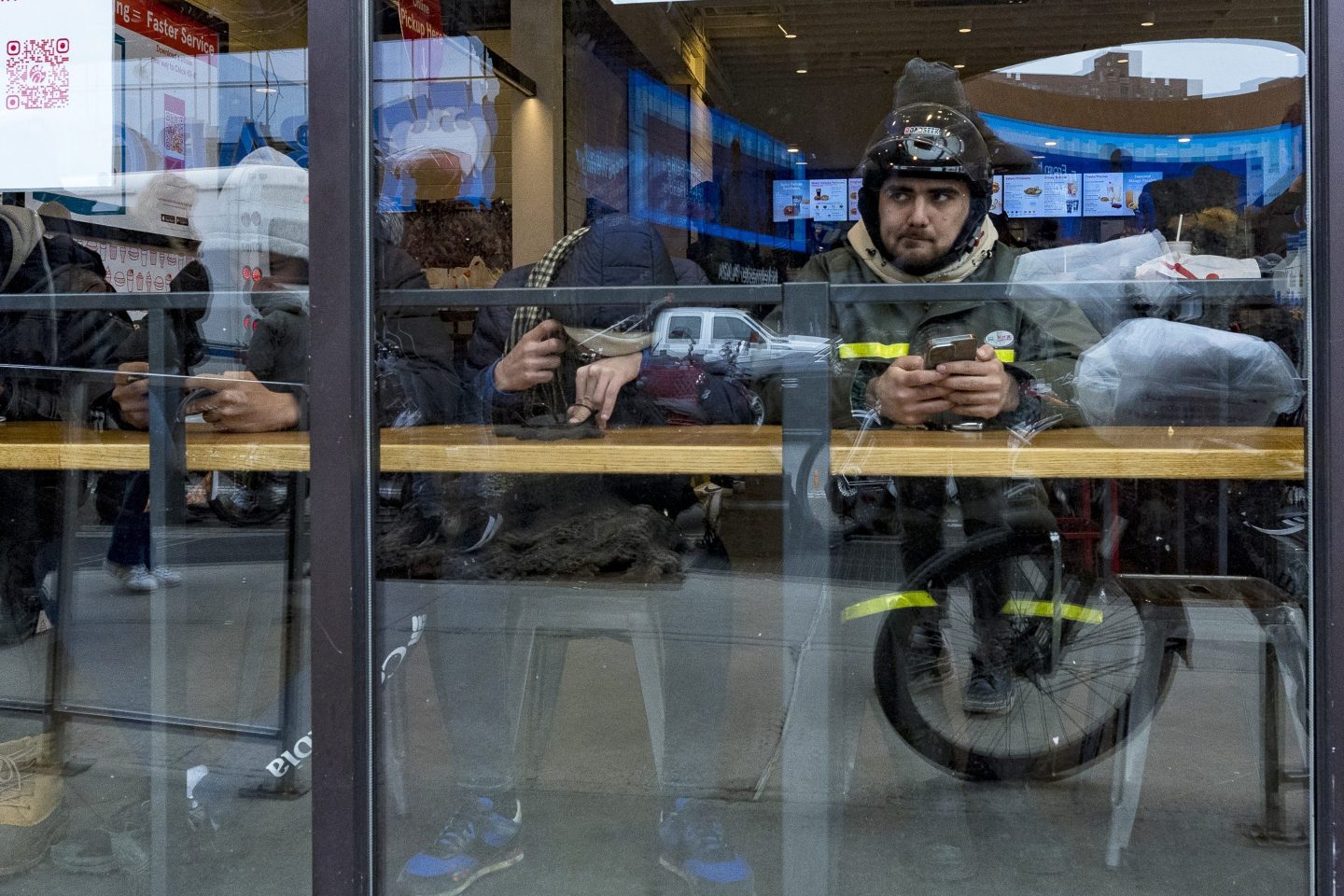
Frustrated, Pineda now spends more time on side hustles. On a recent weekday morning, he sold coffee and arepas to fellow delivery workers from Venezuela and Colombia outside a Chick-fil-A across the road from Brooklyn’s Barclays Center arena. Nearby, two workers from Guinea changed the oil on a scooter while others from Latin America, China and Turkmenistan picked up orders for apps like Uber Eats, Grubhub and DoorDash. The city estimates that, like Pineda, 39% of delivery workers speak English “less than well.”
A few months ago, none of these workers were earning an hourly wage. Like most food delivery drivers across the U.S., they instead logged into the apps when they wanted and earned money by accepting individual delivery jobs. Some jobs made financial sense. Others might not even cover the cost of gas, but many workers said “yes” as often as possible to earn priority access to premium orders or other perks on the gamified apps.
That’s no longer the case in New York, which became the first major city to institute a wage floor for app-based food delivery workers on Dec. 4. Seattle followed in January with a similar law that extends to nearly all app-mediated work.
Before the change, New York City surveyed its estimated 122,000 delivery workers, finding they earned $14 an hour on average. Half of that came from tips and around $2 went to equipment and maintenance, mostly for e-bikes and mopeds.
Exposed to deadly traffic and violent attacks, they were working a dangerous job, but weren’t even making the city’s minimum wage, which rose from $15 to $16 this year.
“This is one of the ways, one of the few ways that an immigrant can get by, at least in this city, which is pricey,” said Pineda.
While some workers say they’re earning less under the new rules, labor organizers and the app companies say average earnings have increased. But the apps are still cutting costs and have the advantage of seeing their workers’ data as they figure out how to do that.
“Delivery companies are still undermining or trying to undermine the minimum pay victory by being less transparent,” said Ligia Gullalpa, executive director of the Workers Justice Project.
None of the major app companies operating in New York City responded to a request for detailed pay statistics. They defended reducing worker hours as key to reducing downtime, in line with the law’s incentives.
“Seattle & New York City failed to think about the negative impacts of their actions,” Uber Eats spokesperson Josh Gold said in an email, adding that he believes there are better options to protect worker flexibility, such as a California law that recategorized gig workers as independent contractors.
DoorDash spokesperson Eli Scheinholtz in a statement called the laws in both cities “extreme,” adding that “the end result has been the same: higher fees for consumers, fewer orders for merchants, and less work for Dashers.”
When the law took effect in New York, both apps announced that customers in the city could no longer add a tip during checkout — instead making it available only after a driver had been assigned in DoorDash’s case, or after the food was delivered for Uber Eats. Apps also tacked on additional fees for New York City customers, starting around $2. Fees to restaurants are capped at 23% of the purchase price.
New York City’s rule allows apps to either pay around $30 an hour on average for the “active time” workers spend delivering orders, or $18 an hour on average for the entire time they are logged in, including “passive time” spent waiting for a job. The apps don’t have to pay workers who don’t do any deliveries. Companies can also decide retroactively which of the two calculations they’ll use, so delivery workers never know exactly what they’re being paid for until up to a week later.
The switch is likely how Pineda ended up with lower pay after the January storm according to pay stubs and notices shared with The Associated Press by him and others.
Seattle’s system only counts active time, paid at a minimum of 44 cents per minute, plus 74 cents per mile. In New York City, there’s no mileage paid.
“People depend on you to bring them their food,” said Daniel Mendoza, a delivery worker who gets coffee and breakfast from Pineda, and is also from Venezuela. “We make magic.”
Mendoza said in February that the new system had been more lucrative for him.
But on March 4, Doordash made the same switch that Uber Eats did that had so angered Pineda. It’s impossible to say if Mendoza’s pay will go up or down, but it will become less predictable.
In a statement, Doordash said that the payment method it had used since December was unsustainable and that workers like Mendoza “can also qualify for additional weekly pay adjustments.”
GrubHub spokesperson Najy Kamal said in a statement that delivery workers are earning more overall in both New York and Seattle, and the company is committed to complying with the new pay standards.
Meanwhile, Pineda continues to make money the old-fashioned way. As he served the delivery workers near the Chick-fil-A recently, a worker from the fast-food chain poked his head out of the door, and yelled, asking what kind of arepas he had. Beef, Pineda’s girlfriend shouted back.
“I’ll take two,” he said, waiting for her to deliver them to him — in exchange for some paper money.