• Home
  • Latest
  • Fortune 500
  • Finance
  • Tech
  • Leadership
  • Lifestyle
  • Rankings
  • Multimedia
TechNvidia

Jensen Huang, Elon Musk, and OpenAI: The story behind the hand delivery of the first AI supercomputer ‘to unlock the powers of superhuman capabilities’

Paolo Confino
By
Paolo Confino
Paolo Confino
Reporter
Down Arrow Button Icon
February 22, 2024, 1:28 PM ET
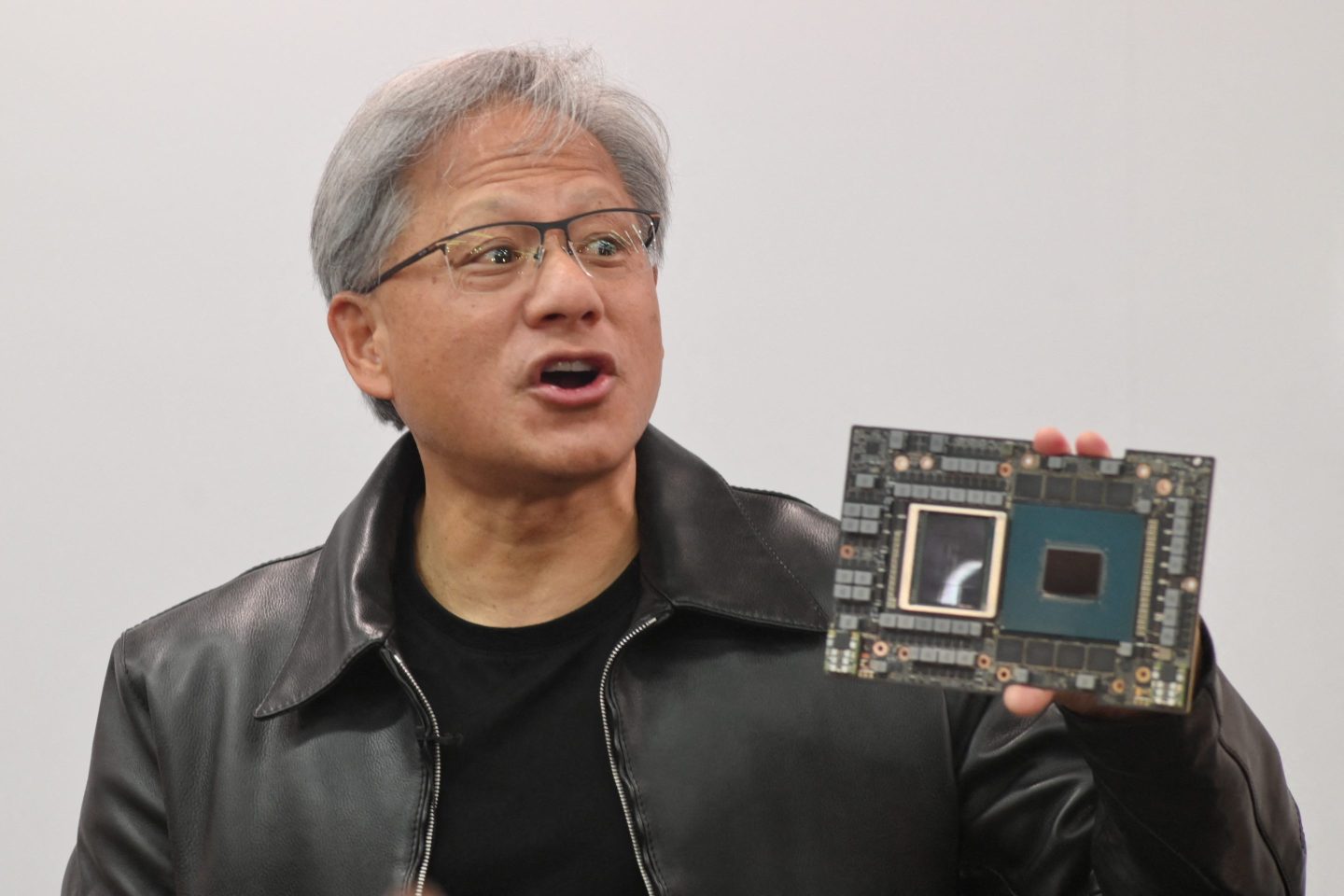
Nvidia CEO Jensen Huang
Nvidia CEO Jensen Huang speaking at a conference in Taipei in May 2023. Sam Yeh—AFP/Getty Images

Jensen Huang, cofounder and CEO of Nvidia, the semiconductor company that has taken the global stock market by storm, was present at the birth of the current AI movement. 

Recommended Video

In fact, one might say he helped sire it when, in August 2016, he donated a groundbreaking new supercomputer specifically designed for AI to a newly founded nonprofit called OpenAI. At the time OpenAI’s research efforts were led by its cofounder Elon Musk, before he departed over differences with current CEO Sam Altman. 

“I delivered to [Musk] the first AI supercomputer the world ever made,” Huang said during an interview at the New York Times Dealbook Summit in November. Building the 70-pound, 35,000-part computer took years, according to Huang. 

“It took us five years to make it. It’s called a DGX, and it’s everywhere in the world today.” 
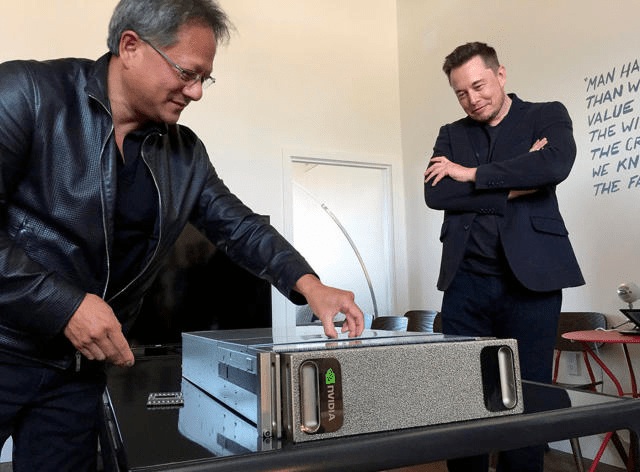
Musk and Huang have a friendly relationship. During an interview at the same New York Times conference, Musk referred to Huang as “awesome.” 

To commemorate that fateful day in Nvidia and OpenAI’s history, Huang signed the supercomputer. “To Elon and the OpenAI Team!” wrote Huang in marker. “To the future of computing and humanity. I present you the world’s first DGX-1!”

Musk had recently founded OpenAI because he was concerned that tech giants like Alphabet and Meta would dominate artificial intelligence by hoarding talent and computing power. A mission which Huang seemed to embrace. “I thought it was incredibly appropriate that the world’s first supercomputer dedicated to artificial intelligence would go to the laboratory that was dedicated to open artificial intelligence,” Huang said at the time. 

OpenAI has since walked back some of its open source protocols. 

Nvidia’s DGX ended up accelerating OpenAI’s research experiments by weeks, according to OpenAI cofounder Ilya Sutskever, who had introduced Huang to early versions of AI several years earlier. A computer as powerful as the DGX also meant OpenAI could run experiments that were previously out of reach simply because they required too much computing power to be executed. Much of that work would eventually forge the foundations of the generative AI tools OpenAI pioneered. In a 2016 video promoting the collaboration between OpenAI and Nvidia, OpenAI researcher Andrej Karpathy described how they planned to use DGX specifically for large language models, the very technology underpinning ChatGPT, which catapulted AI and OpenAI into the mainstream. In a savvy prediction, Karpathy mused, “Eventually we’ll be able to talk to computers just like we talk to people.” 

Announced in April 2016, the DGX was indeed one of the world’s first supercomputers, originally billed by Nvidia as having the power of 250 servers in a single box. The proliferation of AI made Nvidia’s supercomputers, chips, and software hot commodities across the global tech sector. On its 2023 year-end earnings call Wednesday, Nvidia demonstrated just how in-demand its products were. Nvidia posted $22 billion in fourth-quarter revenue, obliterating consensus expectations by about $1.7 billion. 

But even in 2016, Huang was already positioning Nvidia as the go-to supplier for an AI boom he saw as imminent. “The DGX-1 is easy to deploy and was created for one purpose: to unlock the powers of superhuman capabilities and apply them to problems that were once unsolvable,” Huang said in a 2016 press release a few months before OpenAI received its Nvidia supercomputer. 

Huang had originally decided to build the supercomputer so that it could be used by Nvidia’s own engineers. However, when Musk heard about the supercomputer at a conference, he told Huang, “I want one of those,” according to Huang. At the time, OpenAI was still in its infancy as was much of the artificial intelligence technology it had set out to research and ultimately turn into products. Nvidia’s supercomputer would be used to provide the computing power needed to test AI systems. By 2016, researchers had made breakthroughs in deep learning and neural networks. These two techniques allow artificial intelligence to learn from itself and improve the more data it consumes. 

Huang saw an early example of these systems in 2012, and he decided to start building a supercomputer specifically designed for AI. He realized tech was entering a new era of computing after Sutskever, the OpenAI cofounder, showed him a groundbreaking new way to program software from a neural network called AlexNet he had built with Geoffrey Hinton, known as “the Godfather of AI.” AlexNet had created a program that made software by being shown an example of the desired output instead of having to code it and then run tests on it. 

“It was backwards compared to most programs up to then,” Huang said, explaining what spurred him to build the AI supercomputer. 

After his initial excitement, Huang tried to assess the bigger picture of how this new development could affect the entire tech industry. “[We] asked ourselves, ‘What are the implications of this for the future of computers?’” Huang recounted. “And we drew the right conclusions that this was going to change the way computing was going to be done, software was going to be written, and the type of applications we could write.” 

Considering Nvidia’s stock price has risen from $15 a share in August 2016 when Huang gifted Musk the first AI supercomputer to $779 a share, it appears he made the right call.


Join us at the Fortune Workplace Innovation Summit May 19–20, 2026, in Atlanta. The next era of workplace innovation is here—and the old playbook is being rewritten. At this exclusive, high-energy event, the world’s most innovative leaders will convene to explore how AI, humanity, and strategy converge to redefine, again, the future of work. Register now.
About the Author
Paolo Confino
By Paolo ConfinoReporter

Paolo Confino is a former reporter on Fortune’s global news desk where he covers each day’s most important stories.

See full bioRight Arrow Button Icon

Latest in Tech

Finance
Lorem ipsum dolor sit amet, consectetur adipiscing elit, sed do eiusmod tempor incididunt ut labore et dolore magna aliqua. Ut enim ad minim veniam
By Fortune Editors
October 20, 2025
Finance
Lorem ipsum dolor sit amet, consectetur adipiscing elit, sed do eiusmod tempor incididunt ut labore et dolore magna aliqua. Ut enim ad minim veniam
By Fortune Editors
October 20, 2025
Finance
Lorem ipsum dolor sit amet, consectetur adipiscing elit, sed do eiusmod tempor incididunt ut labore et dolore magna aliqua. Ut enim ad minim veniam
By Fortune Editors
October 20, 2025
Finance
Lorem ipsum dolor sit amet, consectetur adipiscing elit, sed do eiusmod tempor incididunt ut labore et dolore magna aliqua. Ut enim ad minim veniam
By Fortune Editors
October 20, 2025
Finance
Lorem ipsum dolor sit amet, consectetur adipiscing elit, sed do eiusmod tempor incididunt ut labore et dolore magna aliqua. Ut enim ad minim veniam
By Fortune Editors
October 20, 2025
Finance
Lorem ipsum dolor sit amet, consectetur adipiscing elit, sed do eiusmod tempor incididunt ut labore et dolore magna aliqua. Ut enim ad minim veniam
By Fortune Editors
October 20, 2025

Most Popular

Finance
Lorem ipsum dolor sit amet, consectetur adipiscing elit, sed do eiusmod tempor incididunt ut labore et dolore magna aliqua. Ut enim ad minim veniam
By Fortune Editors
October 20, 2025
Finance
Lorem ipsum dolor sit amet, consectetur adipiscing elit, sed do eiusmod tempor incididunt ut labore et dolore magna aliqua. Ut enim ad minim veniam
By Fortune Editors
October 20, 2025
Finance
Lorem ipsum dolor sit amet, consectetur adipiscing elit, sed do eiusmod tempor incididunt ut labore et dolore magna aliqua. Ut enim ad minim veniam
By Fortune Editors
October 20, 2025
Finance
Lorem ipsum dolor sit amet, consectetur adipiscing elit, sed do eiusmod tempor incididunt ut labore et dolore magna aliqua. Ut enim ad minim veniam
By Fortune Editors
October 20, 2025
Finance
Lorem ipsum dolor sit amet, consectetur adipiscing elit, sed do eiusmod tempor incididunt ut labore et dolore magna aliqua. Ut enim ad minim veniam
By Fortune Editors
October 20, 2025
Finance
Lorem ipsum dolor sit amet, consectetur adipiscing elit, sed do eiusmod tempor incididunt ut labore et dolore magna aliqua. Ut enim ad minim veniam
By Fortune Editors
October 20, 2025
Rankings
  • 100 Best Companies
  • Fortune 500
  • Global 500
  • Fortune 500 Europe
  • Most Powerful Women
  • Future 50
  • World’s Most Admired Companies
  • See All Rankings
Sections
  • Finance
  • Leadership
  • Success
  • Tech
  • Asia
  • Europe
  • Environment
  • Fortune Crypto
  • Health
  • Retail
  • Lifestyle
  • Politics
  • Newsletters
  • Magazine
  • Features
  • Commentary
  • Mpw
  • CEO Initiative
  • Conferences
  • Personal Finance
  • Education
Customer Support
  • Frequently Asked Questions
  • Customer Service Portal
  • Privacy Policy
  • Terms Of Use
  • Single Issues For Purchase
  • International Print
Commercial Services
  • Advertising
  • Fortune Brand Studio
  • Fortune Analytics
  • Fortune Conferences
  • Business Development
About Us
  • About Us
  • Editorial Calendar
  • Press Center
  • Work At Fortune
  • Diversity And Inclusion
  • Terms And Conditions
  • Site Map

© 2025 Fortune Media IP Limited. All Rights Reserved. Use of this site constitutes acceptance of our Terms of Use and Privacy Policy | CA Notice at Collection and Privacy Notice | Do Not Sell/Share My Personal Information
FORTUNE is a trademark of Fortune Media IP Limited, registered in the U.S. and other countries. FORTUNE may receive compensation for some links to products and services on this website. Offers may be subject to change without notice.


Most Popular

placeholder alt text
Future of Work
Meet a 55-year-old automotive technician in Arkansas who didn’t care if his kids went to college: ‘There are options’
By Muskaan ArshadDecember 21, 2025
20 hours ago
placeholder alt text
Future of Work
A Walmart employee nearly doubled her pay after entering its pipeline for skilled tradespeople. 'I was able to move out of my parents' house'
By Anne D'Innocenzio and The Associated PressDecember 20, 2025
1 day ago
placeholder alt text
Success
Multimillionaire musician Will.i.am says work-life balance is for people 'working on someone else’s dream'—he grinds from 5-to-9 after his 9-to-5
By Orianna Rosa RoyleDecember 21, 2025
13 hours ago
placeholder alt text
Economy
For the first time since Trump’s tariff rollout, import tax revenue has fallen, threatening his lofty plans to slash the $38 trillion national debt
By Sasha RogelbergDecember 12, 2025
9 days ago
placeholder alt text
Success
The scientist who helped create AI says it’s only ‘a matter of time’ before every single job is wiped out—even safer trade jobs like plumbing
By Orianna Rosa RoyleDecember 19, 2025
3 days ago
placeholder alt text
Future of Work
'They'll lose their humanity': Dartmouth professor says he's surprised just how scared his Gen Z students are of AI
By Nick LichtenbergDecember 20, 2025
2 days ago

Latest in Tech

AIOpenAI
OpenAI sees better margins on business sales, report says
By Mark Bergen and BloombergDecember 21, 2025
6 hours ago
Innovationautonomy
Waymos froze, blocked traffic during San Francisco power outage
By Maria Paula Mijares Torres and BloombergDecember 21, 2025
6 hours ago
Successwork-life balance
Multimillionaire musician Will.i.am says work-life balance is for people ‘working on someone else’s dream’—he grinds from 5-to-9 after his 9-to-5
By Orianna Rosa RoyleDecember 21, 2025
13 hours ago
Young banker
SuccessCareers
Is AI really killing finance and banking jobs? Experts say Wall Street’s layoffs may be more hype than takeover—for now
By Emma BurleighDecember 21, 2025
17 hours ago
InnovationDefense
Shield AI took its drones from the ‘Batcave’ to the battlefield. Now the $5.6 billion defense-tech startup’s new CEO says it’s at an inflection point
By Jessica MathewsDecember 21, 2025
18 hours ago
Gao
AIBrainstorm AI
Top AI investors say maybe it’s a bubble, but ‘bubbles are good for innovation’
By Nick LichtenbergDecember 21, 2025
19 hours ago