U.S. lawmakers are raising alarms about what they see as America’s failure to compete with China in biotechnology, warning of the risks to U.S. national security and commercial interests. But as the two countries’ rivalry expands into the biotech industry, some say that shutting out Chinese companies would only hurt the U.S.
Biotechnology promises to revolutionize everyday life, with scientists and researchers using it to make rapid advances in medical treatment, genetic engineering in agriculture and novel biomaterials. Because of its potential, it has caught the attention of both the Chinese and U.S. governments.
Bills have been introduced in the House and Senate to bar “foreign adversary biotech companies of concern” from doing business with federally funded medical providers. The bills name four Chinese-owned companies.
The Chinese Embassy said those behind the bills have an “ideological bias” and seek to suppress Chinese companies “under false pretexts.” It demanded that Chinese companies be given “open, just, and non-discriminatory treatment.”
The debate over biotechnology is taking place as the Biden administration tries to stabilize the volatile U.S.-China relationship, which has been battered by a range of issues, including a trade war, the COVID-19 pandemic, cybersecurity and militarization in the South China Sea.
Critics of the legislation warn that restrictions on Chinese companies would impede advances that could bring a greater good.
“In biotech, one cannot maintain competitiveness by walling off others,” said Abigail Coplin, an assistant professor at Vassar College who specializes in China’s biotech industry. She said she was worried that U.S. policymakers would get too obsessed with the technology’s military applications at the cost of hindering efforts to cure disease and feed the world’s population.
In a letter to senators sponsoring the bill, Rachel King, chief executive officer of the trade association Biotechnology Innovation Organization, said the legislation would “do untold damage to the drug development supply chain both for treatments currently approved and on market as well as for development pipelines decades in the making.”
But supporters say the legislation is crucial to protecting U.S. interests.
The National Security Commission on Emerging Biotechnology, a group created by the U.S. Senate to review the industry, said the bill would help secure the data of the federal government and of American citizens and it would discourage unfair competition from Chinese companies.
The commission warned that advancement in biotechnology can result not only in economic benefits but also rapid changes in military capabilities and tactics.
Much is at stake, said Rep. Mike Gallagher, chair of the House Select Committee on the Chinese Communist Party. Gallagher, a Wisconsin Republican, introduced the House version of the bill and last week led a congressional delegation to Boston to meet with biotech executives.
“It’s not just a supply chain battle or a national security battle or an economic security battle; I would submit it’s a moral and ethical battle,” Gallagher said. ”Just as the sector advances at a really astronomic pace, the country who wins the race will set the ethical standards around how these technologies are used.”
He argues that the U.S. must “set the rules of the road” and if not, “we’re going to live in a less free, less moral world as a result.”
Both the United States and China, the world’s two largest economies, have identified biotech as a critical national interest.
The Biden administration has put forward a “whole-of-government approach” to advance biotechnology and biomanufacturing that is important for health, climate change, energy, food security, agriculture and supply chain resilience. A stated goal is to maintain U.S. technological leadership and economic competitiveness.
The Chinese government has plans to develop a “national strategic technology force” in biotech, which would be tasked with making breakthroughs and helping China achieve “technological independence,” primarily from the U.S.
“Both the Chinese government and the Americans have identified biotech as an area important for investment, a sector that presents an opportunity to grow their economy,” said Tom Bollyky, the Bloomberg chair in global health at the Council on Foreign Relations. He said any restrictive U.S. measures should be tailored to address military concerns and concerns about genomic data security.
“Naturally there’s going to be competition, but what’s challenging in biotech is that we are talking about human health,” Bollyky said.
Ray Yip, who founded the U.S. Centers for Disease Control and Prevention office in China, also worries that the rivalry will slow medical advancements.
The benefit of coming up with better diagnostics and therapy is beyond any individual country, Yip said, “and will not overshadow the capacity or prestige of the other country.”
What concerns Anna Puglisi, a senior fellow at Georgetown University’s Center for Security and Emerging Technology, is Beijing’s lack of transparency and its unfair market practices. “Competition is one thing. Unfair competition is another thing,” she said.
Puglisi described BGI, a major Chinese biotech company identified in both the House and Senate bills, as “a national champion” that is subsidized and given favored treatment by the state in a system that “blurs private and public as well as civilian and military.”
“This system creates market distortions and undermines the global norms of science by using researchers and academic and commercial entities to further the goals of the state,” Puglisi said.
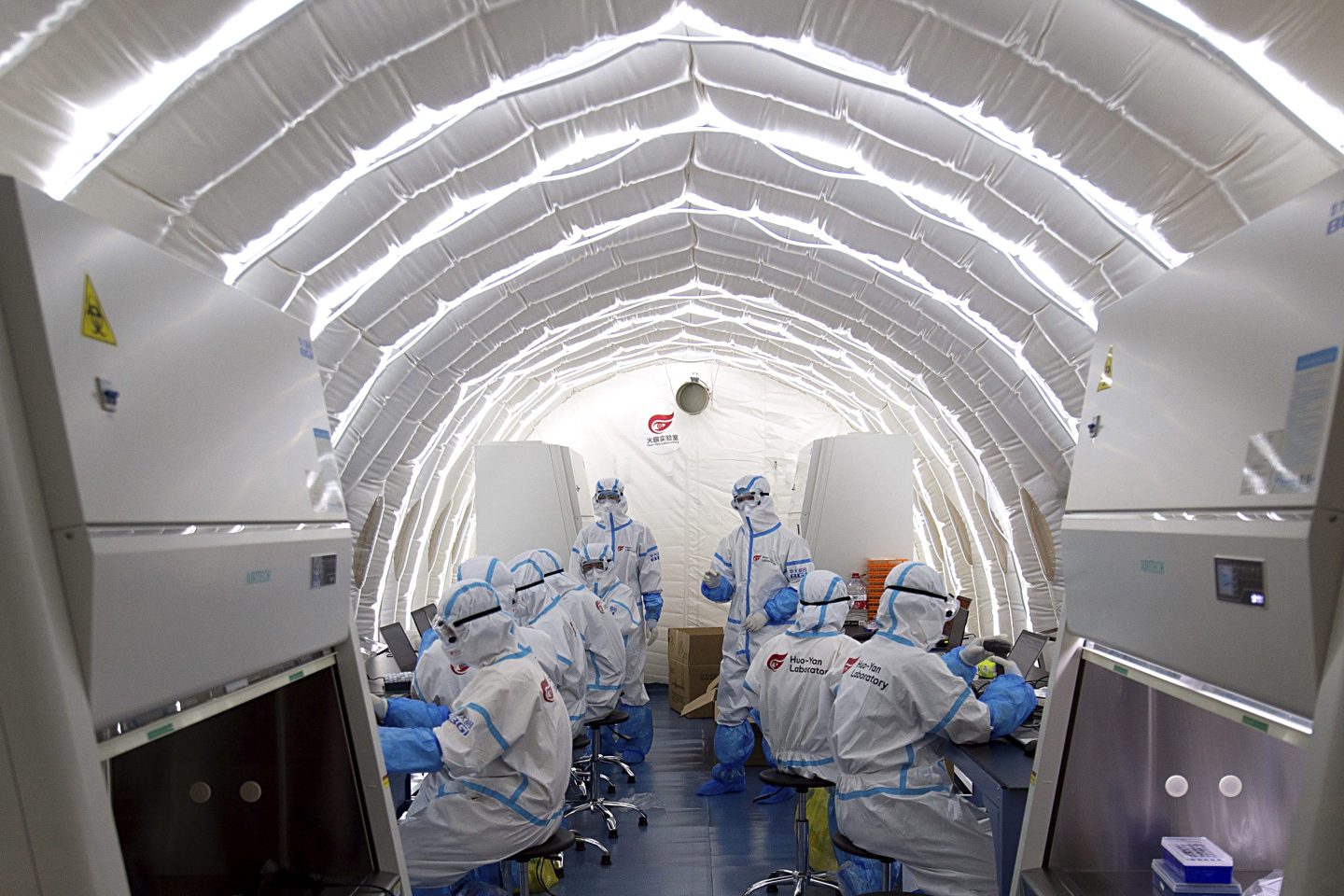
BGI, which has stressed its private ownership, offers genetic testing kits and a popular prenatal screening test to detect Down syndrome and other conditions. U.S. lawmakers say they are concerned such data could end up in the hands of the Chinese government.
The Defense Department has listed BGI as a Chinese military company, and the Commerce Department has blacklisted it on human rights grounds, citing a risk that BGI technology might have contributed to surveillance. BGI has rejected the allegations.
In raising its concerns about BGI, the National Security Commission on Emerging Biotechnology says the company is required to share data with the Chinese government, has partnered with the Chinese military, and has received considerable Chinese state funding and support.
State subsidies have allowed BGI to offer genomic sequencing services at a highly competitive price that is attractive to U.S. researchers, according to the commission. The genomic data, once in the hands of the Chinese government, “represents a strategic asset that has privacy, security, economic, and ethical implications,” it said.
BGI could not immediately be reached for comment.
Also named in the bills is WuXi AppTec, a Chinese pharmaceutical and medical device company. The legislation states that the company presents a national security threat because of its ties to the Chinese military and its involvement in a Chinese plan to develop technologies for both civilian and military use.
WuXi AppTec said in a statement that it abides by the laws in the countries where it operates and does not pose a security risk to any country. “In fact, we serve as a valued contributor to the global pharmaceutical and life sciences industries,” the company said in a statement.