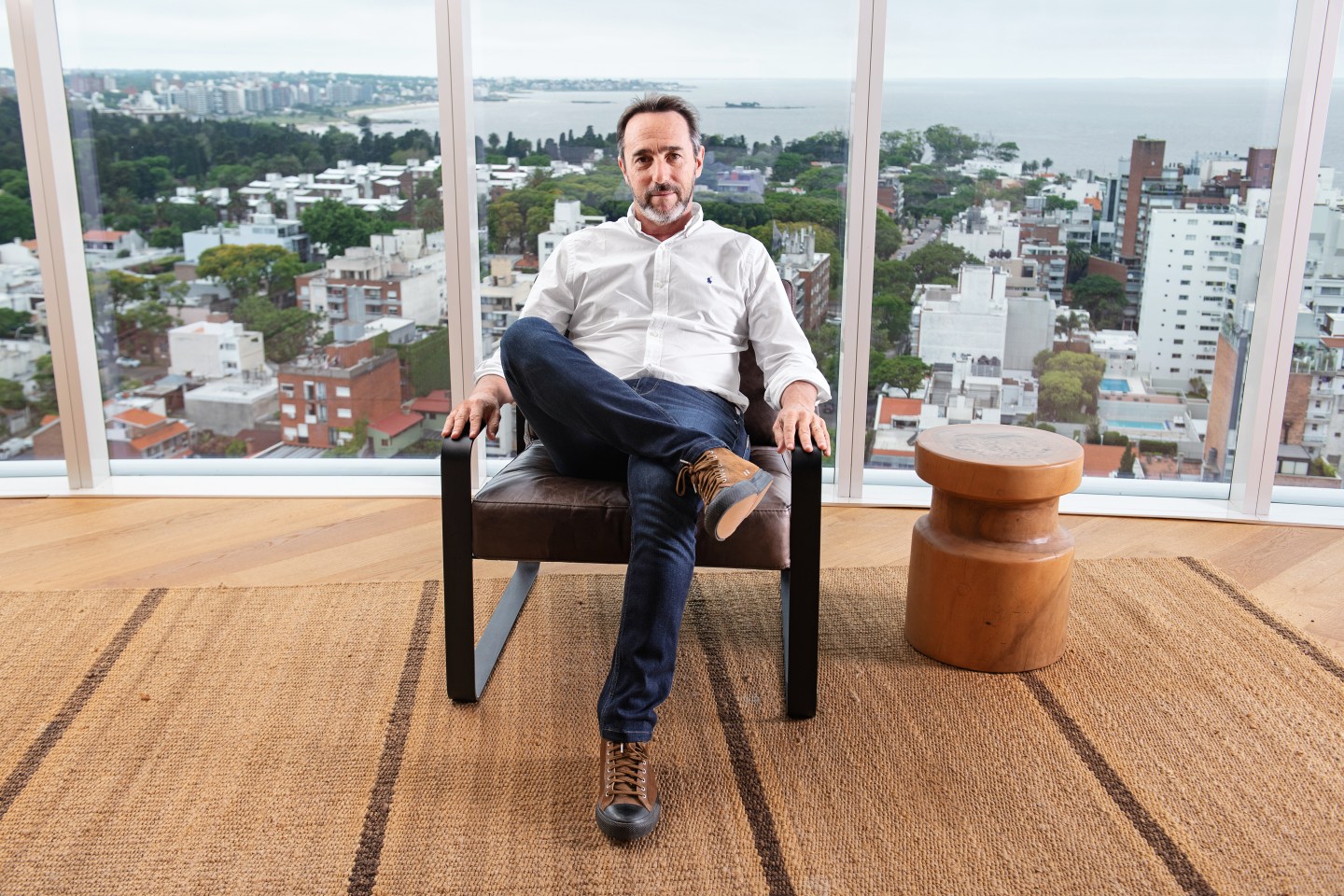
When Marcos Galperin started online marketplace MercadoLibre in a parking garage, he wasn’t trying to evoke the origin stories of U.S. tech companies like Hewlett-Packard and Apple. In Buenos Aires in 1999, the garage of his father’s leather company was just the best option for fast broadband internet. “It was a building with terrible offices, but at least we had good connectivity,” he says.
But like his Big Tech brethren, Galperin spun gold from the dingiest of spaces. Today, Galperin is one of the wealthiest men in Latin America, with an estimated net worth of over $7 billion thanks to MercadoLibre’s astronomical growth. The company, now based in Uruguay, started as a clone of eBay but today is known as the Amazon of Latin America. The e-commerce site sold over $11 billion in goods in the third quarter of 2023, a nearly 60% increase year over year.
MercadoLibre’s marketplace resembles Amazon, selling goods from electronics to supermarket basics with the promise of 24-hour delivery, but it would be a disservice to paint Galperin as a Jeff Bezos imitator. He has combined MercadoLibre’s e-commerce prowess with payment tools to usher regional shopping into the digital age. By adapting to the complex challenges of Latin America and reinventing MercadoLibre over the course of 25 years, Galperin created a tech company with a market cap of nearly $85 billion, second only to Brazil’s state-owned energy giant Petrobras in Latin America. Its regional dominance has little parallel in the rest of the world.
As U.S. and Asian competitors vie for Latin America’s red-hot e-commerce market, and regional politics poses risks to its business, Galperin keeps pushing MercadoLibre into new sectors, from mutual funds to crypto. “We’re always paranoid,” he says. “We don’t think it’s game over by any means.”
Galperin, 52, came of age in an Argentina that bears little resemblance to the country that today is suffering from skyrocketing inflation. The relative stability of the 1990s and his family’s flourishing leather company gave Galperin the opportunity to attend the University of Pennsylvania. He enrolled at Stanford Business School in 1997.
Over a video call from his office in Uruguay, Galperin, who has salt-and-pepper hair and a quiet affect, recalls how he marveled over the digital advances of U.S. tech companies as a student in Palo Alto. Sites like eBay were converting droves of new online shoppers. Galperin even sold his Volkswagen Golf via an early online classified ad. “I was very enthusiastic about what I thought the internet was going to do to the world,” he says. “And I was very frustrated because I had to come back to Latin America, and there was nothing.”
Galperin was convinced that an eBay-type platform would explode in Latin America, where problems with retail ran deeper than a lack of web applications. Brick-and-mortar retail was available only in major urban areas, with more rural regions cut off from shopping. “People would rather live in a slum next to a big city than live in better conditions in the countryside,” Galperin says. “So I was convinced this was going to work really, really well in Latin America.”
“I was very enthusiastic about what I thought the internet was going to do to the world.”
Marcos Galperin, CEO, MercadoLibre
Back in Argentina, Galperin and his early team erected makeshift cubicles in the parking garage. From the windowless space they conceived of MercadoLibre. (The building eventually kicked them out for violating safety codes.) Galperin had been inspired by eBay—and in fact, eBay was an early investor in MercadoLibre—but early on he abandoned its auction model; he wanted to build a platform that people came to for everyday shopping, not just the thrill of a ticking clock. MercadoLibre launched its marketplace that connects buyers with third-party sellers in 1999, a year before Amazon.
MercadoLibre expanded to Brazil and Mexico in its first year. By the time it went public in 2007, it had earned its “Amazon of Latin America” moniker, but its annual revenue remained low, crossing $100 million in 2008 and $1 billion in 2017. The pandemic accelerated growth, and revenue topped $10 billion in 2022.
Galperin doesn’t mind the association with—or attention from—U.S. counterparts. He claims eBay came close to buying MercadoLibre several times, most recently in the 2010s. (eBay did not return a request for comment.) He says he admires Amazon’s long-term vision, but Galperin set MercadoLibre on a different path as it navigated Latin America’s logistical snarls. “MercadoLibre is not really the copy of Amazon in Latin America,” says Guillermo Ochovo, director at consulting firm Cargo Facts. “They’ve been doing their own thing.”
While Amazon established a second business out of cloud-hosting, MercadoLibre expanded into payments, more out of necessity than diversification. In Mexico, one of MercadoLibre’s main markets, less than 25% of the urban population held a savings account in 2000. Sales that MercadoLibre facilitated between vendors and buyers often took place in person and in cash, with no way for MercadoLibre to verify transactions to earn its cut. “We were at the mercy of whatever the sellers claimed had happened,” Galperin says.
So in 2003 MercadoLibre launched Mercado Pago, a payments system that let users load their balances with cash. Later it added features like a point-of-sale system and QR code payments that could be used outside its marketplace. Merchants—from storefronts to food stalls—could accept payments via Mercado Pago. The innovations fueled adoption of online financial tools. In the first three quarters of 2023, Mercado Pago reported 167 million active users and processed over 6.5 billion transactions.
“People that have traditionally been unbanked are not willing to walk into a bank branch,” says Galperin. “They feel that it’s not for them and they will be laughed out of the place.”
In 2017, the company expanded into the credit business, offering financing to customers and merchants to make purchases, build out their businesses, and even pay taxes. In the third quarter of 2023, fintech accounted for over 43% of MercadoLibre’s revenue of $3.8 billion. “MercadoLibre is really a payments company,” says Juozas Kaziukenas, founder of business intelligence firm Marketplace Pulse.
MercadoLibre also set itself apart by partnering with local companies to adapt to the logistical challenges of countries in the region. In Brazil, the largest market in Latin America, e-commerce companies struggled with deliveries, since homes there might not have addresses or may be in dangerous areas. Through logistics company Kangu, MercadoLibre connected sellers to local shops that served as delivery points. MercadoLibre acquired Kangu in 2021.
MercadoLibre has also benefited from “being a company of Latin America, from Latin America, and for Latin America,” says Matteo Ceurvels, principal Latin America analyst for eMarketer. MercadoLibre went as far as to change its name in Brazil to MercadoLivre, Portuguese for “free market.” Amazon, meanwhile, struggled to properly translate its website when it launched there, says Ochovo. (Amazon didn’t return a request for comment.) In 2022, MercadoLibre accounted for 34% of online sales in Brazil—nearly the same share as its two largest competitors combined.
“MercadoLibre is not really the copy of Amazon in Latin America. They’ve been doing their own thing.”
Guillermo Ochovo, Director, Cargo Facts
Asian e-commerce companies like Temu, Shein, and Shopee may pose a greater threat to MercadoLibre than Amazon ever did, with their gamified shopping and low-priced inventory. MercadoLibre has responded in a few ways; it launched a short video platform called Clips in 2023 that mirrors its Asian rivals. But so far the new competition hasn’t made much of a dent in MercadoLibre’s business, Ochovo says. The upstarts are still struggling to figure out the particularities of different Latin American markets. After a much-hyped expansion, Shopee closed operations in four countries in 2022.
For now, Galperin remains focused on payments. In response to Argentina’s economic turmoil, he wants to create hedges against inflation that reached 185% in 2023. In 2018, MercadoLibre started offering Argentine customers the option to invest in mutual funds. By late last year, 12 million users—equal to 25% of the nation’s population—used the feature, MercadoLibre says. Starting in 2022, it added a tool to buy and sell cryptocurrencies, including U.S.-dollar-backed stablecoins. (Argentina’s Central Bank banned the feature, but it’s available in other markets.)
Among MercadoLibre’s largest markets, Argentina is a distant second to Brazil, but it remains Galperin’s spiritual, if not physical, home. And the country represents how the region’s economic and political uncertainty poses a perpetual threat to its business.
Galperin has long clashed with Argentina’s presidential administrations and has resided across the La Plata River in Uruguay for years. He returned under center-right Mauricio Macri, but in 2020 resigned as president of MercadoLibre’s Argentina unit after a federal prosecutor accused Galperin and his board of fraud and insider trading. Galperin denied the charges but left the country again. The case has been dropped.
Argentina stunned the world in November by electing as president the self-proclaimed “anarcho-capitalist” Javier Milei, who has vowed to impose a bruising austerity campaign. Galperin is cautiously optimistic about the firebrand: “I’m enthusiastic about the ideas he advocates.”
Galperin recognizes that Milei’s economic policies are causing the prices of everyday items like diapers and beef to soar. The whiplash is challenging MercadoLibre’s operations, but he says he’s accustomed to volatility. After all, the company has operated in Venezuela since 2005.
Galperin says that the possibility of punishing days ahead evokes his early vision for MercadoLibre—to serve customers living on informal salaries or without ready access to goods. “What we do, at the end of the day, helps the weakest people in Latin America,” he says. “I worry more about the country than I worry about the company.”
This article appears in the February/March 2024 issue of Fortune with the headline, “In focus: Marcos Galperin.”