• Home
  • Latest
  • Fortune 500
  • Finance
  • Tech
  • Leadership
  • Lifestyle
  • Rankings
  • Multimedia
Environmentpoultry

Chicken prices to finally fall thanks to boom in renewable fuel: ‘A tailwind for the protein industry’

By
Gerson Freitas Jr.
Gerson Freitas Jr.
,
Tarso Veloso
Tarso Veloso
,
Isis Almeida
Isis Almeida
and
Bloomberg
Bloomberg
Down Arrow Button Icon
By
Gerson Freitas Jr.
Gerson Freitas Jr.
,
Tarso Veloso
Tarso Veloso
,
Isis Almeida
Isis Almeida
and
Bloomberg
Bloomberg
Down Arrow Button Icon
January 28, 2024, 4:21 PM ET
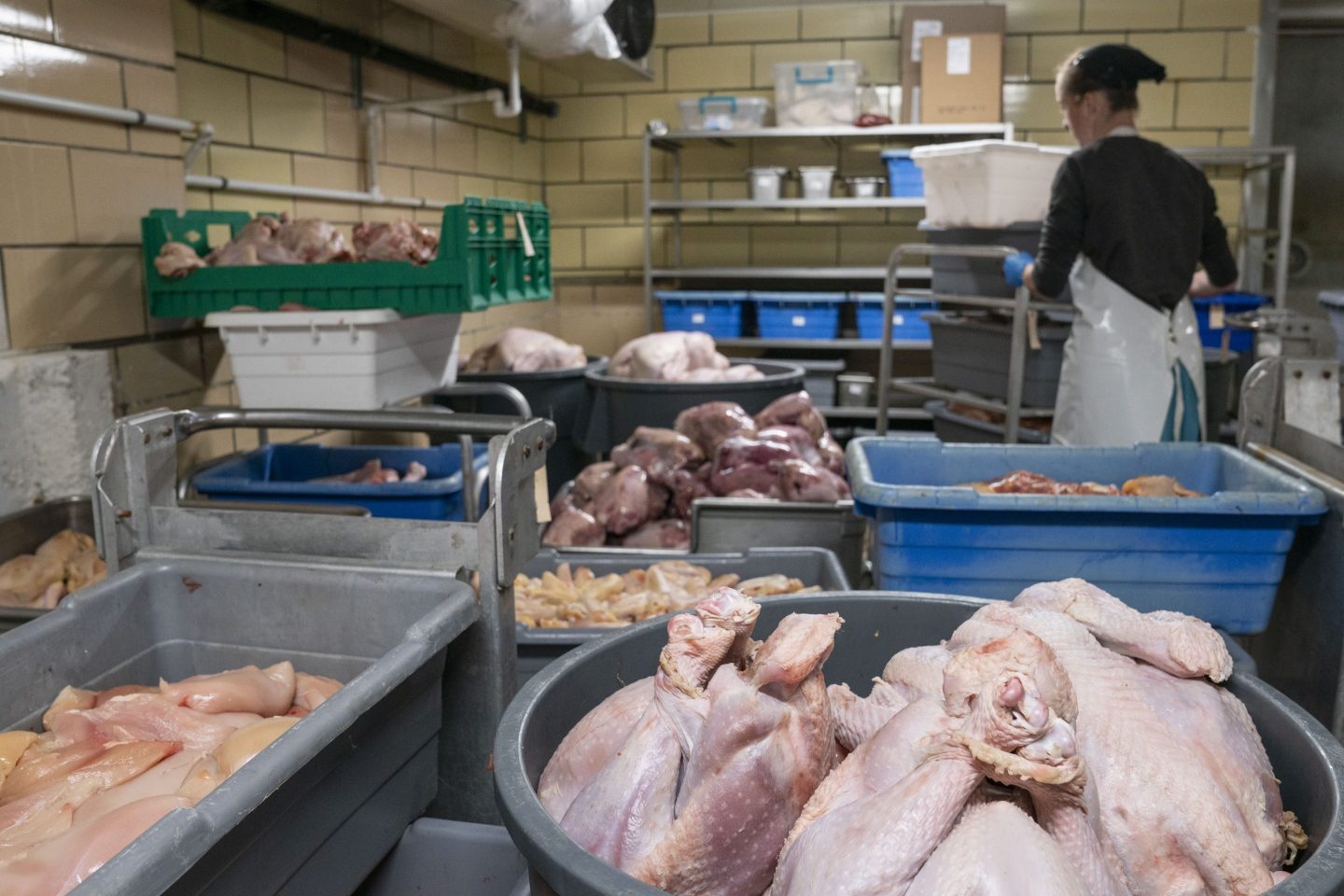
Poultry sits in bins at the Pleasant Valley Poultry processing facility in Baltic, Ohio.
Poultry sits in bins at the Pleasant Valley Poultry processing facility in Baltic, Ohio. Dane Rhys/Bloomberg via Getty Images

After years of butcher-counter sticker shock, Americans are likely to see a drop in meat prices thanks to an unlikely ally: the emerging renewable fuel industry.

Processing the vast amounts of soybeans needed to make the plant-based jet fuel and diesel required to lower US emissions will also create mountains of co-product soymeal, widely used in animal feed. The less expensive it is for meatpackers to feed their animals, the more meat they’ll produce, ultimately trickling down to lower prices at the grocery store.

“Meal is going to be priced to disappear and go away,” said Gordon Denny, an agricultural consultant and former procurement director at crop giant Bunge Global SA. As a result, “protein in all forms will get a little less expensive.”

It will undoubtedly take months or even years for the cost savings to work their way down the supply chain. Still, any drop in meat costs will bring welcome relief to inflation-fatigued households. Although the consumer price index for core goods, which excludes energy and food, ended 2023 at the weakest pace in more than two years, the prices of some basic grocery items have been sticky.

Meat inflation has been particularly stubborn. Retail chicken breast prices, which averaged less than $3 a pound in March 2020, soared to $4.75 a pound in September 2022. Prices have since inched back to earth but are still elevated, US Department of Agriculture data show. With Americans eating around 100 pounds of chicken a year, the price hikes are hard to ignore. Lower-income consumers are more likely to trade down or walk away from high-priced meat versus groceries overall, said Sofia Baig, an economist at market research company Morning Consult.

To be sure, meat prices are also influenced by a number of other factors including the availability of corn — the other key feed component — as well as labor, logistical disruptions, animal disease outbreaks and consumer demand. More than half the cost of meat on the grocery store shelf occurs after the animal has left the farm, said Chad Hart, professor of economics at Iowa State University.

Companies including Archer-Daniels-Midland Co. and Bunge are racing to expand soybean processing capacity, but it will take some plants years to reach full capacity. Even once the increased supply of meal hits the market, the lower feed costs won’t translate to smaller grocery bills immediately.

“It’s still going to take them a while to work that through the cost of goods to what the consumer sees or even to the wholesale channel,” said Brian Earnest, lead protein industry analyst at CoBank. When the lower prices start showing up, they’re likely to arrive in the form of sales, like buy one, get one offers. “That promotional activity is going to ramp up here this year.”

The lower input costs will also be good news for meatpackers, who’ve seen a sharp drop in their margins. Although many meat companies raked in the profits during the pandemic as Americans working from home bought more food, the sector has since been slammed by a supply glut and high feed costs. US meat giant Tyson Foods Inc. has logged multiple quarters of negative operating margins for both its pork and chicken divisions and announced last year the shutdown of several chicken plants to help rein in costs. Federal probes into price-fixing and labor practices in the wider US chicken industry have only added to the sector’s headaches.

The broiler chicken industry will be able to capitalize on the lower feed costs before pork, given the shorter cycle of production. Beef prices are unlikely to be directly impacted, since cows aren’t generally fed soymeal, though lower prices for chicken and pork may eventually bring down beef, too, due to competition between the meats.

Feed costs — including soymeal and corn — make up roughly 60% of the expense of raising birds and hogs. Unlike producing ethanol from corn, which leaves much less byproduct meal, processing soybeans creates four tons of soymeal for every one ton of oil. And the country is going to be needing a whole lot of that oil. S&P Global sees domestic demand for renewable diesel reaching 4 billion gallons in 2030, up from around 2.7 billion last year.

As a result, the US will find itself with roughly 30% more US soybean meal production capacity in 2026 compared with 2022 levels, “which is quite bearish for soymeal,” Stephens Inc. analyst Ben Bienvenu said. Cheaper forward contracts indicate meal prices will trend lower through at least 2027.

“Refiners are going to be running for oil, and there’ll be that derivative meal,” said Hans Kabat, who runs the North American protein business for Cargill Inc., the co-owner of the country’s third-largest poultry producer. “That is a tailwind for the protein industry.”

Some of that extra soymeal will also be consumed abroad, as will any surplus meat produced as companies enjoying the lower feed costs ramp up output.

“We’re going to expand our pork and poultry industry and that’s what we’re going to export,” said Gregg Doud, former chief agriculture negotiator in the Office of US Trade Representative under the Donald Trump administration. “We’re going up the value chains.”

— With assistance from Deena Shanker and Augusta Saraiva

    Join us at the Fortune Workplace Innovation Summit May 19–20, 2026, in Atlanta. The next era of workplace innovation is here—and the old playbook is being rewritten. At this exclusive, high-energy event, the world’s most innovative leaders will convene to explore how AI, humanity, and strategy converge to redefine, again, the future of work. Register now.
    About the Authors
    By Gerson Freitas Jr.
    See full bioRight Arrow Button Icon
    By Tarso Veloso
    See full bioRight Arrow Button Icon
    By Isis Almeida
    See full bioRight Arrow Button Icon
    By Bloomberg
    See full bioRight Arrow Button Icon

    Latest in Environment

    North AmericaMexico
    U.S., Mexico strike deal to settle Rio Grande water dispute
    By Fabiola Zerpa and BloombergDecember 13, 2025
    10 hours ago
    carbon
    Commentaryclimate change
    Banking on carbon markets 2.0: why financial institutions should engage with carbon credits
    By Usha Rao-MonariDecember 13, 2025
    21 hours ago
    mackenzie
    Personal Financephilanthropy
    ‘This year, I really see education and climate’: Patterns in billionaire MacKenzie Scott’s massive giving emerge with time
    By Thalia Beaty and The Associated PressDecember 11, 2025
    3 days ago
    Google DeepMind cofounder and CEO Demis Hassabis
    AIU.K.
    Google DeepMind agrees to sweeping partnership with U.K. government focused on science and clean energy
    By Jeremy KahnDecember 10, 2025
    3 days ago
    InnovationBrainstorm AI
    Rivian CEO says buying an EV isn’t a political choice, pointing out that R1 buyers are split evenly between Republicans and Democrats
    By Jason MaDecember 10, 2025
    4 days ago
    AIBrainstorm AI
    Google Cloud CEO lays out 3-part strategy to meet AI’s energy demands, after identifying it as ‘the most problematic thing’
    By Jason MaDecember 8, 2025
    5 days ago

    Most Popular

    placeholder alt text
    Success
    Apple cofounder Ronald Wayne sold his 10% stake for $800 in 1976—today it’d be worth up to $400 billion
    By Preston ForeDecember 12, 2025
    2 days ago
    placeholder alt text
    Economy
    Tariffs are taxes and they were used to finance the federal government until the 1913 income tax. A top economist breaks it down
    By Kent JonesDecember 12, 2025
    2 days ago
    placeholder alt text
    Success
    40% of Stanford undergrads receive disability accommodations—but it’s become a college-wide phenomenon as Gen Z try to succeed in the current climate
    By Preston ForeDecember 12, 2025
    2 days ago
    placeholder alt text
    Economy
    The Fed just ‘Trump-proofed’ itself with a unanimous move to preempt a potential leadership shake-up
    By Jason MaDecember 12, 2025
    2 days ago
    placeholder alt text
    Success
    Apple CEO Tim Cook out-earns the average American’s salary in just 7 hours—to put that into context, he could buy a new $439,000 home in just 2 days
    By Emma BurleighDecember 12, 2025
    2 days ago
    placeholder alt text
    Economy
    For the first time since Trump’s tariff rollout, import tax revenue has fallen, threatening his lofty plans to slash the $38 trillion national debt
    By Sasha RogelbergDecember 12, 2025
    2 days ago
    Rankings
    • 100 Best Companies
    • Fortune 500
    • Global 500
    • Fortune 500 Europe
    • Most Powerful Women
    • Future 50
    • World’s Most Admired Companies
    • See All Rankings
    Sections
    • Finance
    • Leadership
    • Success
    • Tech
    • Asia
    • Europe
    • Environment
    • Fortune Crypto
    • Health
    • Retail
    • Lifestyle
    • Politics
    • Newsletters
    • Magazine
    • Features
    • Commentary
    • Mpw
    • CEO Initiative
    • Conferences
    • Personal Finance
    • Education
    Customer Support
    • Frequently Asked Questions
    • Customer Service Portal
    • Privacy Policy
    • Terms Of Use
    • Single Issues For Purchase
    • International Print
    Commercial Services
    • Advertising
    • Fortune Brand Studio
    • Fortune Analytics
    • Fortune Conferences
    • Business Development
    About Us
    • About Us
    • Editorial Calendar
    • Press Center
    • Work At Fortune
    • Diversity And Inclusion
    • Terms And Conditions
    • Site Map

    © 2025 Fortune Media IP Limited. All Rights Reserved. Use of this site constitutes acceptance of our Terms of Use and Privacy Policy | CA Notice at Collection and Privacy Notice | Do Not Sell/Share My Personal Information
    FORTUNE is a trademark of Fortune Media IP Limited, registered in the U.S. and other countries. FORTUNE may receive compensation for some links to products and services on this website. Offers may be subject to change without notice.