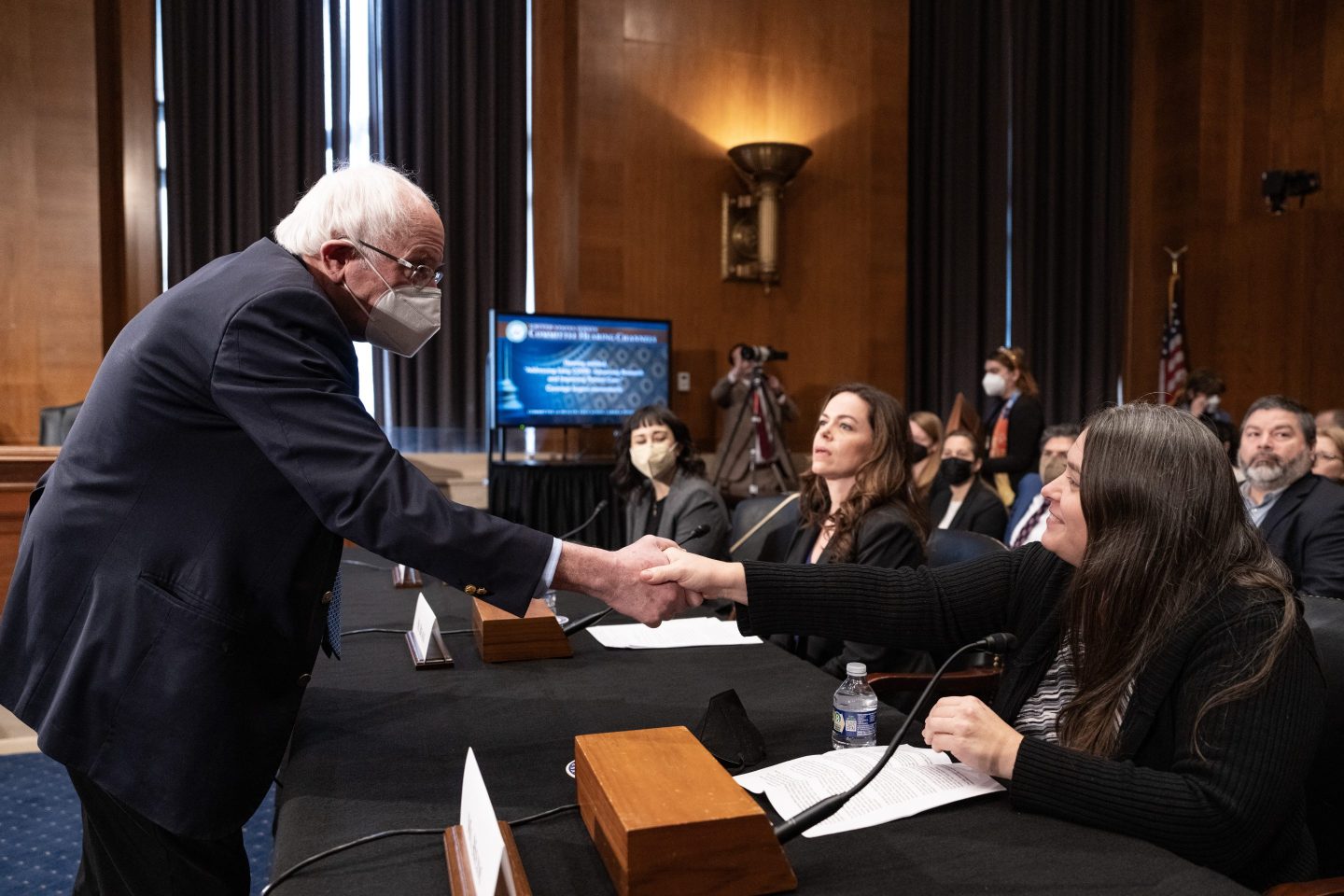
Appearing before a key U.S. Senate committee on Jan. 18, one of the world’s foremost authorities on long COVID-19 laid it on the line. “We developed vaccines at warp speed,” said Dr. Ziyad Al-Aly, a clinical epidemiologist at Washington University in St. Louis. “We are doing trials for long COVID at snail speed.”
These were strong words, backed by statistics and set against the backdrop of a feeble first swipe at long COVID by the National Institutes of Health that has been widely viewed as a disastrous squander of time and money. But the issue is too serious to spend much time looking for scapegoats.
Based on data collected in 2022, an estimated 18 million people in the U.S. and 65 million worldwide have been hit with the debilitating effects of long COVID, and that count is almost certainly rising. In his Congressional testimony, Al-Aly said the U.S. number alone was at least 20 million.
The burden of long COVID
“It affects people across the lifespan, from children to older adults, and across demographic groups,” Al-Aly told the Committee on Health, Education, Labor and Pensions (HELP). Further, he said, “The burden of long COVID, the burden of disease and disability when you measure it, is on par with the burden of cancer and heart disease.”
On par with cancer–and yet the U.S. still does not have a single FDA-approved medication for treating long COVID. “This must change,” Al-Aly told HELP committee chair Sen. Bernie Sanders (I-Vt.) and the rest of the panel.
A few days later, I asked the epidemiologist about his experience on Capitol Hill, which he called historic for the long COVID movement. “I was not nervous at all,” Al-Aly replied. “I spoke truth to power and called for action.”
Is anybody listening?
The one-day hearing in Washington, D.C., was in some ways a microcosm of the struggle to get leaders focused on long COVID in the same way they once were on the disease itself. Among other things, this marked the first hearing on long COVID since the start of the pandemic, even though people have been reporting their inability to recover from the virus since the spring of 2020.
A study last year led by Al-Aly found that the physical fallout from long COVID can last at least two years, and the Congressional testimony of some of those who’ve suffered from it or cared for relatives was wrenching. “Long COVID stripped away my daughter’s life as she knew it,” said Nicole Heim, the mother of a 16-year-old in Virginia who contracted the virus when she was 14. Once a straight-A honor student, the girl now is isolated at home, working slowly toward a GED.
This was a hearing conducted and led by some senators with real knowledge of long COVID and its effects, from brain fog and fatigue to long-term damage to the body’s organs and processes. Sen. Tim Kaine (D-Va.) said he has been dealing with the medical fallout of his own case “for almost four years,” while Sen. Roger Marshall (R-Kan.) noted the “dozens of doctors” a family member has visited while trying to get care, and the frustration of so many unanswered questions.
It all matters. But only resources and commitment will actually move the needle–and there’s a strong argument to be made for the government to provide the funding and then mostly get out of the way so that experts can guide the work that needs to be done. And we need to listen to the lived experiences of those who have been battling long COVID for years, as well as patient advocacy groups who’ve sounded the alarm on this issue for almost as long.
The government’s glacial pace
The fast-tracking of COVID vaccines in 2020 was an admirable exception to the government’s normal glacial pace, but it’s important to remember that those vaccines were significantly the product of work that was already being done. That advance research accelerated the timeline for getting COVID vaccines into the clinical trial stage.
With long COVID, the government has already burned through about $1.15 billion with little to show. As STAT reported, by last year the NIH (through its RECOVER initiative) had not signed up a single person to test potential treatments. Instead, critics say, the agency spent most of the money on observational studies that reached the same conclusions that were already widely known within the long COVID research community.
“We need multidisciplinary clinics with teams of sub-specialists and healthcare providers together to address the myriad of symptoms (and) complexes that these patients face,” Michelle Harkins, the chief of pulmonary and critical care medicine and a COVID researcher at the University of New Mexico, told the HELP committee.
That is where the long COVID story needs to go. Much of medical research isn’t possible without government funding, certainly. But within that framework, the NIH can perhaps be most useful as the umbrella under which a separate institute on infection-associated chronic illness could flourish.
What trials have so far been put into study “are too small and too slow to yield definitive answers,” Al-Aly told me. “They are underpowered to yield anything of consequence.” What is needed, he says, is a set of mega-platform trials to test 50 or 100 out of thousands of possible therapeutic drugs, possibly identified through AI screening, for efficacy against long COVID.
And, of course, the development of long COVID is the byproduct of infection (or reinfection) by the virus itself. As Al-Aly succinctly explained to the Committee, “The best way to prevent long COVID is to prevent COVID.”
It’s not beyond the prowess of American medicine
Almost incomprehensibly, and despite repeated warnings by experts, the U.S. at its governmental levels has largely attempted to treat the virus as a thing of the past. Yet, according to some experts and wastewater data, the U.S. is in its second-largest surge since the pandemic began.
The rise of COVID cases in the Americas and elsewhere has done little to drive higher rates of vaccination. Meanwhile, California, a state that aggressively fought the spread of disease during the pandemic’s early stages, recently shortened the isolation period of a COVID-positive person to a single day from the previous recommendation of five days.
The clear implication of all this is that we are somehow easing out of the COVID era. As millions of Americans suffering with long COVID can attest, that is not at all the case. Only a full-scale attempt to find clinical treatments for the disease, along with a continuing effort to prevent the spread of the virus in the first place, will provide the pushback that’s needed to control it.
Governments absolutely can play a role, particularly in areas such as conducting wastewater analysis and surveillance testing, updating building codes to require better ventilation and filtration, and accelerating the development of variant-proof and more durable vaccines. Tried and true approaches that limit transmission like masking should be seriously considered in high-risk settings, including healthcare and long-term care facilities. Public agencies can also facilitate mass distribution of free COVID-19 tests, better educate the public about post-COVID conditions and the risks of reinfection, and work to make more people aware that access to vaccines is widely available.
“It’s not beyond the might and the prowess of American medicine to solve this problem. We’ve solved much, much harder problems in the past,” Al-Aly told the senators.
Clearly, the first order of action is to make up lost ground. It’s time to let the long COVID experts, including those living with the disease, lead the charge.
Carolyn Barber, M.D., is an internationally published science and medical writer and a 25-year emergency physician. She is the author of the book Runaway Medicine: What You Don’t Know May Kill You, and the co-founder of the California-based homeless work program Wheels of Change.
More must-read commentary published by Fortune:
- Economic pessimists’ bet on a 2023 recession failed. Why are they doubling down in 2024?
- ‘Parroting Putin’s propaganda’: The business exodus over Ukraine was no Russian bonanza
- WEF president: ‘It’s time to revitalize trade—and reverse the trend of Slowbalization’
- The anti-DEI movement has gone from fringe to mainstream. Here’s what that means for corporate America
The opinions expressed in Fortune.com commentary pieces are solely the views of their authors and do not necessarily reflect the opinions and beliefs of Fortune.