• Home
  • News
  • Fortune 500
  • Tech
  • Finance
  • Leadership
  • Lifestyle
  • Rankings
  • Multimedia
CommentaryReal Estate

WeWork’s co-working model was supposed to fix traditional commercial real estate–but both the new idea and the centuries-old industry are failing

By
Christelle Rohaut
Christelle Rohaut
Down Arrow Button Icon
By
Christelle Rohaut
Christelle Rohaut
Down Arrow Button Icon
December 19, 2023, 11:24 AM ET
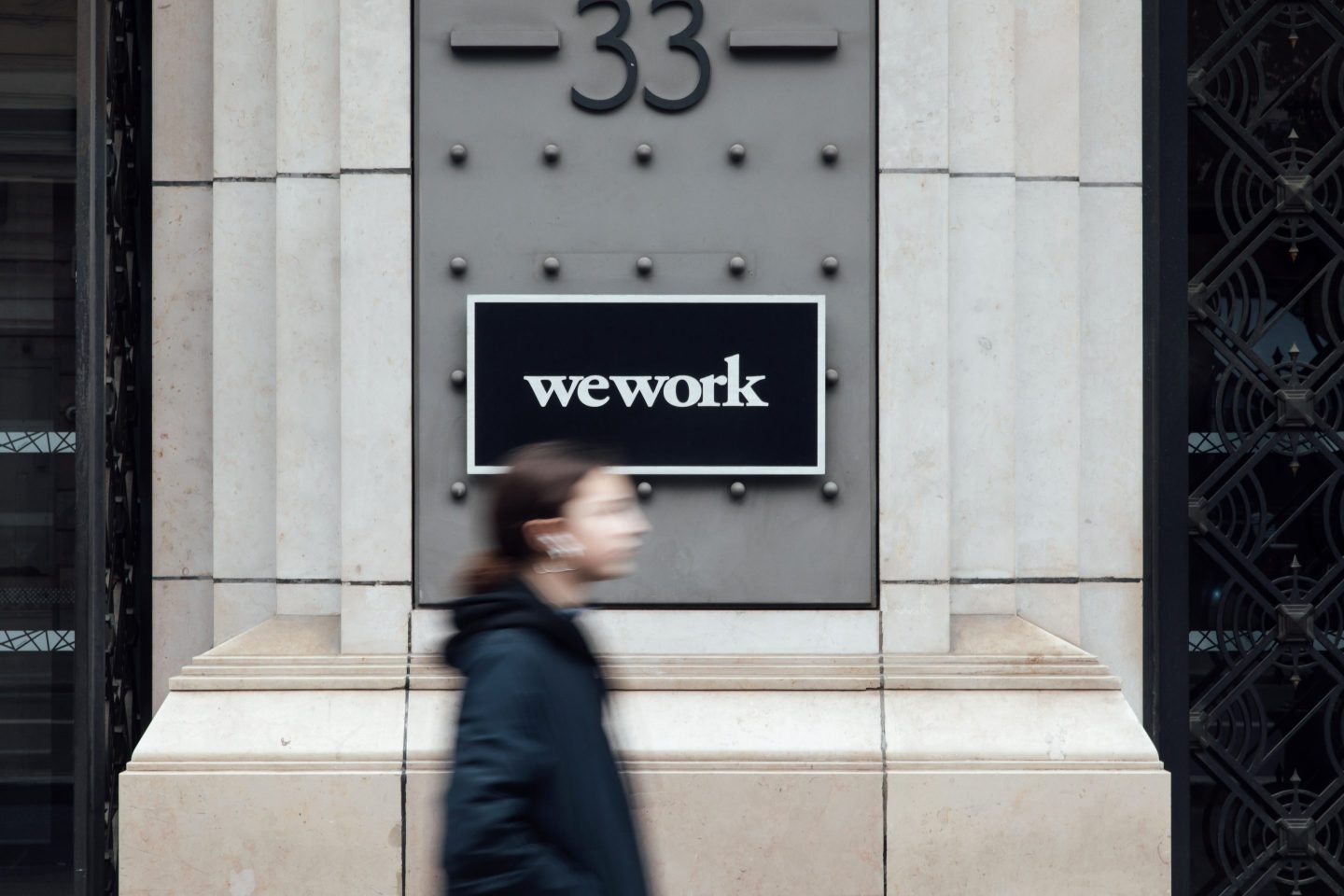
Once valued at $47 billion, WeWork filed for Chapter 11 bankruptcy on Nov. 6.
Once valued at $47 billion, WeWork filed for Chapter 11 bankruptcy on Nov. 6.Cyril Marcilhacy - Bloomberg - Getty Images

While WeWork’s catastrophic fall from grace may have poor business management written all over it, the latest bankruptcy filing represents an indictment of the coworking business model as a whole. 

The idea of co-working is more relevant today than ever before as flexible work has cemented its position globally. The future of five-days-a-week, in-person work remains debatable–and companies across the country have maintained hybrid work options post-pandemic. This year, 73% of American workers reported working in-office for three or more days a week, with an average of three to four days in-person, according to a McKinsey study. Fully remote employees now only represent 15% of the workforce, a strong indication that hybrid work, while previously dubbed the “new normal,” is here to stay. 

WeWork’s inability to take advantage of the paradigm shift in commercial real estate is due to the fact that WeWork’s innovative brand was built on the same traditional terms that commercial real estate has used for centuries. The co-working business model takes on long-term leases at a locked-in rate, placing a huge bet on occupancy rates and rents staying high. This leaves a huge risk imbalance in the committed term lengths between landlords and occupants. As disclosed in WeWork’s infamous S-1 filing in 2019, its average lease term is approximately 15 years. This leaves the company offering clients flexible lease terms, while they remain committed across interest rate cycles and market downturns.

When rates are low, and companies aren’t rigorous about burn, coworking has product-market fit. When rates are high and wallets are tight, the results can be catastrophic, as evidenced by WeWork’s latest bankruptcy–and that’s regardless of the demand for flexible working environments. 

As soon as office spaces are not filled, it’s the coworking platforms that lose money, not the landlords. As of Q3 2023, over 20% of American commercial real estate space remained empty, according to JLL. This has created an existential crisis for firms like WeWork, who are struggling to grapple with an outdated model that has provided a valuable product for consumers, but has failed in changing the status quo with landlords. 

It’s time that we embrace the fact that coworking, while billed as an inventive means to insert energy and collaboration into the workplace, is built on the foundation of the same age-old model that it claims to transform. 

Coworkers crave building culture and feeling a sense of belonging to their company, which requires privacy instead of a shared floor with outside distractions. Existing research has proved that over 52% of employees prefer private offices over open floor plans, which is a foundational aspect of the coworking model. These employees seek in-person work to feel connected to their company’s mission and culture, not to be a part of WeWork’s culture.

In today’s flexible office environment, employees are encouraged to reap the benefits of the workspace by being able to interact closely with their counterparts. If these interactions are becoming less meaningful by participating in coworking, then the model’s key value proposition is at best, failing to address the needs of a substantial segment of its customer base. 

In many ways, WeWork’s collapse is just the tip of the iceberg for a model that failed to live up to its expectations. While the workplace question is clearly a topic that will continue to be iterated on in the coming years, it’s time that we accept that co-working is not the answer.

Christelle Rohaut is the co-founder and CEO of Codi.

More must-read commentary published by Fortune:

  • Economic pessimists’ bet on a 2023 recession failed. Why are they doubling down in 2024?
  • COVID-19 v. Flu: A ‘much more serious threat,’ new study into long-term risks concludes
  • Access to modern stoves could be a game-changer for Africa’s economic development–and help cut the equivalent of the carbon dioxide emitted by the world’s planes and ships
  • The U.S.-led digital trade world order is under attack–by the U.S.

The opinions expressed in Fortune.com commentary pieces are solely the views of their authors and do not necessarily reflect the opinions and beliefs of Fortune.

Fortune Brainstorm AI returns to San Francisco Dec. 8–9 to convene the smartest people we know—technologists, entrepreneurs, Fortune Global 500 executives, investors, policymakers, and the brilliant minds in between—to explore and interrogate the most pressing questions about AI at another pivotal moment. Register here.
About the Author
By Christelle Rohaut
See full bioRight Arrow Button Icon

Latest in Commentary

Ayesha and Stephen Curry (L) and Arndrea Waters King and Martin Luther King III (R), who are behind Eat.Play.Learn and Realize the Dream, respectively.
Commentaryphilanthropy
Why time is becoming the new currency of giving
By Arndrea Waters King and Ayesha CurryDecember 2, 2025
21 hours ago
Trump
CommentaryTariffs and trade
The trade war was never going to fix our deficit
By Daniel BunnDecember 2, 2025
22 hours ago
Elizabeth Kelly
CommentaryNon-Profit
At Anthropic, we believe that AI can increase nonprofit capacity. And we’ve worked with over 100 organizations so far on getting it right
By Elizabeth KellyDecember 2, 2025
23 hours ago
Decapitation
CommentaryLeadership
Decapitated by activists: the collapse of CEO tenure and how to fight back
By Mark ThompsonDecember 2, 2025
23 hours ago
David Risher
Commentaryphilanthropy
Lyft CEO: This Giving Tuesday, I’m matching every rider’s donation
By David RisherDecember 1, 2025
2 days ago
college
CommentaryTech
Colleges risk getting it backwards on AI and they may be hurting Gen Z job searchers
By Sarah HoffmanDecember 1, 2025
2 days ago

Most Popular

placeholder alt text
Economy
Ford workers told their CEO 'none of the young people want to work here.' So Jim Farley took a page out of the founder's playbook
By Sasha RogelbergNovember 28, 2025
5 days ago
placeholder alt text
Success
Warren Buffett used to give his family $10,000 each at Christmas—but when he saw how fast they were spending it, he started buying them shares instead
By Eleanor PringleDecember 2, 2025
1 day ago
placeholder alt text
North America
Jeff Bezos and Lauren Sánchez Bezos commit $102.5 million to organizations combating homelessness across the U.S.: ‘This is just the beginning’
By Sydney LakeDecember 2, 2025
21 hours ago
placeholder alt text
Economy
Elon Musk says he warned Trump against tariffs, which U.S. manufacturers blame for a turn to more offshoring and diminishing American factory jobs
By Sasha RogelbergDecember 2, 2025
20 hours ago
placeholder alt text
C-Suite
MacKenzie Scott's $19 billion donations have turned philanthropy on its head—why her style of giving actually works
By Sydney LakeDecember 2, 2025
1 day ago
placeholder alt text
North America
Anonymous $50 million donation helps cover the next 50 years of tuition for medical lab science students at University of Washington
By The Associated PressDecember 2, 2025
23 hours ago
Rankings
  • 100 Best Companies
  • Fortune 500
  • Global 500
  • Fortune 500 Europe
  • Most Powerful Women
  • Future 50
  • World’s Most Admired Companies
  • See All Rankings
Sections
  • Finance
  • Leadership
  • Success
  • Tech
  • Asia
  • Europe
  • Environment
  • Fortune Crypto
  • Health
  • Retail
  • Lifestyle
  • Politics
  • Newsletters
  • Magazine
  • Features
  • Commentary
  • Mpw
  • CEO Initiative
  • Conferences
  • Personal Finance
  • Education
Customer Support
  • Frequently Asked Questions
  • Customer Service Portal
  • Privacy Policy
  • Terms Of Use
  • Single Issues For Purchase
  • International Print
Commercial Services
  • Advertising
  • Fortune Brand Studio
  • Fortune Analytics
  • Fortune Conferences
  • Business Development
About Us
  • About Us
  • Editorial Calendar
  • Press Center
  • Work At Fortune
  • Diversity And Inclusion
  • Terms And Conditions
  • Site Map

© 2025 Fortune Media IP Limited. All Rights Reserved. Use of this site constitutes acceptance of our Terms of Use and Privacy Policy | CA Notice at Collection and Privacy Notice | Do Not Sell/Share My Personal Information
FORTUNE is a trademark of Fortune Media IP Limited, registered in the U.S. and other countries. FORTUNE may receive compensation for some links to products and services on this website. Offers may be subject to change without notice.