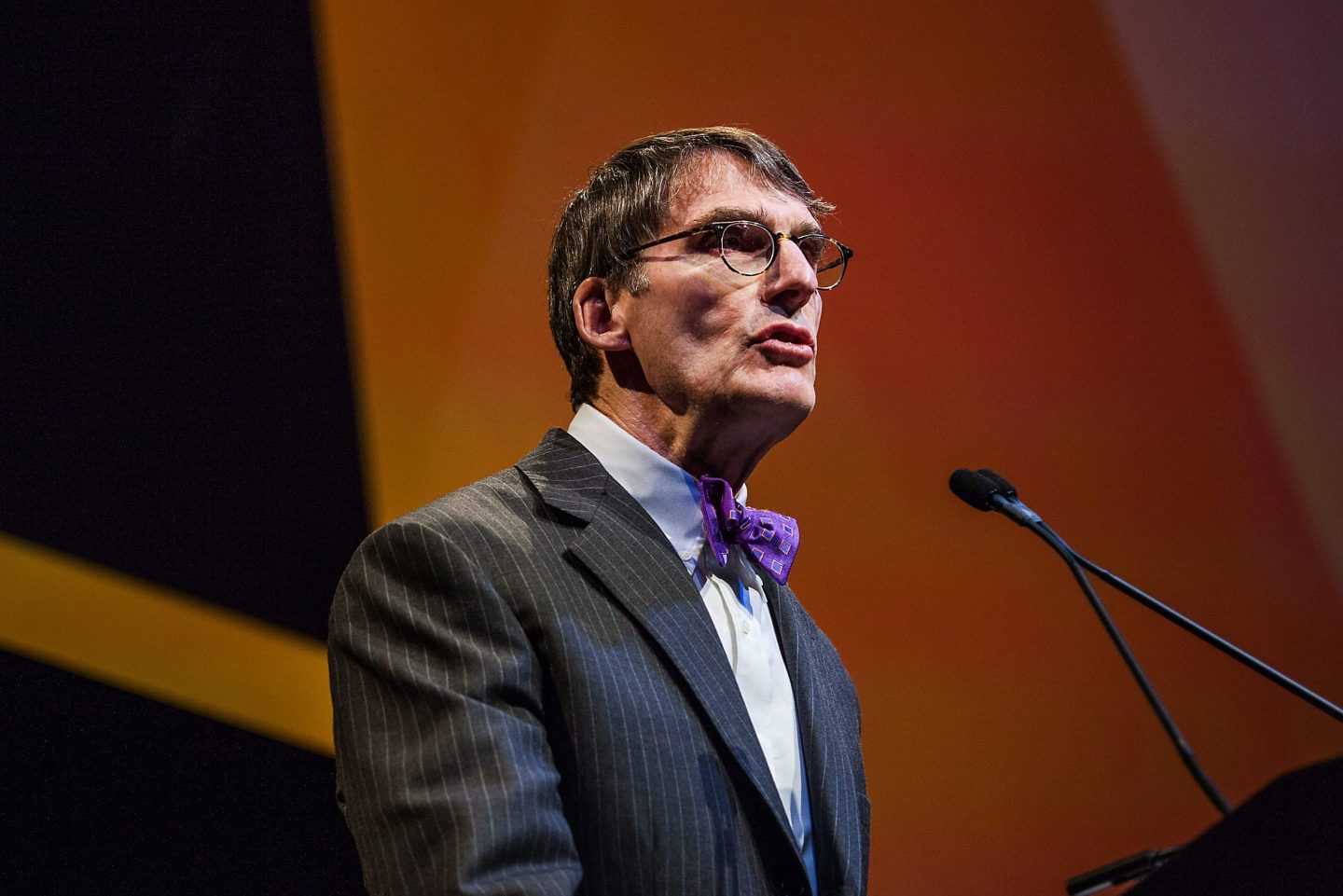
Jim Grant has been tracking the ins and outs of Federal Reserve policy and its effects on the economy and markets in his famed newsletter, Grant’s Interest Rate Observer, for over 40 years. The always bow-tied and often staunchly skeptical economic historian has made a name for himself with some pretty prophetic forecasts ahead of past financial calamities, including the Global Financial Crisis.
Now, in an interview with Fortune, Grant lays out his fears that another potential disaster is on the horizon. After roughly a decade of near-zero interest rates, he argues, the U.S. economy developed a debt problem—one likely to end badly now that higher interest rates are here to stay. The inevitable fallout from the end of the “free money era” has yet to be felt fully, Grant warns.
The ‘everything bubble’ and its consequences
To understand Grant’s worries, we have to take a step back to 2008, the year he believes Federal Reserve policy became completely illogical.
In order to help the economy recover after the GFC, the Fed held interest rates near zero and instituted a policy called quantitative easing (QE)—where it bought government bonds and mortgage-backed securities in hopes of spurring lending and investment. Together, these policies created what is now known colloquially as the ”free money” era, pumping trillions of dollars into the economy in the form of low-interest-rate debt.
Grant has long argued the Fed’s post-GFC policies helped blow up an “everything bubble” in stocks, real estate, and, well, everything. And even after equities’ rough year in 2022, real estate’s two-year slowdown, and a regional banking crisis this March, he still fears that that bubble has only partially deflated.
While the banking and commercial real estate sectors have been hit hard by rising interest rates, Grant’s biggest fear involves credit markets.
After years in which corporations (as well as consumers and governments) rapidly increased their debt loads, Grant worries many will soon be unable to keep carrying that debt. With the current high interest rates, refinancing will present a challenge, especially as the economy slows. “I think that the consequences of more or less 10 years of proverbially free money are going to play out in the credit markets,” he told Fortune.
Grant pointed to so-called “zombie companies” as one example of the issues that lenders may face. As Fortune previously reported, hundreds of companies managed to stay afloat during the free money era using cheap debt to sustain broken business models. But now, many of these firms are facing pressure as the economy slows and borrowing costs rise. That means they may not be able to repay their lenders. “It could be that the accumulation of errors in lending and an allocation of credit that were brought on by the invitation to lend indiscriminately—that is to say the 0% rate regime—was an open invitation to overdo it in credit,” Grant told Fortune, adding that “assets may face the consequences of that yet.”
Take WeWork as an example. David Trainer, the founder and CEO of the investment research firm New Constructs, warned for years that the office co-working company was masking its unprofitable business model with cheap debt during the “free money” era. Now, after a failed IPO, years of cash burn, and a rush to go public via a special purpose acquisition company (SPAC), WeWork has lost investors millions and gone bankrupt, forcing the company to abandon leases and leave lenders in the lurch.
“WeWork is just the first of many other unprofitable and zombie companies facing potential bankruptcy,” New Constructs’ analyst Kyle Guske wrote in a November note. “As the Fed increasingly adopts a ‘higher for longer’ mentality, the days of free and easy money appear over. We hope that the days of billions in capital being thrown at money losing businesses in hopes of duping unsuspecting retail investors are over.”
To his point, bankruptcies are already on the rise. There were 516 corporate bankruptcies through September, according to S&P Global — more than any full year dating back to 2010. And U.S. business bankruptcies rose nearly 30% from a year ago in September, federal court data shows.

The bubble years
Grant is just one of several well-known names in finance who fear the free money era created distortions in the economy that have yet to correct themselves.
Mark Spitznagel, the founder and chief investment officer of the private hedge fund Universa Investments, told Fortune in August that the Fed’s post-GFC (and pandemic era) policies have created the “greatest credit bubble in human history” and a “tinderbox” economy.
“We’ve never seen anything like this level of total debt and leverage in the system. It’s an experiment,” he warned. “But we know that credit bubbles have to pop. We don’t know when, but we know they have to.”
Grant is also known for rather prophetic predictions about past market bubbles. Long before subprime mortgages ran some of Wall Street’s longest-lived institutions into the ground, Grant warned in multiple newsletters that mortgage lending standards had become too lax and the amount of adjustable rate mortgages in the housing market left Americans—and banks—at risk in a rising interest rate environment. He republished some of these columns in the 2008 book Mr. Market Miscalculates: The Bubble Years and Beyond, which the Financial Times praised that year as showing “uncanny examples of prescience.”
Grant’s fears turned to reality when home prices tanked and subprime adjustable-rate mortgages—which had been packaged together into securities by the geniuses on Wall Street—imploded in record time, becoming the nail in the coffin of the world’s economy.
History says: Higher for much, much longer
Grant stands out from the Wall Street pack in another respect: Where many investment gurus are calling for the Fed to start cutting rates at some point in the coming year or two, Grant predicts an era of higher rates that could last a generation.
Fed Chair Jerome Powell has repeatedly warned that rates will need to remain “higher for longer” to truly tame inflation. But many Wall Street leaders, encouraged at inflation’s steep fall from its June 2022 four-decade high, believe peak rates are already here.
Grant, however, takes a historical reading of monetary policy, and argues we’re in for a generation of rising rates, with some volatility in between. “The phrase would be higher for much, much, much, much longer—but we have to underscore and italicize the conditional—if past is prologue,” he told Fortune.
Grant noted that between 1981 and 2023, barring a few brief blips, interest rates continuously trended down. And in the forty years before that, they had essentially trended—again, with a few exceptions—in the opposite direction.
“It is the historical track record, it is the pattern, that interest rates exhibit a tendency to trend over generation-long intervals,” Grant explained, arguing we may have entered a “new regime.”
“We seem to have hit some major point of demarcation with interest rates in 2020 and ‘21,” he added. Based on history, he said, this new regime should last 40 years. Still, Grant clarified that the generation-long uptick likely won’t be a straight line up. If a recession hits, there could be a “substantial,” although temporary, pullback in interest rates.
If Grant is right, that would mean an era of low economic growth, relatively high inflation, and high interest rates—an economic combination that’s often labeled stagflation—may lie ahead. And that’s not exactly a recipe for investing success. It could even be an environment where corporate defaults rise, with the credit markets paying the overdue price of the free-money era.
But what about deflationary technology?
There’s one serious counterargument to Grant’s belief that interest rates will trend higher for decades to come, however, and it’s a fairly simple idea. As Cathie Wood, the CEO of the tech-focused investment management firm ARK Invest, put it in a Wall Street Journal interview last month: “Technology is deflationary.”
Technologists and Wall Street bulls argue that the advent of AI and robotics are heralding an age of revolutionary technological progress that will dramatically boost worker productivity, reduce prices for businesses and consumers, or even balance the national budget.
Grant admitted that technological progress can be deflationary, but it’s not clear that the current rate of progress is fast enough to bring down prices substantially. Looking back at history, he noted that there have been periods where the U.S. economy was undergoing rapid transformation but prices were still rising — meaning innovation and deflation don’t always coincide.
“I don’t know how to compare the intensity of the technological progress of the 1930s versus the 1970s,” he said. “But both were marked by terrific improvements in productive technology and one featured deflation, the other mighty inflation.”
While it’s certainly possible that technology could spur deflation, Grant said he doesn’t see it as likely. However, the veteran economic historian concluded by emphasizing that history is not a blueprint, and forecasters need to be humble.
“We know how rich we would all be if past were dependably and truly prologue—especially the historians who, as it is, have so little money,” Grant quipped, adding that this means experts should “proceed cautiously” when forecasting.