• Home
  • Latest
  • Fortune 500
  • Finance
  • Tech
  • Leadership
  • Lifestyle
  • Rankings
  • Multimedia
SuccessEducation

School children around the world saw an ‘unprecedented drop in performance’ during the pandemic, global study finds

By
Collin Binkley
Collin Binkley
and
The Associated Press
Down Arrow Button Icon
By
Collin Binkley
Collin Binkley
and
The Associated Press
Down Arrow Button Icon
December 5, 2023, 9:01 AM ET
Schools
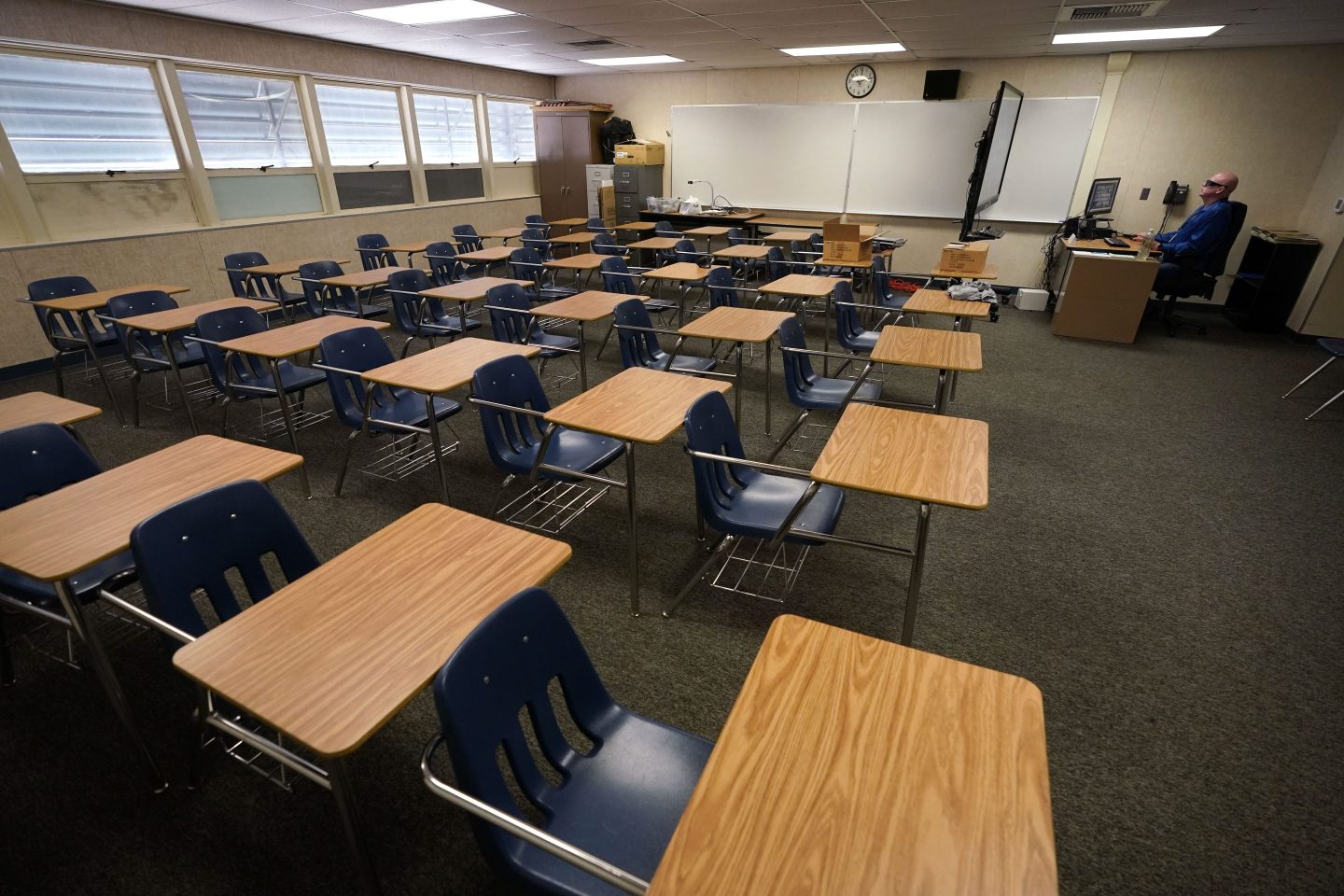
The question about whether our children our learning remains.AP Photo/Gregory Bull

Students around the world suffered historic setbacks in reading and math during the COVID-19 pandemic, with declines in test scores so widespread that the United States climbed in global rankings simply by falling behind less sharply, a new study finds.

The state of global education was given a bleak appraisal in the Program for International Student Assessment, the first study to examine the academic progress of students in dozens of countries during the pandemic. Released Tuesday, it finds the average international math score fell by the equivalent of three-quarters of a year of learning. Reading scores fell by the equivalent of half a year.

The setbacks spanned nations rich and poor, big and small, with few making progress. In the countries where students were tested, a quarter are now considered low performers in math, reading and science, meaning they struggle to perform basic math problems or interpret simple texts.

Usually given every three years, the latest test was delayed a year because of the pandemic. It was administered in 2022 to a sample of 15-year-olds in 37 countries that are members of the Organisation for Economic Co-operation and Development, plus 44 other partner countries. The OECD has been conducting the test since 2000.

The new results point to an “unprecedented drop in performance,” the report says. It raises concerns about countries including Germany, Iceland and the Netherlands, which saw drops of 25 points or more in math scores. Twenty points is seen as equivalent to a year of learning.

Across all participating countries, the average math score fell by about 15 points since the 2018 tests. Reading scores fell by 10 points. Neither subject had seen a change of more than five points previously. The bright light was in science, where scores changed little since 2018.

In the U.S., which historically has lagged in math, the average math score fell by 13 points. Reading and science stayed mostly even. Overall, the country improved to No. 26 in math, up three spots from 2018. It ranked No. 6 in reading and 10th in science, up two and one spots, respectively.

America’s math score was about even with the international average. Science and reading were slightly higher.

“The whole world is struggling with math, and we are not immune from that,” said Peggy Carr, head of the National Center for Education Statistics, an office of the U.S. Education Department. “Everyone had struggles during the pandemic. What we’re seeing here is we had less.”

The new results line up with findings from individual countries reporting deep and persistent academic setbacks, especially in math. A national study in the U.S. last year found math scores fell by more than ever, with reading scores dropping to 1992 levels.

There’s no doubt the disruption of the pandemic was a major factor in the global setbacks. But the OECD cautions against blaming it all on COVID-19. Science and reading scores were falling before the pandemic, it says, and some countries were already trending downward in math, including Belgium, Finland, Canada and France.

It also finds the link between school closures and academic setbacks was “not so direct.”

A survey of students found about half faced closures of more than three months, but it didn’t always lead to lower scores. There was “no clear difference” in performance trends between countries that had limited closures, including Iceland and Sweden, and those with longer closures, including Brazil and Ireland, according to the report.

“Many other factors impacted learning during this period, such as the quality of remote teaching and levels of support granted to struggling students,” it said.

Singapore, long seen as an education powerhouse, had the highest scores by far in every subject. It was joined in the upper echelons by other East Asian countries including Japan and China. Also among the higher performers were Estonia, Canada and Ireland.

Albania saw the biggest decrease in math scores, with a staggering 69-point decrease, followed by Jordan, with 39 points, and Iceland, with 36. Iceland’s drop knocked it below the U.S. and the OECD average. Norway fell 33 points, dropping to the global average.

Most of the countries that saw math gains had relatively low performance levels to start with, including Saudi Arabia, the Dominican Republic and Cambodia.

In the U.S., Education Secretary Miguel Cardona attributed the relative success to President Joe Biden’s investments in education, including $190 billion in pandemic relief that Congress sent to schools. Still, he said, America’s math scores remain “stubbornly low.”

“We cannot be complacent at home,” he said, “not when math is critical to our global competitiveness and leadership.”

___

The Associated Press education team receives support from the Carnegie Corporation of New York. The AP is solely responsible for all content.


Join us at the Fortune Workplace Innovation Summit May 19–20, 2026, in Atlanta. The next era of workplace innovation is here—and the old playbook is being rewritten. At this exclusive, high-energy event, the world’s most innovative leaders will convene to explore how AI, humanity, and strategy converge to redefine, again, the future of work. Register now.
About the Authors
By Collin Binkley
See full bioRight Arrow Button Icon
By The Associated Press
See full bioRight Arrow Button Icon

Latest in Success

Ryan Serhant lifts his arms at the premiere of Owning Manhattan, his Netflix show
Successrelationships
Ryan Serhant, a real estate mogul who’s met over 100 billionaires, reveals his best networking advice: ‘Every room I go into, I use the two C’s‘
By Dave SmithDecember 12, 2025
10 hours ago
Apple CEO Tim Cook
SuccessBillionaires
Apple CEO Tim Cook out-earns the average American’s salary in just 7 hours—to put that into context, he could buy a new $439,000 home in just 2 days
By Emma BurleighDecember 12, 2025
11 hours ago
Tensed teenage girl writing on paper
SuccessColleges and Universities
40% of Stanford undergrads receive disability accommodations—but it’s become a college-wide phenomenon as Gen Z try to succeed in the current climate
By Preston ForeDecember 12, 2025
12 hours ago
SuccessHow I made my first million
Hinge CEO says he bribed students with Kit Kats to get the $550-million-a-year business off the ground: ‘I had to beg and borrow a lot‘
By Orianna Rosa RoyleDecember 12, 2025
13 hours ago
Steve Jobs, Steve Wozniak, and Ronald Wayne's signatures on the bottom of Apple's founding contract.
SuccessWealth
Apple cofounder Ronald Wayne sold his 10% stake for $800 in 1976—today it’d be worth up to $400 billion
By Preston ForeDecember 12, 2025
13 hours ago
Former Meta COO Sheryl Sandberg
SuccessWomen
Sheryl Sandberg breaks down why it’s a troubling time for women in the workplace right now
By Emma BurleighDecember 12, 2025
17 hours ago

Most Popular

placeholder alt text
Economy
Tariffs are taxes and they were used to finance the federal government until the 1913 income tax. A top economist breaks it down
By Kent JonesDecember 12, 2025
17 hours ago
placeholder alt text
Success
At 18, doctors gave him three hours to live. He played video games from his hospital bed—and now, he’s built a $10 million-a-year video game studio
By Preston ForeDecember 10, 2025
3 days ago
placeholder alt text
Success
Palantir cofounder calls elite college undergrads a ‘loser generation’ as data reveals rise in students seeking support for disabilities, like ADHD
By Preston ForeDecember 11, 2025
1 day ago
placeholder alt text
Success
Apple cofounder Ronald Wayne sold his 10% stake for $800 in 1976—today it’d be worth up to $400 billion
By Preston ForeDecember 12, 2025
13 hours ago
placeholder alt text
Success
40% of Stanford undergrads receive disability accommodations—but it’s become a college-wide phenomenon as Gen Z try to succeed in the current climate
By Preston ForeDecember 12, 2025
12 hours ago
placeholder alt text
Arts & Entertainment
'We're not just going to want to be fed AI slop for 16 hours a day': Analyst sees Disney/OpenAI deal as a dividing line in entertainment history
By Nick LichtenbergDecember 11, 2025
1 day ago
Rankings
  • 100 Best Companies
  • Fortune 500
  • Global 500
  • Fortune 500 Europe
  • Most Powerful Women
  • Future 50
  • World’s Most Admired Companies
  • See All Rankings
Sections
  • Finance
  • Leadership
  • Success
  • Tech
  • Asia
  • Europe
  • Environment
  • Fortune Crypto
  • Health
  • Retail
  • Lifestyle
  • Politics
  • Newsletters
  • Magazine
  • Features
  • Commentary
  • Mpw
  • CEO Initiative
  • Conferences
  • Personal Finance
  • Education
Customer Support
  • Frequently Asked Questions
  • Customer Service Portal
  • Privacy Policy
  • Terms Of Use
  • Single Issues For Purchase
  • International Print
Commercial Services
  • Advertising
  • Fortune Brand Studio
  • Fortune Analytics
  • Fortune Conferences
  • Business Development
About Us
  • About Us
  • Editorial Calendar
  • Press Center
  • Work At Fortune
  • Diversity And Inclusion
  • Terms And Conditions
  • Site Map

© 2025 Fortune Media IP Limited. All Rights Reserved. Use of this site constitutes acceptance of our Terms of Use and Privacy Policy | CA Notice at Collection and Privacy Notice | Do Not Sell/Share My Personal Information
FORTUNE is a trademark of Fortune Media IP Limited, registered in the U.S. and other countries. FORTUNE may receive compensation for some links to products and services on this website. Offers may be subject to change without notice.