Justin Ryan Horton has two jobs. When he’s not working 24-hour shifts as a firefighter, the 22-year-old is working as an administrative assistant for a local community college from his home in Colorado Springs.
Firefighting is, of course, not a work-from-home kind of job. So when the community college position gave Horton the choice to clock in remotely, he took it.
“I’m gone a lot being a firefighter,” Horton said. “Instead of coming home and then seeing my family for a few minutes before leaving to go to my other job… I feel like I have just more time with (them) when I work from home.”
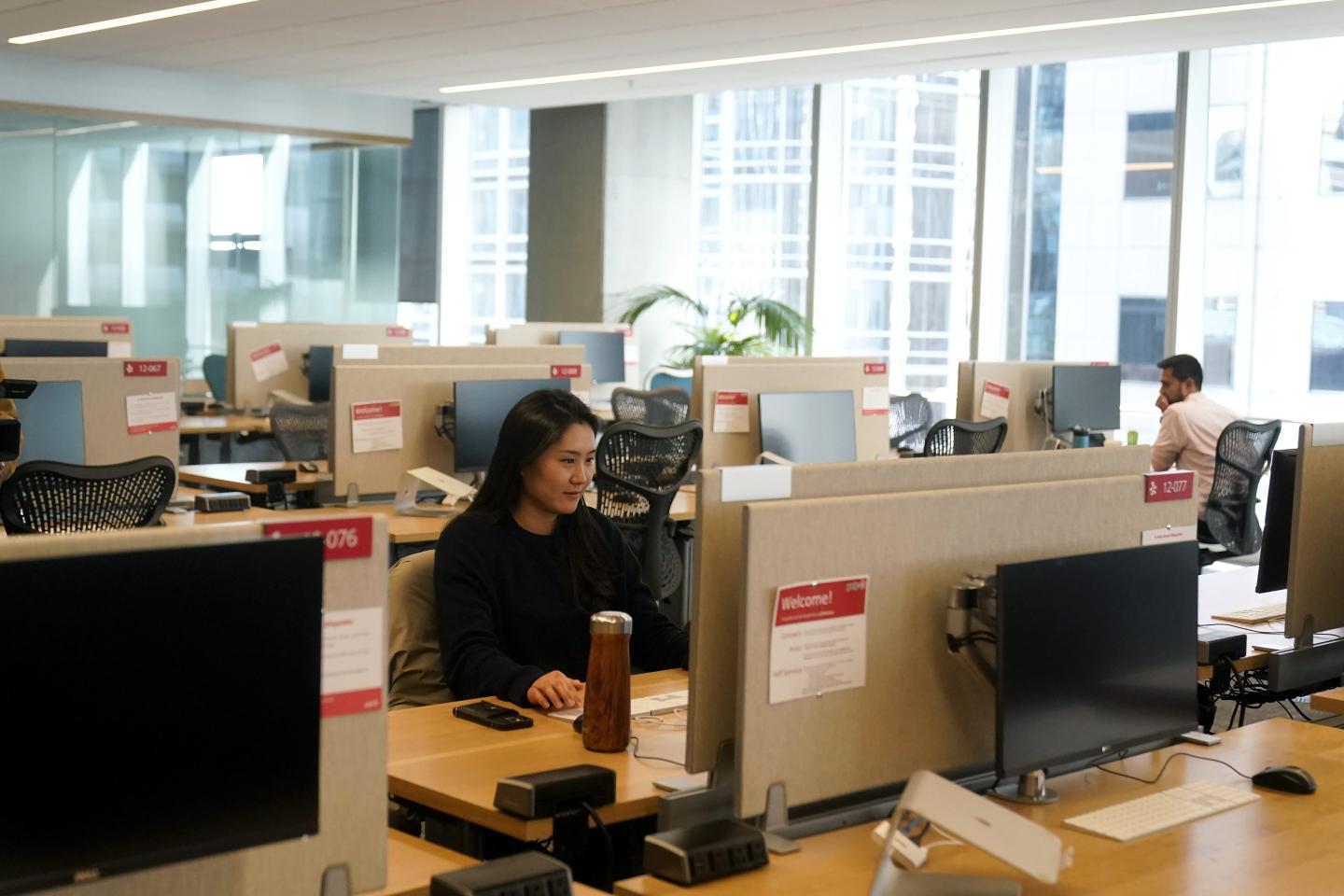
The COVID-19 pandemic upended what working looks like for millions of people all around the world. While many jobs can only be done in person, swaths of employers shuttered their physical doors and moved their workplaces increasingly online.
Workers have since begun to return to the office in waves, at least for part of the week, and navigating that transition is an ongoing and significant hurdle for employers and workers alike. And many simply cannot fathom a return to the pre-COVID status quo, changing how companies approach their staffing needs.
Retaining employees who don’t want to work in person is an issue for companies, but relatively few employers (13%) have introduced new incentives that would make employees more satisfied with it, according to a newly released poll conducted by NORC at the University of Chicago.
About 3 in 4 human resources representatives say that retaining employees who don’t want to work in the office is a problem — including 19% who call it a “major problem.” Another 54% of HR representatives call it a minor problem. And only about one-third of HR professionals say employees at their workplace are “extremely” or “very” happy about returning to the workplace.
“Once workers discovered that (remote work could be) less expensive and… make their life a little easier, they just wanted to keep doing it, even once the pandemic began fading away,” Marjorie Connelly, senior fellow with NORC’s Public Affairs & Media Research department, told The Associated Press.
In both the HR survey and a separate poll of U.S. adults, researchers found that the top factors behind employees’ desire to work from home include their prioritization of flexibility and work-life balance. Other HR representatives and employees who work from home cite the length and costs of commuting as key.
Those are some of the main reasons that Megan Homis, 33, prefers remote work. As a senior account executive for an advertising and marketing firm in Southern California, Homis goes into the office once a month.
“With traffic, it’s about an hour and 45 minute drive each way into the office,” she said. “And on top of that, I have two little kids — so just wrangling childcare for them with drop off and pick up is a lot.”
Homis said that the ability to work remotely will continue to be a priority for her down the road. She would consider potentially going into the office more if an employer offered sufficient incentives and support for in-person work, but hasn’t seen opportunities that would sway her in that direction yet.
Bill Castellano, a professor in the Rutgers School of Management and Labor Relations, notes that flexibility is key — particularly in giving employees agency for scheduling their work.
“Employees really value more of when to do work vs. where to do work,” Castellano, who was not involved in the NORC surveys, said. He added that this is a key benefit for many remote workers today — and could be duplicated in physical offices with the right policy, such as having flexible start times.
There are some initiatives that could incentivize more employees to work in-person — or at least increase their satisfaction about already going into the office — the poll shows. Most hybrid workers (55%) say paying employees more for their in-office work would provide “a lot” of encouragement for them to work in-person more often.
Additional pay topped the list across respondents whether they were working in-person, remotely (44%) or in hybrid (50%) roles. However, just 4% of HR representatives whose companies have introduced new policies to get employees back to the workplace say that higher compensation is among them.
Employees who are already going into the office — either entirely or part-time — indicated that other incentives such as commuter benefits, in-office childcare, free food and social gatherings could also add at least “some” more satisfaction with returning to the office.
Those in-office perks had less sway among solely remote workers, Connelly noted — particularly social gatherings. “For example, I work hundreds of miles away from the main office, so they can have a pizza party (and) all the pizza parties they want, but I’m not going to be affected by it,” she said.
Regardless, many U.S. employees have returned to in-person work, or had never left. Most paid employees report that they work in person per NORC’s survey, and three-quarters of those in-person employees say they are required by their employer to do so. About 1 in 10 indicate that they could work remotely but prefer working from the office.
Meanwhile, about one-third of paid employees surveyed work remotely or in hybrid positions. The majority cited convenience and work-life balance, as well as a lack of in-office requirements, as reasons to do so.
The number of people working remotely has fallen significantly since the peak of COVID-19 — but is still far higher than pre-pandemic levels.
Estimates are mixed, but according to a Pew Research Center survey published in March, 35% of workers with jobs that can be completed remotely were working from home all of the time. That’s down from 43% in January 2022 and 55% in October 2020. Still, that’s much higher than the mere 7% recorded before the pandemic.
This coincides with dwindling work-from-home options from employers. According to the U.S. Bureau of Labor Statistics, 72.5% of private-sector establishments, for example, had little to no telework in mid-2022 — up from 60.1% a year earlier.
“I would think that this trend downward will continue, but I don’t think it’s going to go down to zero… (or) where we were pre-pandemic,” Castellano said, adding that he believes the hybrid model will grow in popularity. “The question is, what kind of schedule will that be?”