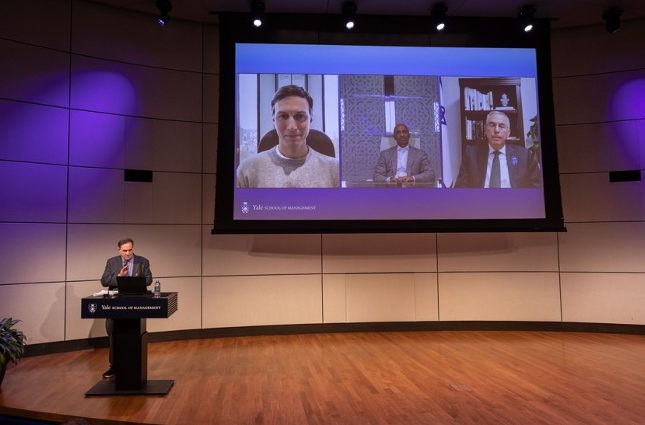
Amidst the daily mass suffering and horrific battles in the Middle East, much of the focus remains squarely on Israel’s military operation in Gaza and the horrifying humanitarian fallout. But the Middle East Peace Dialogue I hosted at Yale last week provided a powerful reminder that despite daily tragedies, peaceful coexistence between Jews and Muslims and between Israel, the Palestinians, and Arab neighbors is not just an “impossible dream.”
Opening with the playing of The Impossible Dream written by a Yale alum, last week, Yale hosted an Arab-Israeli diplomatic dialogue on campus that harkens to the first Thanksgiving, a dialogue that promoted harmony across cultural divides. In the fall of 1621, 90 members of the indigenous Wampanoag tribe joined 52 English pilgrims in Plymouth, Massachusetts, to mark a successful harvest at the time of the ancient Hebrew holiday of Succoth.
While invitations to Palestinian officials went unanswered, we are told that our event was the first public dialogue between any senior Arab government official and any senior Israeli government official since the tragic events of Oct. 7: UAE Ambassador Yousef Al Otaiba and Israeli Ambassador Michael Herzog.
Headline guests also included Abraham Accords architect Jared Kushner, and longtime Middle East advisor to several U.S. presidents Ambassador Dennis Ross, among many others. In 2019, Kushner unveiled a $50 billion economic plan, one whose implementation would be predicated on a future political peace agreement. His plan gave the opposing parties a chance to visualize what the quality of life could look like when tensions subside. Drawing on the remarkable economic development successes in other countries that have been torn by past political violence, such as South Korea, the proposal detailed highly specific uses of grants, low-interest loans, and private investment intended to double the size of the Palestinian economy, create one million new jobs, reduce Palestinian unemployment from 30% to single digits, and reduce Palestinian poverty by 50%.
Roughly 190 specific projects in the Bahrain Plan would aim to increase export revenue from 17% to 40% of Palestinian GDP, ensure reliable electricity, double the drinkable water supply, connect more schools to high-speed data services, increase women’s participation in the workforce, and generate a 500% increase in foreign direct investment. The plan would have boosted investment in key industries such as tourism, agriculture, digital services, housing, and manufacturing; it would also have also provided for infrastructure enhancements such as a $5 billion high-speed highway connecting Gaza to the West Bank. Then, as now, Palestinian officials boycotted the discussions we facilitated–but regional and international investors such as the UAE’s Emaar Properties founder Mohamed Alabbar and Blackstone Chairman and CEO Stephen Schwarzman endorsed the plan that would have improved the lives of people across the region.
A leap of faith
That the latest event at Yale event took place at all was a leap of faith from all involved–exactly the kind of leap of faith and trust that’ll be needed to restore peace–and a leap of faith from the Yale community, as well.
H.L. Mencken once quipped that old universities tend to teach dead languages as if they were alive and living languages as if they were dead. There is nothing wrong with learning old languages, but it is also nice when old universities are at the forefront of current issues. Sadly, however, in recent weeks, old universities have often been at the forefront for the wrong reasons amidst campus unrest with alarming rises in both antisemitic and Islamophobic violence.
With hostile fractious exchanges at fellow Ivy League schools such as Penn, Harvard, and Cornell, as well as more positive examples such as those at Dartmouth, we were proud that on this spectrum, Yale modeled respectful, interfaith, cross-cultural, and interdisciplinary exchanges, showing that we can all still talk to each other with respect and find areas of common ground even if we do not agree on everything, on college campuses and beyond. Partisan leanings were virtually imperceptible; in fact, even before any discussions commenced, the audience–including leading bipartisan Mideast voices–gave a rousing standing ovation to Jared Kushner in recognition of his role in the Abraham Accords, which paved the way for Arab and Israeli normalization of relations and for public forums such as this one, which just five years ago would have been impossible.
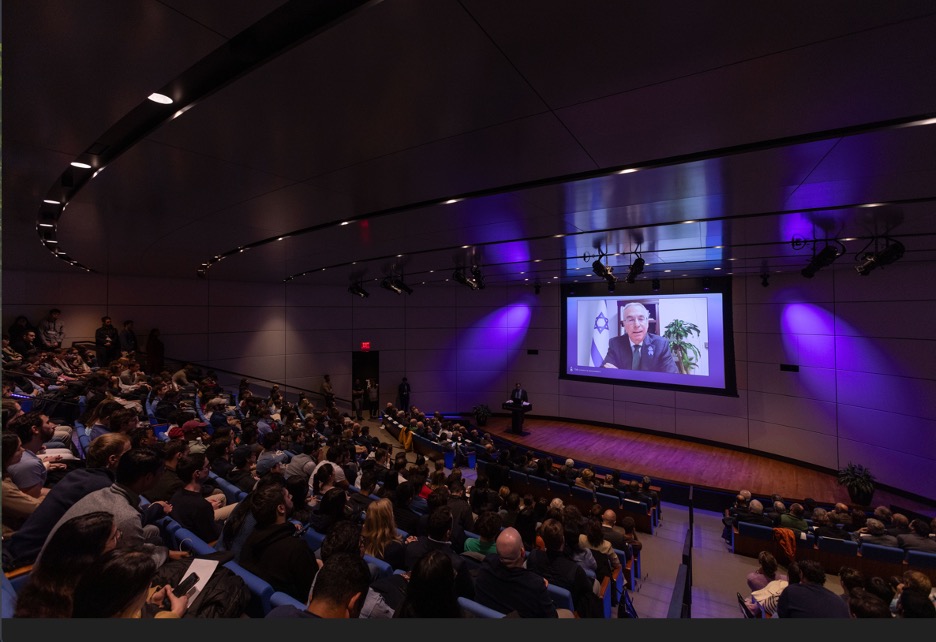
Our gathering drew an impressive lineup of two dozen interfaith clergy and divinity faculty, headlined by Imam Feisal Abdul Rauf, the highly influential Imam of Masjid al-Farah and Cordoba House, and one of TIME’s “100 Most Influential People,” who traveled 100 miles to join Rabbi Herbert Brockman, the renowned seventh-generation rabbi of nearby Congregation Mishkan Israel, the oldest continuing synagogue in New England, in a new inter-faith call for dialogue and understanding. We were further joined by 80 senior Yale faculty members and bipartisan, interfaith Mideast experts, ranging from former Mexican president Ernesto Zedillo to Iranian-American journalist to Ethan Allen CEO and Muslim-Jewish Council Co-Chair Farooq Kathwari, to former deputy national security advisor Olivia Troye, and many others.
The event started with an interfaith invocation from the Imam and Rabbi. Rabbi Brockman concluded, “The hope for this hour depends on the immediacy of dialogue among human beings. Dialogue. That is my prayer today.” Imam Abdul Rauf movingly appealed, “We Muslims believe that God has 99 descriptive names, one of which is peace as Salaam, so may God’s attribute of peace descend upon us here in this gathering, on all of us participating in this discourse today, and move us to help implement peace.”
An achievable consensus
Given elevated sensitivities for our high-level guests, the subsequent discussions from our event were unfortunately off-the-record But we can share some of the insights that emerged without attribution, providing compelling strategic context. Furthermore, while there were cordial disagreements, there were also issues where our guests, Arab and Israeli, Muslim and Jewish alike, were largely if not completely in agreement, which may provide a reassuring blueprint to an eventual “day-after scenario” once the current violence ends.
- For centuries, throughout the history of the Middle East, Jews and Muslims lived a largely peaceful coexistence.
- Understanding and respect between Arabs and Israelis does not mean they agree with each other on everything–it just means they agree to live and co-exist peacefully with each other.
- Security, and a sense of security, are non-negotiable for Israel.
- Palestinian aspirations must be addressed, with potentially a political horizon towards a two-state solution, which will require genuine concessions, commitment, and good-faith dealmaking from Israeli and Palestinian officials alike.
- The unresolved issue of the plight of the Palestinian people has haunted every U.S. president, every Israeli government, and every Palestinian regime, and if no permanent solution can be worked out, the current situation will inevitably continue to deteriorate.
- Few outside countries will be able to have any direct influence on the outcome of the war, but many more countries in the region and beyond will need to be engaged in what the “day-after” solution will look like.
- The prospects for the people of Gaza and Israel alike are infinitely better if Hamas can be removed from control and extremists marginalized on all sides.
- Gaza has to be governed by Palestinians, but nobody wants to hand Gaza over to an entity that cannot govern it effectively.
- Trust is the bedrock of any agreement, but there is a deficit of trust right now.
- An Iranian-American women’s rights activist reminded all that Iran’s role in supporting terrorism must be countered.
- It may be in China and Russia’s interest to keep the U.S. distracted in the Middle East–but China has the tools to play a more positive role in the region.
- It is better to give people something to look forward to, politically and economically, than to be haunted by the ghosts of history.
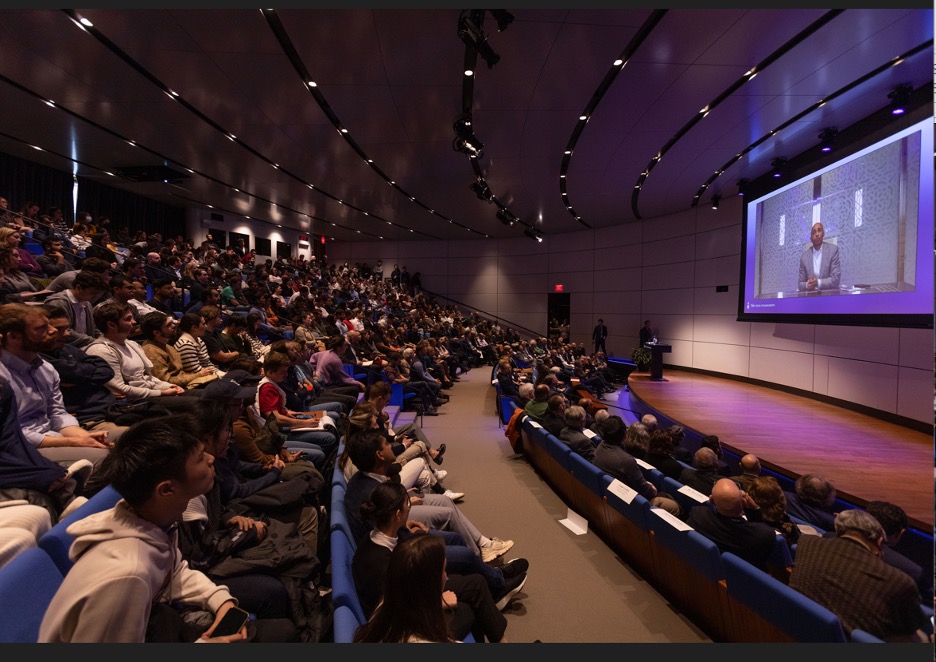
Those messages were not lost on students who welcome the inclusive, respectful, and candid town hall dialogue over shouting from street protests by campus outsiders who hijack learning at some campuses. One of the first questions was a direct inquiry from a Palestinian student regarding the transition in Gaza post-Hamas. A Yale College senior who spent two summers in high school at a camp called Seeds of Peace and has kept in touch with a number of Israeli and Palestinian friends said they struggled with how to engage with the topic on campus when the conversation is so charged, but that our event gave them hope that there’s a viable model for solutions-oriented conversations.
“The idea was to talk about peace, and how to build bridges after this savage war,” a graduate fellow who is a Druze Israeli, said. “I felt really included. The message was really how we can get together after this war and work together to rebuild Gaza and also to rebuild trust in the region.”
Ultimately, for every difference, there are also commonalities that bond the disparate peoples of the Middle East together. It is those commonalities rather than the differences that will prove paramount to any lasting peace–but only if there is the political willpower among its leaders to prove that peaceful coexistence between Jews and Muslims and between Israelis, Palestinians, and Arab neighbors is not just an “impossible dream.” As Winston Churchill remarked in 1942, “Now this is not the end. It is not even the beginning of the end. But it is, perhaps, the end of the beginning.”
Jeffrey Sonnenfeld is the Lester Crown Professor in Management Practice and Senior Associate Dean at Yale School of Management. He was named “Management Professor of the Year” by Poets & Quants magazine.
Steven Tian is the director of research at the Yale Chief Executive Leadership Institute and a former quantitative investment analyst with the Rockefeller Family Office.
More must-read commentary published by Fortune:
- Amazon’s $26 billion delivery business runs on exhausted, sweat-soaked drivers running door to door. Now we’re on strike
- Merit-based flexibility could be the future of work as return-to-office mandates fail to prop up productivity
- China’s export restrictions on critical minerals are threatening the viability of EV makers–and forcing them to innovate
- Melinda French Gates: ‘It’s time to change the face of power in venture capital’
The opinions expressed in Fortune.com commentary pieces are solely the views of their authors and do not necessarily reflect the opinions and beliefs of Fortune.