
• Home
  • Latest
  • Fortune 500
  • Finance
  • Tech
  • Leadership
  • Lifestyle
  • Rankings
  • Multimedia
SuccessProductivity

Goldman’s chief economist just weighed in on the productivity debate—and says it’s been dropping for years before remote work came along

By
Jane Thier
Jane Thier
Down Arrow Button Icon
By
Jane Thier
Jane Thier
Down Arrow Button Icon
November 14, 2023, 4:18 PM ET
Remote work
Are remote workers really less productive?Getty Images

It isn’t hard to find a white collar CEO bemoaning the flexible work era, insisting that workers located anywhere but the office are less focused, less productive, and generally the reason for any sub-par financial results. Goldman Sachs’ David Solomon has long insisted that any gesture towards flexibility is an “aberration.” JPMorgan Chase’s Jamie Dimon insists remote workers can simply work elsewhere, and Amazon’s Andy Jassy cautioned anti-office workers that things “probably won’t work out for you” if they don’t change their tune. Plus, Jassy added, almost all large company CEOs agree with him. 

Recommended Video

Some of the top economists in academia and even Wall Street are saying that actually, maybe that’s too harsh. Thomas Philippon, an economist at New York University, argued in a widely read 2022 paper that the modern workforce has been dragging its feet, so to speak, on a slow but continuous basis since the Industrial Revolution. It comes down to a concept called “total factor productivity,” which describes the growth a company or nation can attain without adding to their labor force or capital. In other words, working smarter, not harder. 

A recent Goldman Sachs report, written by a team led by chief economist Jan Hatzius, throws support to Philippon’s claim, pointing out that productivity growth has either stalled or dropped over the past five years. No, it’s not because of remote work, or rapid executive turnover, or any other modern plight. “Trend productivity growth simply tends to fall over time,” the analysts wrote. 

Rather than productivity growing exponentially thanks to newer and more cutting-edge technologies, things actually tend to gradually even off. Per Goldman, the slow drip model rather than the exponential model “helps to explain some but not all of the underperformance of productivity growth over the last 15 years relative to the long-term historical average.” This is the ultimate big, if true, because Philippon looked at hundreds of years of data, going back to 1890, shortly after the Industrial Revolution.

All of this being said, will bosses change their tune on the merits of in-person work? 

The productivity paradox is about way more than where you work—or with what tech

Philippon argues that contrary to the decades-old assumption that total factor productivity (TFP) grows exponentially as human ingenuity expands, it actually grows linearly. He literally looked at data going back hundreds of years, using British TFP data from 1600 to 1914 and American data of TFP from 1890 to the present. If true, this is both good and bad news.

The good news is that the sputtering growth rate of TFP, instead of the warning of plummeting innovation that most economists see, is more like business as usual. As long as annual increments of TFP remain high, slow growth rates are no reason for executives to panic, or cast blame on any modern trend, like work flexibility or job hopping. The bad news, of course, is that the economy has been trickling along for literally hundreds of years, absent a few big bangs.

Goldman analysts tend to agree. And, they add: Beyond just remaining level, workers are actually slowing down. “The historical average rate of TFP growth is not the right baseline expectation for future TFP growth—it is too optimistic,” they write. “Instead, we should expect TFP growth to slow over time.” That, they say, helps partly explain the past 15 years of underperforming productivity growth. 
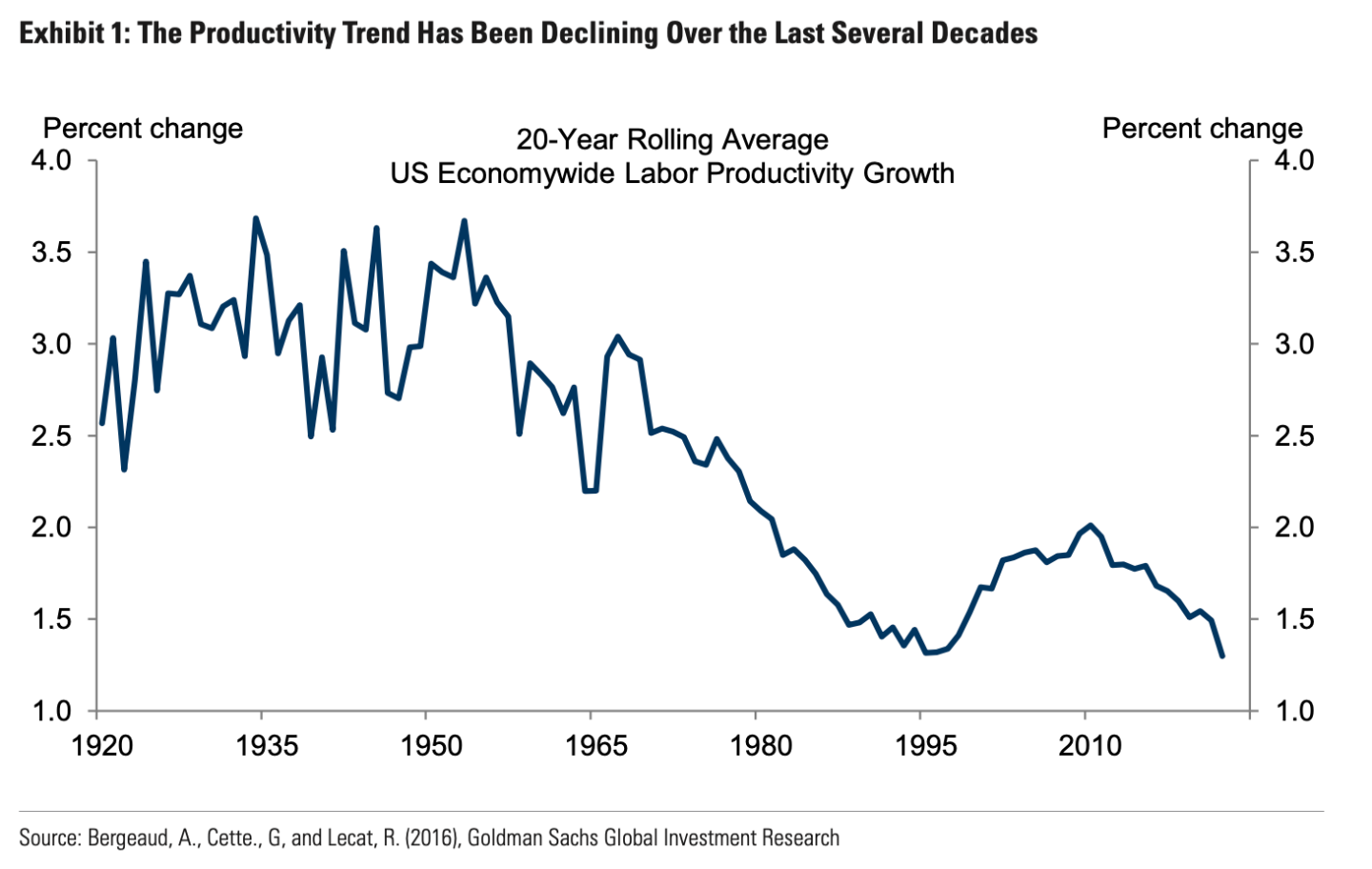
Goldman Sachs productivity chart
Declining productivity, as tabulated by Goldman Sachs
Goldman Sachs

Generative AI could actually throw a wrench into Philippon’s argument, they write, noting that the productivity gains stemming from AI adoption “could more than offset the underlying growth slowdown over the next 10-20 years.” Still, Hatzius cautions that this is “possible but very premature.” 

Many bosses who are throwing their weight—and dollars—behind AI adoption in their workplaces would certainly hope that’s true. Doubly so if they believe workers are simply working less hard. Earlier this year, per EY-Parthenon research and Bureau of Labor Statistics data, the U.S. underwent five consecutive quarters of year-over-year productivity declines for the first time since 1948. Gregory Daco, chief economist for EY-Parthenon, told Fortune at the time that the productivity drop stemmed partly from remote work—but not entirely. “From our clients across sectors, we hear similar stories of reduced productivity because of the new work environment,” he said. 

But people were also working longer hours (which means higher labor utilization) while barely putting out more work product, which shakes out to reduced productivity overall.

“When you have an environment in which output is outpacing labor growth, that’s an environment of stronger productivity,” Daco said. “When you have the opposite, when output growth is sluggish but labor growth is strong, you have a weak productivity environment.” 

What if generative AI is the real deal?

Goldman’s Hatzius gives himself some wiggle room by noting a flaw in Philippon’s argument: That just because TFP does not grow exponentially, that doesn’t mean it has to grow linearly instead. He agrees with Philippon that “new transformative technologies with wide-ranging effects on the economy like electricity” have come along from time and time and ushered in new periods of faster productivity growth.

Another reason Daco offered for productivity dropping substantial turnover and churn; as a lingering impact of the Great Resignation and quiet quitting, many workers have taken to leaving their jobs after short spells, feeling no sense of loyalty. “Because people were job-hopping so regularly, there wasn’t really a chance to bring them up to the speed, or productivity, that a former worker would’ve had,” Daco said. 

Nonetheless, “the whole idea of remote work and flexible work is to allow people to be more productive.” To that end, a recent report from think tank Economist Impact found that flexible work actually isn’t to blame for workers losing focus—it’s actually a lack of employee choice and “weak infrastructure for a thriving workplace.”  

So even if a hybrid arrangement stands the test of time, the workers who gravitate towards the office are likely to reap the most rewards. “We’ll probably see more weight towards three to four days in the office, rather than one or two, if the labor market slows,” Daco said in May. 

That’s probably unwelcome news to workers who have long maintained that they’re just as productive—if not more productive—at home. But Philippon’s findings, bolstered by Goldman Sachs’s note, should provide a solid source of comfort, and a strong rebuttal to a pro-office boss: Humans have been becoming gradually less productive since Eli Whitney debuted the cotton gin—why, even with rapidly advancing AI, would that change now?

This headline has been modified to remove the implication that Jan Hatzius was critiquing CEOs’ objections to remote work on the grounds of declining productivity. The text is unchanged.


Join us at the Fortune Workplace Innovation Summit May 19–20, 2026, in Atlanta. The next era of workplace innovation is here—and the old playbook is being rewritten. At this exclusive, high-energy event, the world’s most innovative leaders will convene to explore how AI, humanity, and strategy converge to redefine, again, the future of work. Register now.
About the Author
By Jane Thier
LinkedIn iconTwitter icon
See full bioRight Arrow Button Icon

Latest in Success

Finance
Lorem ipsum dolor sit amet, consectetur adipiscing elit, sed do eiusmod tempor incididunt ut labore et dolore magna aliqua. Ut enim ad minim veniam
By Fortune Editors
October 20, 2025
Finance
Lorem ipsum dolor sit amet, consectetur adipiscing elit, sed do eiusmod tempor incididunt ut labore et dolore magna aliqua. Ut enim ad minim veniam
By Fortune Editors
October 20, 2025
Finance
Lorem ipsum dolor sit amet, consectetur adipiscing elit, sed do eiusmod tempor incididunt ut labore et dolore magna aliqua. Ut enim ad minim veniam
By Fortune Editors
October 20, 2025
Finance
Lorem ipsum dolor sit amet, consectetur adipiscing elit, sed do eiusmod tempor incididunt ut labore et dolore magna aliqua. Ut enim ad minim veniam
By Fortune Editors
October 20, 2025
Finance
Lorem ipsum dolor sit amet, consectetur adipiscing elit, sed do eiusmod tempor incididunt ut labore et dolore magna aliqua. Ut enim ad minim veniam
By Fortune Editors
October 20, 2025
Finance
Lorem ipsum dolor sit amet, consectetur adipiscing elit, sed do eiusmod tempor incididunt ut labore et dolore magna aliqua. Ut enim ad minim veniam
By Fortune Editors
October 20, 2025

Most Popular

Finance
Lorem ipsum dolor sit amet, consectetur adipiscing elit, sed do eiusmod tempor incididunt ut labore et dolore magna aliqua. Ut enim ad minim veniam
By Fortune Editors
October 20, 2025
Finance
Lorem ipsum dolor sit amet, consectetur adipiscing elit, sed do eiusmod tempor incididunt ut labore et dolore magna aliqua. Ut enim ad minim veniam
By Fortune Editors
October 20, 2025
Finance
Lorem ipsum dolor sit amet, consectetur adipiscing elit, sed do eiusmod tempor incididunt ut labore et dolore magna aliqua. Ut enim ad minim veniam
By Fortune Editors
October 20, 2025
Finance
Lorem ipsum dolor sit amet, consectetur adipiscing elit, sed do eiusmod tempor incididunt ut labore et dolore magna aliqua. Ut enim ad minim veniam
By Fortune Editors
October 20, 2025
Finance
Lorem ipsum dolor sit amet, consectetur adipiscing elit, sed do eiusmod tempor incididunt ut labore et dolore magna aliqua. Ut enim ad minim veniam
By Fortune Editors
October 20, 2025
Finance
Lorem ipsum dolor sit amet, consectetur adipiscing elit, sed do eiusmod tempor incididunt ut labore et dolore magna aliqua. Ut enim ad minim veniam
By Fortune Editors
October 20, 2025
Rankings
  • 100 Best Companies
  • Fortune 500
  • Global 500
  • Fortune 500 Europe
  • Most Powerful Women
  • Future 50
  • World’s Most Admired Companies
  • See All Rankings
Sections
  • Finance
  • Leadership
  • Success
  • Tech
  • Asia
  • Europe
  • Environment
  • Fortune Crypto
  • Health
  • Retail
  • Lifestyle
  • Politics
  • Newsletters
  • Magazine
  • Features
  • Commentary
  • Mpw
  • CEO Initiative
  • Conferences
  • Personal Finance
  • Education
Customer Support
  • Frequently Asked Questions
  • Customer Service Portal
  • Privacy Policy
  • Terms Of Use
  • Single Issues For Purchase
  • International Print
Commercial Services
  • Advertising
  • Fortune Brand Studio
  • Fortune Analytics
  • Fortune Conferences
  • Business Development
About Us
  • About Us
  • Editorial Calendar
  • Press Center
  • Work At Fortune
  • Diversity And Inclusion
  • Terms And Conditions
  • Site Map
  • Facebook icon
  • Twitter icon
  • LinkedIn icon
  • Instagram icon
  • Pinterest icon

Latest in Success

Hubbard
Future of WorkJobs
Carhartt CEO says they always focused on blue-collar workers—but hipsters came anyway: ‘We welcome anyone … that wants to celebrate hard work’
By Nick LichtenbergJanuary 13, 2026
21 hours ago
micro
Future of Workhybrid
‘Microshifting,’ an extreme form of hybrid working that breaks work into short, non-continuous blocks, is on the rise
By Nick LichtenbergJanuary 13, 2026
1 day ago
North Americaphilanthropy
Meet the Nvidia billionaire giving away his wealth—His son’s cancer battle inspired a recent $100 million gift
By Jacqueline MunisJanuary 13, 2026
1 day ago
Warren Buffett on the phone
SuccessProductivity
Gen X CEO uses AI versions of Steve Jobs and Warren Buffett as a ‘fantasy board of directors’ to help him prepare for meetings and performance reviews
By Preston ForeJanuary 13, 2026
1 day ago
Photo of MacKenzie Scott
SuccessMacKenzie Scott
MacKenzie Scott is using her $26 billion philanthropy push to rescue organizations in danger after the Trump administration’s funding cuts
By Sydney LakeJanuary 13, 2026
1 day ago
Jimmy Donaldson, also known as MrBeast
SuccessBillionaires
Despite his $2.6 billion net worth, MrBeast says he’s having to borrow cash and doesn’t even have enough money in his bank account to buy McDonald’s
By Emma BurleighJanuary 13, 2026
1 day ago

Most Popular

placeholder alt text
Success
Despite his $2.6 billion net worth, MrBeast says he’s having to borrow cash and doesn’t even have enough money in his bank account to buy McDonald’s
By Emma BurleighJanuary 13, 2026
1 day ago
placeholder alt text
AI
'Godfather of AI' says the technology will create massive unemployment and send profits soaring — 'that is the capitalist system'
By Jason MaJanuary 12, 2026
2 days ago
placeholder alt text
Economy
The longer the Supreme Court delays its tariff decision, the better it is for President Trump
By Jim EdwardsJanuary 13, 2026
1 day ago
placeholder alt text
Future of Work
'Microshifting,' an extreme form of hybrid working that breaks work into short, non-continuous blocks, is on the rise
By Nick LichtenbergJanuary 13, 2026
1 day ago
placeholder alt text
Tech
Elon Musk asked people to upload their medical data to X so his AI company could learn to interpret MRIs and CT scans
By Sasha RogelbergJanuary 11, 2026
3 days ago
placeholder alt text
Economy
Goldman Sachs top economist says Powell probe won’t change the Fed: 'Decisions are going to be made based on employment and inflation'
By Sasha RogelbergJanuary 12, 2026
2 days ago

© 2025 Fortune Media IP Limited. All Rights Reserved. Use of this site constitutes acceptance of our Terms of Use and Privacy Policy | CA Notice at Collection and Privacy Notice | Do Not Sell/Share My Personal Information
FORTUNE is a trademark of Fortune Media IP Limited, registered in the U.S. and other countries. FORTUNE may receive compensation for some links to products and services on this website. Offers may be subject to change without notice.