International aid groups are warning that they cannot deliver food and other basic services to people in the Gaza Strip and that a “dire” humanitarian crisis is set to worsen.
International aid groups provide food and other means of support to about 63% of people in Gaza.
Israel stopped allowing deliveries of food, fuel and other supplies to Gaza’s 2.3 million residents on Oct. 10, 2023, and is reportedly preparing for a ground invasion.
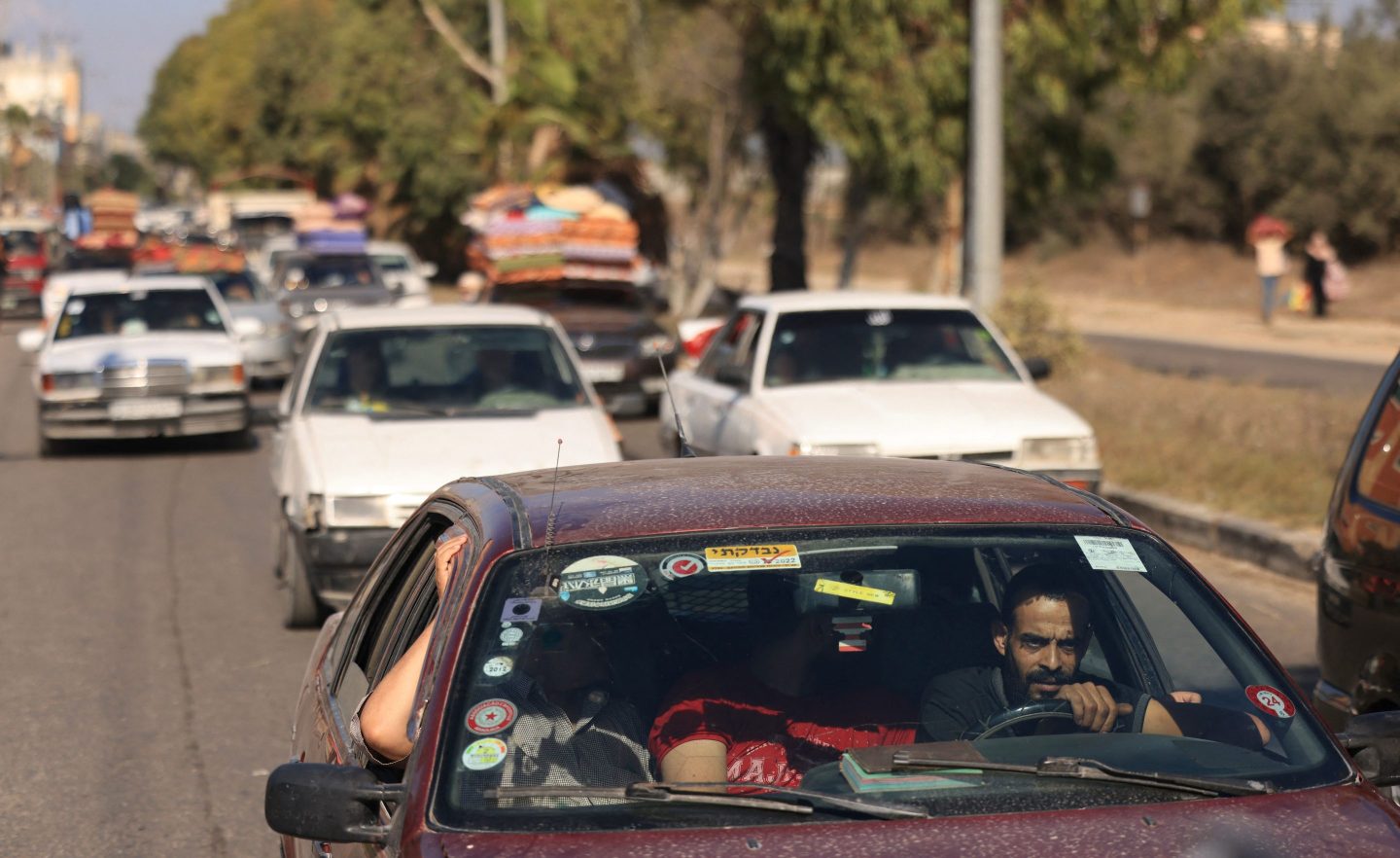
On Oct. 12, 2023, Israel warned 1.1 million Gaza residents in the northern section of the enclave to leave for the southern region, in advance of a potential ground invasion.
I am a scholar of peace and conflict economics and a former World Bank consultant, including during the 2014 war between Hamas and Israel.
International aid groups now face the same problem in Gaza that local businesses and residents have encountered for about 16 years: a blockade that prevents civilians and items, like medicine from easily moving into or out of the enclosed area, roughly 25 miles long. That 16-year blockade did not apply to the food and fuel that groups brought in to Gaza.
Now, it does.
Gaza’s blockade and economy
Gaza is about the size of Philadelphia and requires trade with different businesses and countries in order to maintain and grow its economy.
But Gaza is heavily dependent on foreign aid.
This is partially the result of Israel setting up permanent air, land and sea blockades around Gaza in 2007, one year after Hamas rose to political power. Egypt, which borders Gaza on its southern end, also oversees one checkpoint that specifically limits people coming and going.
While Israel has granted permits to about 17,000 Gaza residents to enter and work in Israel, the food, fuel and medical supplies that people in Gaza use all first pass through Israel.
Israel controls two physical checkpoints along Gaza, which monitor both the entry and exit of people and trucks. Israel limits the kind and quantity of materials that pass into Gaza. And the blockades generally prohibit Gazans who do not have work permits or special clearance – for medical purposes, for example – from entering Israel.
Israel’s restrictions through the blockade intensified since Hamas’ surprise attack on 20 Israeli towns and several military bases on Oct. 7, with Israel then announcing a broad blockade of imports into Gaza. This stopped all food, fuel and medical supplies from entering the region.
Gaza’s isolation
The Palestinian enclaves of West Bank and Gaza – which are generally lumped together in economic analyses – both have small economies that run a massive deficit of US$6.6 billion in losses each year, as the value of the imports they receive greatly outweighs the value of the items they produce and sell elsewhere.
More than 53% of Gaza residents were considered below the poverty line in 2020, and about 77% of Gazan households receive some form of aid from the United Nations and other groups, mostly in the form of cash or food.
Gaza’s weak economy is caused by a number of complex factors, but the largest is the blockade and the economic and trade isolation it creates.
For the average Gazan, the blockade has several practical effects, including people’s ability to get food. About 64% of people in Gaza are considered food insecure, meaning they do not have reliable access to sufficient amounts of food.
Food as a percentage of Gaza’s total imports has skyrocketed by 50% since 2005, when Israel first imposed a temporary blockade. And the amount of food the West Bank and Gaza actually produce has tumbled by 30% since then.
It is hard for Gaza to produce food within its own borders. One factor is that Israeli airstrikes hit Gaza’s only power generation plant and main sewage treatment plant in 2008 and again in 2018. These attacks resulted in the spread of sewage waste on land and in the water, destroying farmlands and food crops and threatening fish stocks in the ocean as well.
The UN’s big role in Gaza
Gaza’s weak economy and isolation because of the blockade mean that it relies heavily on international aid organizations to provide basic services to residents. The biggest of these aid groups in Gaza is the United Nations Relief and Works Agency for Palestine Refugees in the Near East – also known as UNRWA.
Today, UNRWA is the second-largest employer in Gaza, following Hamas. It provides the bulk of the education, food aid and health care services for people in Gaza, in addition to 3 million other people registered as Palestinian refugees who live in Jordan, Lebanon, Syria, the West Bank and other places.
Over time, UNRWA has evolved into a kind of parallel government, alongside Hamas, which Israel, the United States and other countries designate as a terrorist organization.
UNRWA funds and runs a network of 284 schools in Gaza alone, employing over 9,000 local people as staff and educating over 294,000 children each year.
UNRWA runs 22 hospitals in Gaza that employ almost 1,000 health staff and has 3.3 million patient visits per year.
Its schools are converted into humanitarian shelters in times of crisis, such as the current war. People can go there to get clean water, food, mattresses and blankets, showers and more.
The number of people in Gaza who are displaced from their homes has quickly risen over the last few days, totaling over 330,000 on Oct. 12, 2023. Over two-thirds of these people are staying in UNRWA schools.
A complicated US relationship
The U.S. has historically been the single-largest funder of UNRWA, a U.N. agency that relies on governments to support its work. The U.S. gave more than $500 million to Palestinians from April 2021 through March 2022, including more than $417 million that went to UNRWA.
U.S. support to UNRWA has fluctuated throughout different presidential administrations.
Total U.S. aid to the West Bank and Gaza peaked at $1 billion in 2009 – after Israel sealed off the territory. It reached $1 billion in annual contributions again in 2013, when former Secretary of State John Kerry helped restart peace talks between Israel and Hamas.
In 2018, the Trump Administration cut almost all of the money the U.S. typically gives to UNRWA, amounting to roughly 30% of the organization’s total budget.
Defenders of the policy change cited UNRWA-published textbooks that allegedly glorified jihad. UNRWA, for its part, maintained that, as an outside organization, it can only use the educational materials the country it is working in wants.
The Biden administration then restored funding to UNRWA and other organizations helping Palestinians in 2021.
Some Republican politicians have said that UNRWA has “cozied up” to Hamas. And an internal UNRWA ethics committee has accused top staff at the agency of “sexual misconduct, nepotism, retaliation … and other abuses of authority” that created a toxic work environment.
Meanwhile, since the war between Israel and Hamas began on Oct. 8, more than 1,500 Gazans have been killed and more than 5,300 injured, while Hamas attacks have killed more than 1,300 people in Israel and injured about 3,200 others.
International aid groups and European Union officials have called for a humanitarian corridor to be set up in Gaza – meaning a protected path specifically for civilians, aid workers and necessary basic items to pass through safely back and forth from Gaza to Israel and Egypt. So far, there are no clear plans for such a protected pathway.
Topher L. McDougal is Professor of Economic Development & Peacebuilding, University of San Diego.
This article is republished from The Conversation under a Creative Commons license. Read the original article.