• Home
  • Latest
  • Fortune 500
  • Finance
  • Tech
  • Leadership
  • Lifestyle
  • Rankings
  • Multimedia
TechPandemic Purchases

Educators alarmed by flood of $190 billion in federal spending: ‘When money is available, it’s like a vampire smelling blood’

By
Collin Binkley
Collin Binkley
and
The Associated Press
Down Arrow Button Icon
By
Collin Binkley
Collin Binkley
and
The Associated Press
Down Arrow Button Icon
October 9, 2023, 5:12 AM ET
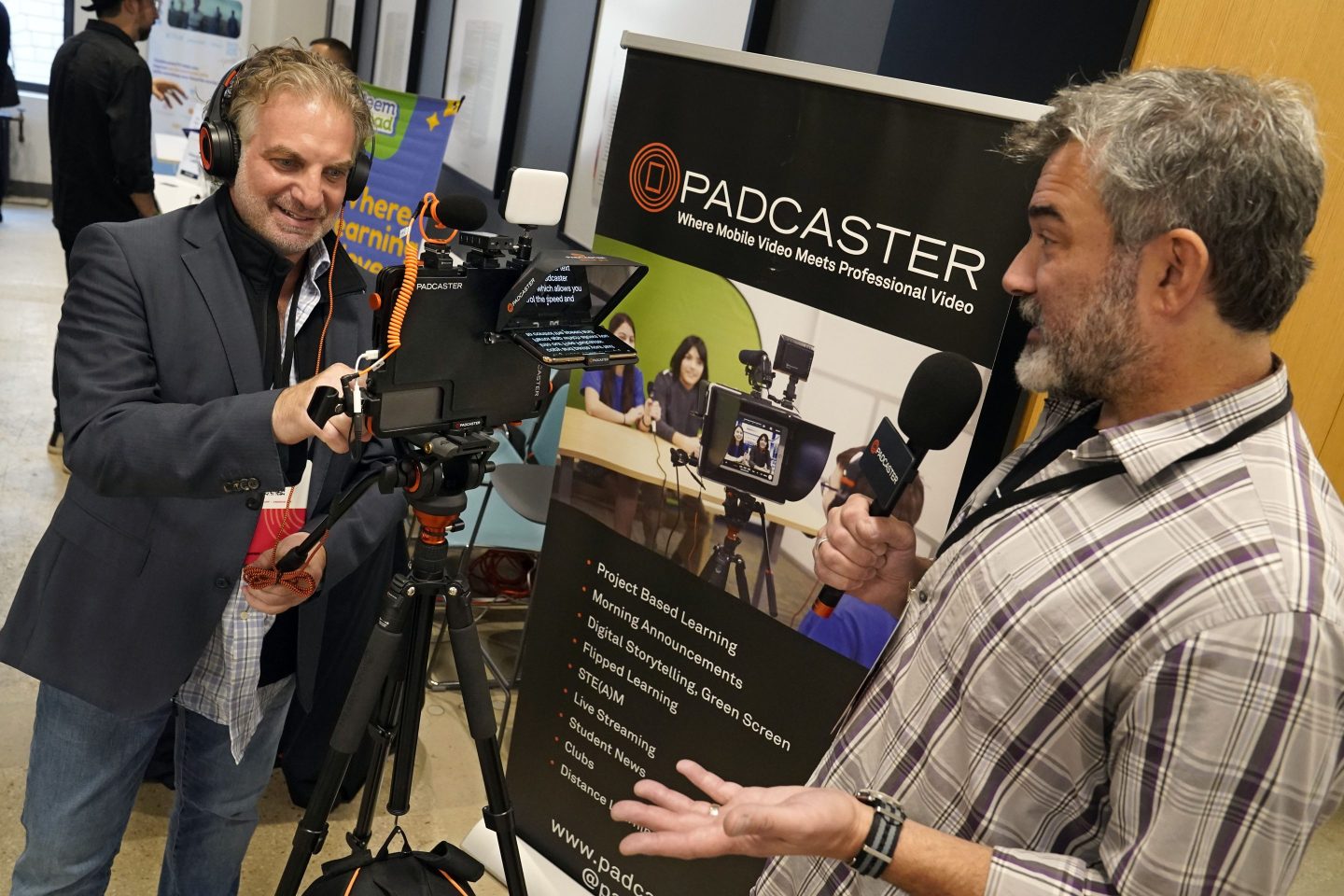
Padcaster president Jon Goldberg, left, and CEO Josh Apter, demonstrate their Padcaster Studio for remote and virtual learning, at EDTECHWEEK 2023, in New York, on Oct. 3, 2023.
Padcaster president Jon Goldberg, left, and CEO Josh Apter, demonstrate their Padcaster Studio for remote and virtual learning, at EDTECHWEEK 2023, in New York, on Oct. 3, 2023. Richard Drew—AP

As soon as the federal pandemic relief started arriving at America’s schools, so did the relentless calls.

Recommended Video

Tech companies by the dozens wanted a chance to prove their software was what schools needed. Best of all, they often added, it wouldn’t take a dime from district budgets: Schools could use their new federal money.

They did, and at a tremendous scale.

An Associated Press analysis of public records found many of the largest school systems spent tens of millions of dollars in pandemic money on software and services from tech companies, including licenses for apps, games and tutoring websites.

Schools, however, have little or no evidence the programs helped students. Some of the new software was rarely used.

The full scope of spending is unknown because the aid came with few reporting requirements. Congress gave schools a record $190 billion but didn’t require them to publicly report individual purchases.

The AP asked the nation’s 30 largest school districts for contracts funded by federal pandemic aid. About half provided records illuminating an array of software and technology, collectively called “edtech.” Others didn’t respond or demanded fees for producing the records totaling thousands of dollars.

Clark County schools in the Las Vegas area, for one, signed contracts worth at least $70 million over two years with 12 education technology consultants and companies. They include Achieve3000 (for a suite of learning apps), Age of Learning (for math and reading acceleration), Paper (for virtual tutoring) and Renaissance Learning (for learning apps Freckle and MyON).

The pandemic sparked a boom for tech companies as schools went online. Revenue skyrocketed and investors poured billions into startups.

At the same time, new marketing technology made it easier for companies to get school officials’ attention, said Chris Ryan, who left a career in edtech to help districts use technology effectively. Equipped with automated sales tools, marketers bombarded teachers and school leaders with calls, emails and targeted ads.

“It’s probably predatory, but at the same time, schools were looking for solutions, so the doors were open,” Ryan said.

At the school offices in rural Nekoosa, Wisconsin, the calls and emails made their way to business manager Lynn Knight.

“I understand that they have a job to do, but when money is available, it’s like a vampire smelling blood,” she said. “It’s unbelievable how many calls we got.”

The spending fed an industry in which research and evidence are scarce.

“That money went to a wide variety of products and services, but it was not distributed on the basis of merit or equity or evidence,” said Bart Epstein, founder and former CEO of EdTech Evidence Exchange, a nonprofit that helps schools make the most of their technology. “It was distributed almost entirely on the strength of marketing, branding and relationships.”

Many schools bought software to communicate with parents and teach students remotely. But some of the biggest contracts went to companies that promised to help kids catch up on learning.

Clark County schools spent more than $7 million on Achieve3000 apps. Some were widely used, such as literacy app Smarty Ants for young students.

Others were not. Less than half of elementary school students used Freckle, a math app that cost the district $2 million. When they did use it, sessions averaged less than five minutes.

The district declined an interview request.

Some Las Vegas parents say software shouldn’t be a priority in a district with issues including aging buildings and more than 1,100 teacher vacancies.

“What’s the point of having all this software in place when you don’t even have a teacher to teach the class? It doesn’t make sense,” said Lorena Rojas, who has two teens in the district.

Education technology accounts for a relatively small piece of pandemic spending. Tech contracts released by Clark County amount to about 6% of its $1.2 billion in federal relief money. But nearly all schools spent some money on technology.

As districts spend the last of their pandemic aid, there is no consensus on how well the investments paid off.

The company Edmentum says Clark County students who used one of its programs did better on standardized tests. But a study of a ThinkCERCA literacy program found it had no impact on scores.

A team of international researchers reported in September that edtech has generally failed to live up to its potential. With little regulation, companies have few incentives to prove their products work, according to the researchers at Harvard and universities in Norway and Germany.

The federal government has done little to intervene.

The Education Department urges schools to use technology with a proven track record and offers a rating system to assess a product’s evidence. The lowest tier is a relatively easy target: Companies must “demonstrate a rationale” for the product, with plans to study its effectiveness. Yet studies find the vast majority of popular products fail to hit even that mark.

“There has never been anything close to a proper accounting of what has been spent on or how it was deployed,” Epstein said. “You can call it mismanagement, you can call it a lack of oversight, you can call it a crisis. There was a lot of it.”

Epstein has called for more federal regulation.

“Some companies sold hundreds of thousands, even millions of dollars in products that they could see were barely ever being used,” the nonprofit CEO said.

In Louisville, Kentucky, education technology contracts totaled more than $30 million. The Jefferson County district signed contracts with online tutoring companies Paper and FEV for a combined $7.7 million. Millions more went to companies such as Edmentum and ThinkCERCA for software to supplement classroom teaching.

Jefferson County declined an interview request, saying most of the contracts were approved by officials who have left. Asked for records evaluating the use and effectiveness of the purchases, the district said it had none.

The district said it is using this year as “a fresh start.”

“We will be compiling baseline data and the new academic leadership team will be analyzing it to determine the impact these programs are having on student learning,” a district statement said.

In Maryland’s Prince George’s County, curriculum director Kia McDaniel spent hours sifting through pitches. Her team tried to focus on software backed by independent research, but for many products that doesn’t exist.

Often, she said, “we really did depend on the results that the sales team or the research team said that the product could deliver.”

Students made gains using some apps, but others didn’t catch on. The district paid $1.4 million for learning support from IXL Learning, but few students used it. Another contract for online tutoring also failed to generate student interest.

The district plans to pull back contracts that didn’t work and expand those that did.

Even before the pandemic, there was evidence that schools struggled to manage technology. A 2019 study by education technology company Glimpse K 12 found, on average, schools let 67% of their educational software licenses go unused.

Ryan, the former edtech marketer, said that at the end of the day, no technology can guarantee results.

“It’s like the Wild West, figuring this out,” he said. “And if you take a huge step back, what really works is direct instruction with a kid.”


Join us at the Fortune Workplace Innovation Summit May 19–20, 2026, in Atlanta. The next era of workplace innovation is here—and the old playbook is being rewritten. At this exclusive, high-energy event, the world’s most innovative leaders will convene to explore how AI, humanity, and strategy converge to redefine, again, the future of work. Register now.
About the Authors
By Collin Binkley
See full bioRight Arrow Button Icon
By The Associated Press
See full bioRight Arrow Button Icon

Latest in Tech

Finance
Lorem ipsum dolor sit amet, consectetur adipiscing elit, sed do eiusmod tempor incididunt ut labore et dolore magna aliqua. Ut enim ad minim veniam
By Fortune Editors
October 20, 2025
Finance
Lorem ipsum dolor sit amet, consectetur adipiscing elit, sed do eiusmod tempor incididunt ut labore et dolore magna aliqua. Ut enim ad minim veniam
By Fortune Editors
October 20, 2025
Finance
Lorem ipsum dolor sit amet, consectetur adipiscing elit, sed do eiusmod tempor incididunt ut labore et dolore magna aliqua. Ut enim ad minim veniam
By Fortune Editors
October 20, 2025
Finance
Lorem ipsum dolor sit amet, consectetur adipiscing elit, sed do eiusmod tempor incididunt ut labore et dolore magna aliqua. Ut enim ad minim veniam
By Fortune Editors
October 20, 2025
Finance
Lorem ipsum dolor sit amet, consectetur adipiscing elit, sed do eiusmod tempor incididunt ut labore et dolore magna aliqua. Ut enim ad minim veniam
By Fortune Editors
October 20, 2025
Finance
Lorem ipsum dolor sit amet, consectetur adipiscing elit, sed do eiusmod tempor incididunt ut labore et dolore magna aliqua. Ut enim ad minim veniam
By Fortune Editors
October 20, 2025

Most Popular

Finance
Lorem ipsum dolor sit amet, consectetur adipiscing elit, sed do eiusmod tempor incididunt ut labore et dolore magna aliqua. Ut enim ad minim veniam
By Fortune Editors
October 20, 2025
Finance
Lorem ipsum dolor sit amet, consectetur adipiscing elit, sed do eiusmod tempor incididunt ut labore et dolore magna aliqua. Ut enim ad minim veniam
By Fortune Editors
October 20, 2025
Finance
Lorem ipsum dolor sit amet, consectetur adipiscing elit, sed do eiusmod tempor incididunt ut labore et dolore magna aliqua. Ut enim ad minim veniam
By Fortune Editors
October 20, 2025
Finance
Lorem ipsum dolor sit amet, consectetur adipiscing elit, sed do eiusmod tempor incididunt ut labore et dolore magna aliqua. Ut enim ad minim veniam
By Fortune Editors
October 20, 2025
Finance
Lorem ipsum dolor sit amet, consectetur adipiscing elit, sed do eiusmod tempor incididunt ut labore et dolore magna aliqua. Ut enim ad minim veniam
By Fortune Editors
October 20, 2025
Finance
Lorem ipsum dolor sit amet, consectetur adipiscing elit, sed do eiusmod tempor incididunt ut labore et dolore magna aliqua. Ut enim ad minim veniam
By Fortune Editors
October 20, 2025
Rankings
  • 100 Best Companies
  • Fortune 500
  • Global 500
  • Fortune 500 Europe
  • Most Powerful Women
  • Future 50
  • World’s Most Admired Companies
  • See All Rankings
Sections
  • Finance
  • Leadership
  • Success
  • Tech
  • Asia
  • Europe
  • Environment
  • Fortune Crypto
  • Health
  • Retail
  • Lifestyle
  • Politics
  • Newsletters
  • Magazine
  • Features
  • Commentary
  • Mpw
  • CEO Initiative
  • Conferences
  • Personal Finance
  • Education
Customer Support
  • Frequently Asked Questions
  • Customer Service Portal
  • Privacy Policy
  • Terms Of Use
  • Single Issues For Purchase
  • International Print
Commercial Services
  • Advertising
  • Fortune Brand Studio
  • Fortune Analytics
  • Fortune Conferences
  • Business Development
About Us
  • About Us
  • Editorial Calendar
  • Press Center
  • Work At Fortune
  • Diversity And Inclusion
  • Terms And Conditions
  • Site Map
  • Facebook icon
  • Twitter icon
  • LinkedIn icon
  • Instagram icon
  • Pinterest icon

Most Popular

placeholder alt text
Economy
Elon Musk warns the U.S. is '1,000% going to go bankrupt' unless AI and robotics save the economy from crushing debt
By Jason MaFebruary 7, 2026
1 day ago
placeholder alt text
Success
Even with $850 billion to his name, Elon Musk admits ‘money can’t buy happiness.’ But billionaire Mark Cuban says it’s not so simple
By Preston ForeFebruary 6, 2026
2 days ago
placeholder alt text
Success
Gen Z Patriots quarterback Drake Maye still drives a 2015 pickup truck even after it broke down on the highway—despite his $37 million contract
By Sasha RogelbergFebruary 7, 2026
1 day ago
placeholder alt text
Future of Work
Anthropic cofounder says studying the humanities will be 'more important than ever' and reveals what the AI company looks for when hiring
By Jason MaFebruary 7, 2026
1 day ago
placeholder alt text
AI
AI can make anyone rich: Mark Cuban says it could turn 'just one dude in a basement' into a trillionaire
By Sydney LakeFebruary 7, 2026
1 day ago
placeholder alt text
Energy
Next-gen nuclear's tipping point: Meta and hyperscalers start deals with Bill Gates’ TerraPower, Sam Altman-backed Oklo, and more
By Jordan BlumFebruary 7, 2026
22 hours ago

© 2026 Fortune Media IP Limited. All Rights Reserved. Use of this site constitutes acceptance of our Terms of Use and Privacy Policy | CA Notice at Collection and Privacy Notice | Do Not Sell/Share My Personal Information
FORTUNE is a trademark of Fortune Media IP Limited, registered in the U.S. and other countries. FORTUNE may receive compensation for some links to products and services on this website. Offers may be subject to change without notice.


Latest in Tech

InvestingVenture Capital
NFL legend Joe Montana lived around top VC execs as a 49er, then leveraged those ties to launch his second career as an investor
By Jason MaFebruary 8, 2026
1 hour ago
CybersecurityJeffrey Epstein
FBI found little evidence Epstein ran a sex trafficking ring for powerful men and concluded a ‘client list’ doesn’t exist
By Michael R. Sisak, David B. Caruso, Larry Neumeister and The Associated PressFebruary 8, 2026
3 hours ago
RetailEurope
Trump’s Greenland crisis triggered a surge in apps designed to help shoppers boycott U.S. goods, though few American imports are on store shelves
By James Brooks and The Associated PressFebruary 8, 2026
4 hours ago
nfl
CommentaryTV
The Super Bowl was made for TV and instant replay was made for visual AI. Here’s how it could be better and what it would look like
By Jason CorsoFebruary 8, 2026
5 hours ago
monkey
CybersecurityAnimals
One way AI won’t ruin the world: tools to crack down on the $23 billion animal trafficking trade
By Eve Bohnett and The ConversationFebruary 8, 2026
6 hours ago
heacock
CommentaryLeadership
I’m a CEO who grew a ‘boring’ air filter business into a $260 million company, and AI is going to help blue-collar, everyday people just like me
By David HeacockFebruary 8, 2026
6 hours ago