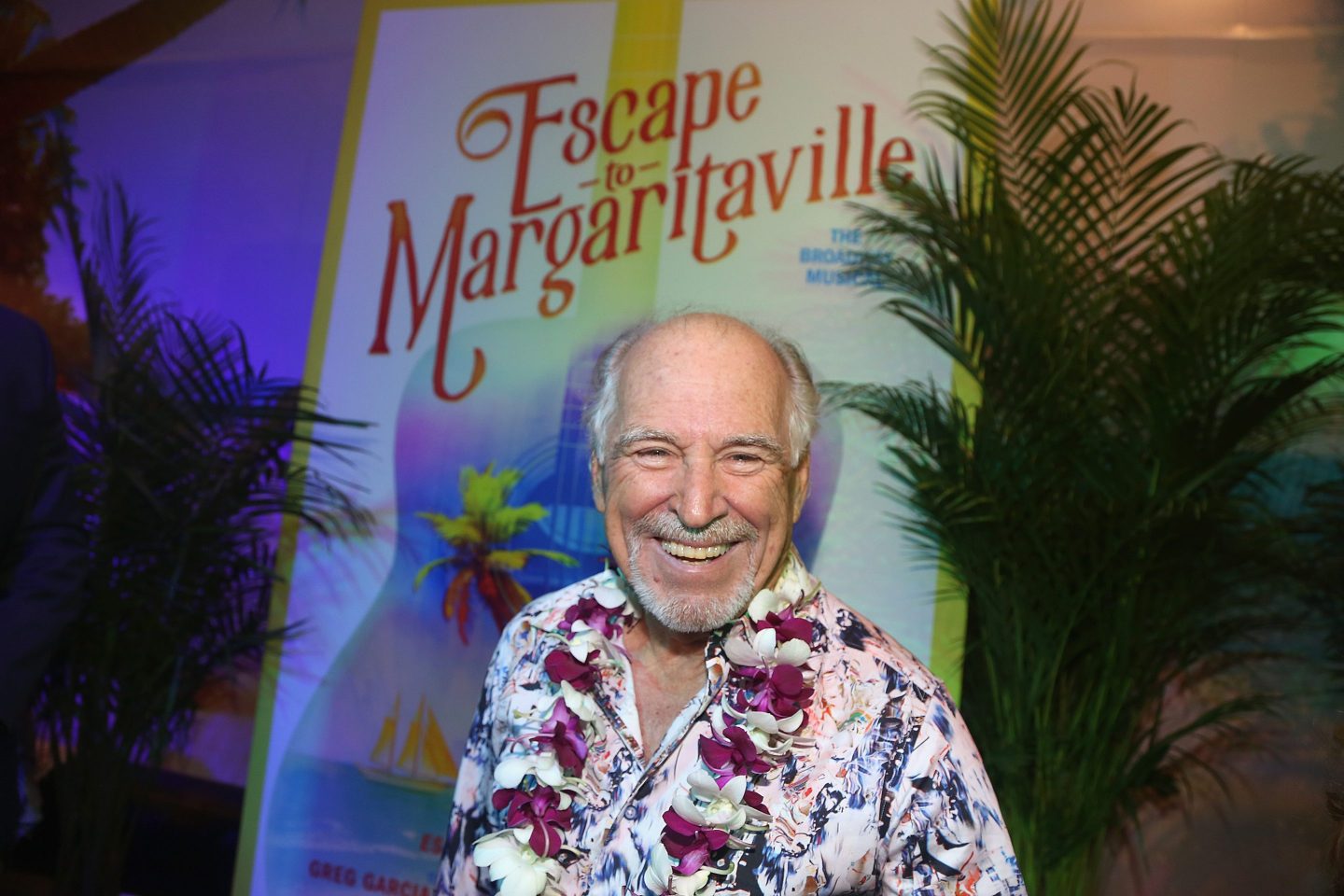
With the death of Jimmy Buffett, the feathers of his loyal network of fans – affectionately known as Parrot Heads – collectively drooped.
Over the course of his career, Buffett earned their love by transforming himself into a kind of musical shaman who offered transport from the banalities of everyday life to the bounty of a never-never land of eternal sun, endless sandy beaches and bottomless boat drinks: Margaritaville.
As a young fan in the 1980s and 1990s, I marveled at the power of Buffett’s music to carry his audience to this fantastic utopia, seeing in it nothing more than a bit of harmless fun.
But as I matured and eventually became a professor of philosophy, I came to see Buffett’s music as less an expression of optimistic pleasure-seeking and more a reflection of a profoundly pessimistic assessment of the trials and tribulations of life. Now his work strikes me as a closer companion to the pessimistic conclusions of the 19th-century philosopher Arthur Schopenhauer than to the hedonism of leisure culture.
I see this hidden pessimism – which underlies most of Buffett’s music – as the key to its enduring power and allure.
An escape to Saint Somewhere
Half troubadour and half travel agent, Buffett has long been in the business of selling escape.
Escapism was not only the driving force and centerpiece of his 30 studio albums and the main plotline of his three novels. It was also the heart and soul of his billion-dollar business empire, which included two restaurant chains, a line of frozen dinners and a fleet of hotels and casinos.
These myriad products, as their varied taglines and marketing campaigns tout, promise to carry their consumer away from the monotony of suburbia to the galleys of some imaginary Caribbean Island – “Saint Somewhere,” as Buffett put it in his 1979 hit “Boat Drinks.”
Buffett readily admitted his commitment to supplying his fans with some relief from reality. In his 2004 appearance on “60 Minutes,” he gleefully professed, “I sell escapism.” When interviewed by Sports Illustrated in 2007 he said, “I’m just doing my part to add a little more escapism to an otherwise crazy world.”
The question remains, however: Why are people so consistently drawn to Buffett’s special brand of escapism? Or to escapism in general?
Answering this question uncovers the pessimistic heart of Buffett’s work.
Just a little relief
Buffett himself ventured an answer to this question in the afterword of his 2004 novel, “A Salty Piece of Land”: “… now, more than ever, we don’t just enjoy our escapism – we NEED it.”
For Buffett, escapism was not merely something fun, some fiddling flight of fancy that can be taken up or discarded at will.
It is something essential to our survival – something that, as he put it in his 1974 track “Trying to Reason with the Hurricane Season,” “cleans [us] out” so that it’s possible to move on with life.
To love the music of Jimmy Buffett, in other words, is not to love life. It is to pessimistically admit that life is difficult and that it needs to be escaped every once in a while just to be endured.
In Buffett’s music one catches a glimpse, however fleeting and even false, of the possibility that somewhere out there, somewhere beyond the persistent struggles and disappointment of life, there lies “somewhere warm,” as he puts it: some utopia where all our fears and anxieties might be wiped away and we can heal from whatever grieves us, whether the heartache of a breakup or the trauma of having “[blown] out a flip-flop,” or “stepped on a pop top.”
“When I look out at my audience,” Buffett noted in a 1998 interview with Time magazine, “I see people who are caring for aging parents and dealing with tough jobs, adolescent kids, and they look like they could use a little relief.”
And that’s what he endeavored to give them: a little relief from the woes and worries of their lives.
The role of good art and good music
Buffett’s first big hit, “Come Monday,” originated from his own need to escape a particularly dark period of life.
“I was deathly depressed and living in Howard Johnson’s in Marin County,” he confessed to David Letterman in 1983, “and this song kept me from killing myself.”
Fortunately, he explained to Letterman, “it hit, and I was able to pay my rent and get my dog out of the pound.” It was his capacity to respond to the overwhelming difficulties of life in this spirit of comedic melancholia that made Buffett’s music so special.
His songs acknowledge what everyone already knows to be true: that life can be excruciatingly painful and is often too much to bear, but that one must nevertheless find a way to move on. It is this pessimistic subtext to Buffett’s escapism that made it so achingly irresistible.
In this sense, Buffett’s music exemplifies what the 19th-century pessimistic philosopher Arthur Schopenhauer thought of as the ultimate power of art.
To Schopenhauer, good art grows from a recognition of the difficulties of life, and it endeavors to respond to them by offering a momentary respite from its otherwise relentless slings and arrows.
For these reasons, Schopenhauer saw in art – and in music, especially – a way of escaping reality, of being carried away into a fantasy land that everyone knows can never exist, but that is nonetheless comforting to contemplate.
The value of art, according to Schopenhauer’s pessimistic perspective, comes from how it creates an imaginary space where one can momentarily hide from reality to summon the courage to continue on – and perhaps to even learn from that hiatus how to laugh at the gallows that confront every living creature.
By this pessimistic measure, Buffett’s music was high art, for what it did so well was to help its listeners to escape the onslaught of modern life and teach them to laugh again – not in hedonistic ignorance of its difficulties, but in spite of them. What Buffett and all of his fans secretly know is that such escapist reveries are not merely an optional lark but a necessary tool for survival.
As Buffett himself put it in his 1977 hit “Changes in Latitudes, Changes in Attitudes,” “If we couldn’t laugh we would all go insane.”
Drew M. Dalton is Professor of Philosophy, Dominican University.
This article is republished from The Conversation under a Creative Commons license. Read the original article.