
• Home
  • Latest
  • Fortune 500
  • Finance
  • Tech
  • Leadership
  • Lifestyle
  • Rankings
  • Multimedia
Apple

Tim Cook said Apple and China had a ‘symbiotic’ relationship just 6 months ago. Now Beijing’s reported iPhone ban may mean the good feelings are over 

Nicholas Gordon
By
Nicholas Gordon
Nicholas Gordon
Asia Editor
Down Arrow Button Icon
Nicholas Gordon
By
Nicholas Gordon
Nicholas Gordon
Asia Editor
Down Arrow Button Icon
September 8, 2023, 6:08 AM ET
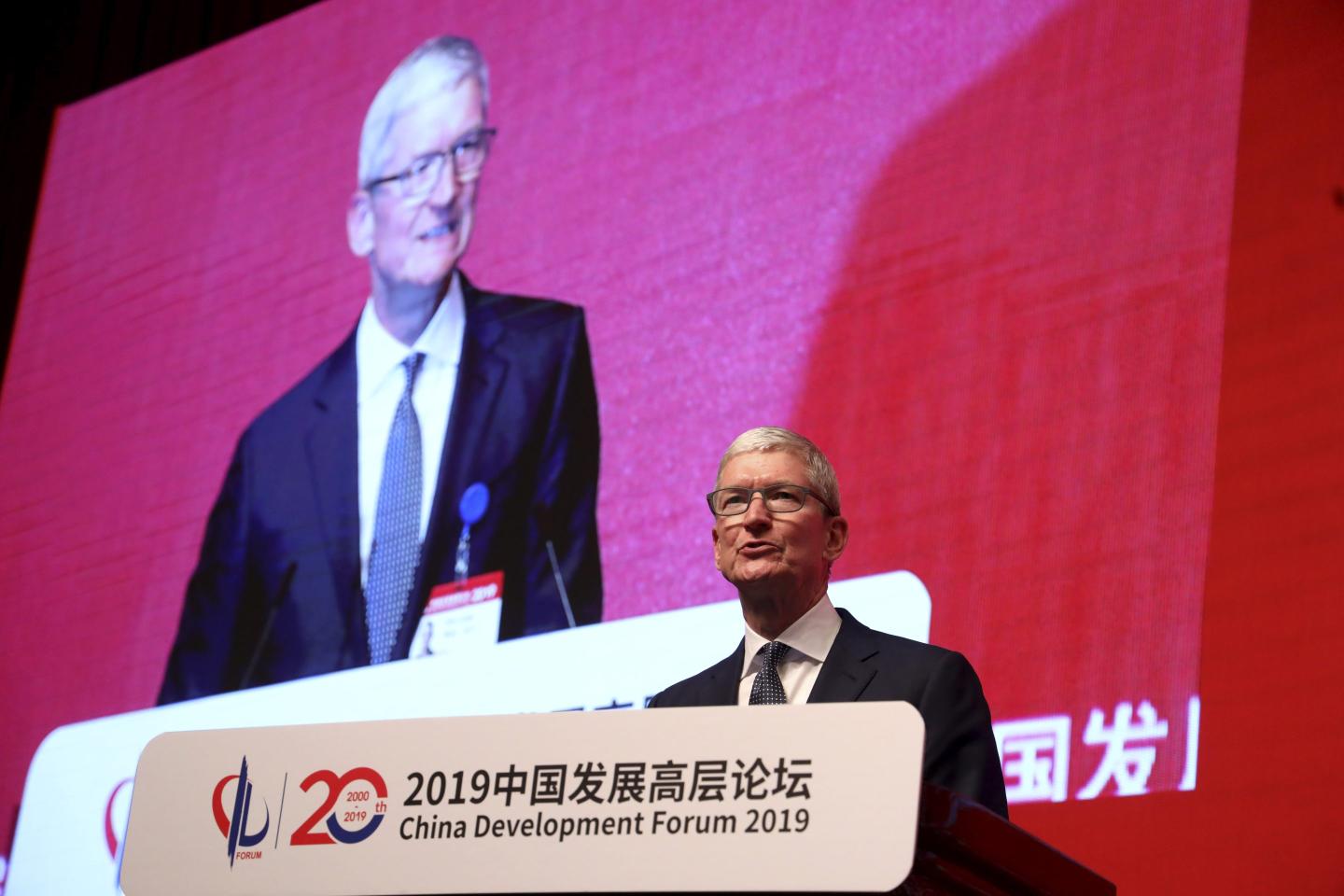
Apple CEO Tim Cook speaks at the 2019 China Development Forum.
Apple CEO Tim Cook speaks at the 2019 China Development Forum. NgG Han Guan—AFP/Getty Images

Just a few months ago, Tim Cook was one of the few U.S. CEOs brave enough to venture to China after its reopening. In March, Apple’s chief executive attended a high-profile government-organized conference, met with China’s leaders, and proudly declared that Apple and China had a “symbiotic kind of relationship.”

Recommended Video

That relationship is now being tested amid reports that Beijing is stopping some of its state employees from using Apple’s smartphone, as China takes a hard line against any official use of foreign technologies. 

Beijing is ordering officials in some government departments to stop using iPhones, the Wall Street Journal reported Wednesday. Beijing is also considering extending the ban across the government and to state-owned enterprises, Bloomberg reported Thursday.

The news hit Apple’s stocks hard. Shares are now down by almost 7% over the past two days, wiping out $200 billion in market value for the tech company. (Apple is still the world’s most valuable company by far, at $2.7 trillion versus second-place Microsoft at $2.4 trillion.)

Apple did not immediately respond to a request for comment. 

If Beijing really does limit the use of the iPhone, it’s a potential blow to the close connection between Apple and China. Yet it was a relationship that was already slightly shaky after supply-chain disruptions, and is now pressured by the return of a competitor: Huawei Technologies. 

How important is China to Apple?

China is key to Apple’s supply chain and to its sales.

Apple relies on Chinese suppliers to make many of its electronics, including the iPhone, iPad, AirPods and its upcoming Vision Pro headset. About half of Apple’s smartphones are made in a giant factory complex in Zhengzhou, nicknamed “iPhone City,” operated by electronics manufacturer Foxconn. 

China is also a major consumer market for Apple, as its largest outside the U.S. The company generated $15.8 billion in sales from China alone last quarter, just over 19% of its total. And Chinese consumers flock to the iPhone, too: Apple has 65% market share for premium phones over $600, according to the Wall Street Journal citing data from research firm IDC. (Apple is in fourth place overall, behind cheaper domestic brands Oppo, Vivo, and Honor, according to the South China Morning Post.)

Apple also complies with Chinese regulations on censorship and data security, including storing the personal data of its Chinese customers in domestic data centers. 

But recent events may have pushed Apple to reconsider its reliance on the country. COVID-zero lockdowns, especially in Zhengzhou, drove the company to warn last November that production of the then–latest-model iPhones would be lower than expected heading into the U.S. holiday season.

China’s economic slowdown could also weigh on smartphone sales, though Apple has managed to withstand the drop in consumer confidence thus far. Apple was the only smartphone vendor among the top five in China to increase its sales last quarter, according to CNBC. 

Apple is investing in manufacturing elsewhere in Asia to diversify its supply chain. The company now makes 7% of its iPhones in India, and has reportedly started production of the next iPhone in the South Asian country. Apple is also shifting some production of iPads, MacBooks, and AirPods to Vietnam.

The company also hopes that India will be the next big market for its electronics. Cook called the country “a hugely exciting market for us” on a call with analysts in February, and Apple opened its first retail outlets in the country earlier this year.  

Espionage concerns

China reportedly set out a plan in 2019 to remove all foreign technology from government operations within three years. The decision was motivated partly by U.S. sanctions on Huawei, barring it from buying advanced chips. The Chinese company was forced to stop producing its premium phones, revealing U.S. leverage over China’s tech sector.

Last year, China ordered government agencies to stop using foreign-made PCs and software, diverting them from Western companies like HP and Microsoft toward domestic alternatives like Lenovo and Kingsoft. 

Chinese concerns about data security and espionage have even extended to Tesla, with officials at times barring the company’s electric cars from sensitive areas. 

Of course, the U.S. has similar espionage concerns when it comes to Chinese-made hardware and software. Washington has pushed U.S. telecom companies to strip Huawei from their 5G networks, and has banned TikTok, from China-based developer ByteDance, from government devices. The U.S. is currently discussing whether to ban TikTok from the U.S. entirely.

An alternative

And another threat for Apple may loom on the horizon. 

Huawei, at one point the world’s largest smartphone manufacturer, quietly launched the Mate 60 Pro last week. The phone features performance that keeps pace with Apple’s iPhone, and a processor that’s only a few years behind the cutting-edge. The technological achievement comes despite years of U.S. controls on sales of advanced chips and chipmaking equipment to Huawei and China more broadly in a bid to kneecap the country’s semiconductor sector.

On Friday, Huawei announced an even more powerful version of the Mate 60 Pro, which features more memory and connections to China’s GPS competitor, BeiDou.

While Huawei was muted about the phone’s release, Chinese state media was not. “The resurgence of Huawei smartphones after three years of forced silence is enough to prove that the U.S.’s extreme suppression has failed,” wrote the Global Times, a state-run English-language outlet. 

The U.S. Commerce Department on Thursday said it would investigate how Huawei got its hands on the advanced chip, made by the also-blacklisted Semiconductor Manufacturing International Corp., China’s largest chipmaker.

Join us at the Fortune Workplace Innovation Summit May 19–20, 2026, in Atlanta. The next era of workplace innovation is here—and the old playbook is being rewritten. At this exclusive, high-energy event, the world’s most innovative leaders will convene to explore how AI, humanity, and strategy converge to redefine, again, the future of work. Register now.
About the Author
Nicholas Gordon
By Nicholas GordonAsia Editor
LinkedIn iconTwitter icon

Nicholas Gordon is an Asia editor based in Hong Kong, where he helps to drive Fortune’s coverage of Asian business and economics news.

See full bioRight Arrow Button Icon

Latest in

Finance
Lorem ipsum dolor sit amet, consectetur adipiscing elit, sed do eiusmod tempor incididunt ut labore et dolore magna aliqua. Ut enim ad minim veniam
By Fortune Editors
October 20, 2025
Finance
Lorem ipsum dolor sit amet, consectetur adipiscing elit, sed do eiusmod tempor incididunt ut labore et dolore magna aliqua. Ut enim ad minim veniam
By Fortune Editors
October 20, 2025
Finance
Lorem ipsum dolor sit amet, consectetur adipiscing elit, sed do eiusmod tempor incididunt ut labore et dolore magna aliqua. Ut enim ad minim veniam
By Fortune Editors
October 20, 2025
Finance
Lorem ipsum dolor sit amet, consectetur adipiscing elit, sed do eiusmod tempor incididunt ut labore et dolore magna aliqua. Ut enim ad minim veniam
By Fortune Editors
October 20, 2025
Finance
Lorem ipsum dolor sit amet, consectetur adipiscing elit, sed do eiusmod tempor incididunt ut labore et dolore magna aliqua. Ut enim ad minim veniam
By Fortune Editors
October 20, 2025
Finance
Lorem ipsum dolor sit amet, consectetur adipiscing elit, sed do eiusmod tempor incididunt ut labore et dolore magna aliqua. Ut enim ad minim veniam
By Fortune Editors
October 20, 2025

Most Popular

Finance
Lorem ipsum dolor sit amet, consectetur adipiscing elit, sed do eiusmod tempor incididunt ut labore et dolore magna aliqua. Ut enim ad minim veniam
By Fortune Editors
October 20, 2025
Finance
Lorem ipsum dolor sit amet, consectetur adipiscing elit, sed do eiusmod tempor incididunt ut labore et dolore magna aliqua. Ut enim ad minim veniam
By Fortune Editors
October 20, 2025
Finance
Lorem ipsum dolor sit amet, consectetur adipiscing elit, sed do eiusmod tempor incididunt ut labore et dolore magna aliqua. Ut enim ad minim veniam
By Fortune Editors
October 20, 2025
Finance
Lorem ipsum dolor sit amet, consectetur adipiscing elit, sed do eiusmod tempor incididunt ut labore et dolore magna aliqua. Ut enim ad minim veniam
By Fortune Editors
October 20, 2025
Finance
Lorem ipsum dolor sit amet, consectetur adipiscing elit, sed do eiusmod tempor incididunt ut labore et dolore magna aliqua. Ut enim ad minim veniam
By Fortune Editors
October 20, 2025
Finance
Lorem ipsum dolor sit amet, consectetur adipiscing elit, sed do eiusmod tempor incididunt ut labore et dolore magna aliqua. Ut enim ad minim veniam
By Fortune Editors
October 20, 2025
Fortune Secondary Logo
Rankings
  • 100 Best Companies
  • Fortune 500
  • Global 500
  • Fortune 500 Europe
  • Most Powerful Women
  • World's Most Admired Companies
  • See All Rankings
  • Lists Calendar
Sections
  • Finance
  • Fortune Crypto
  • Features
  • Leadership
  • Health
  • Commentary
  • Success
  • Retail
  • Mpw
  • Tech
  • Lifestyle
  • CEO Initiative
  • Asia
  • Politics
  • Conferences
  • Europe
  • Newsletters
  • Personal Finance
  • Environment
  • Magazine
  • Education
Customer Support
  • Frequently Asked Questions
  • Customer Service Portal
  • Privacy Policy
  • Terms Of Use
  • Single Issues For Purchase
  • International Print
Commercial Services
  • Advertising
  • Fortune Brand Studio
  • Fortune Analytics
  • Fortune Conferences
  • Business Development
  • Group Subscriptions
About Us
  • About Us
  • Press Center
  • Work At Fortune
  • Terms And Conditions
  • Site Map
  • About Us
  • Press Center
  • Work At Fortune
  • Terms And Conditions
  • Site Map
  • Facebook icon
  • Twitter icon
  • LinkedIn icon
  • Instagram icon
  • Pinterest icon

Latest in

Google Cloud CEO Thomas Kurian at Fortune Brainstorm AI 2025 in San Francisco. (Photo: Stuart Isett/Fortune)
NewslettersFortune Tech
Google Cloud is almost one-fifth of Alphabet’s business
By Andrew NuscaApril 30, 2026
54 minutes ago
Mohamed Aly El-Erian during a Bloomberg Television interview in London, UK, on Monday, Sept. 25, 2023.
EconomyRecession
The global economy has a month—eight weeks at most—to avoid a recession, warns top economist
By Eleanor PringleApril 30, 2026
58 minutes ago
Global investors are shrugging off Iran worries and returning to markets in Asia, the ‘backbone of the whole AI value chain’
AsiaInvestment
Global investors are shrugging off Iran worries and returning to markets in Asia, the ‘backbone of the whole AI value chain’
By Angelica AngApril 30, 2026
1 hour ago
hoskins
Commentaryoffices
Gensler Co-Chair: Hot-desking was supposed to save money. It may be costing you your culture
By Diane HoskinsApril 30, 2026
1 hour ago
Photo: Donald Trump
Big TechMarkets
With no end in sight, Trump considers new options in Iran war—including the ‘Dark Eagle’ hypersonic missile
By Jim EdwardsApril 30, 2026
1 hour ago
Top CD rates today, April 30, 2026: Lock in up to up to 4.20%
Personal FinanceCertificates of Deposit (CDs)
Top CD rates today, April 30, 2026: Lock in up to up to 4.20%
By Glen Luke FlanaganApril 30, 2026
2 hours ago

Most Popular

Apple cofounder Ronald Wayne—whose stake would be worth up to $400 billion had he not sold it in 1976—says that at 91, he has no regrets
Success
Apple cofounder Ronald Wayne—whose stake would be worth up to $400 billion had he not sold it in 1976—says that at 91, he has no regrets
By Preston ForeApril 27, 2026
3 days ago
‘Take the money and run’: Johns Hopkins economist Steve Hanke on why the UAE quit OPEC
Energy
‘Take the money and run’: Johns Hopkins economist Steve Hanke on why the UAE quit OPEC
By Shawn TullyApril 29, 2026
1 day ago
Jamie Dimon gets candid about national debt: ‘There will be a bond crisis, and then we’ll have to deal with it’
Economy
Jamie Dimon gets candid about national debt: ‘There will be a bond crisis, and then we’ll have to deal with it’
By Eleanor PringleApril 29, 2026
1 day ago
‘The cost of compute is far beyond the costs of the employees’: Nvidia executive says right now AI is more expensive than paying human workers
AI
‘The cost of compute is far beyond the costs of the employees’: Nvidia executive says right now AI is more expensive than paying human workers
By Sasha RogelbergApril 28, 2026
2 days ago
‘They left me no choice’: Powell isn’t going anywhere—blocking Trump from another Fed appointee
Banking
‘They left me no choice’: Powell isn’t going anywhere—blocking Trump from another Fed appointee
By Eva RoytburgApril 29, 2026
17 hours ago
More than two-thirds of U.S. schools say they’re unable to afford the cost of student free lunch—and MAHA’s dietary guidelines may make it worse
Economy
More than two-thirds of U.S. schools say they’re unable to afford the cost of student free lunch—and MAHA’s dietary guidelines may make it worse
By Sasha RogelbergApril 29, 2026
1 day ago

© 2026 Fortune Media IP Limited. All Rights Reserved. Use of this site constitutes acceptance of our Terms of Use and Privacy Policy | CA Notice at Collection and Privacy Notice | Do Not Sell/Share My Personal Information
FORTUNE is a trademark of Fortune Media IP Limited, registered in the U.S. and other countries. FORTUNE may receive compensation for some links to products and services on this website. Offers may be subject to change without notice.