• Home
  • Latest
  • Fortune 500
  • Finance
  • Tech
  • Leadership
  • Lifestyle
  • Rankings
  • Multimedia
Personal FinanceTipping

With tipping etiquette in flux, here’s how to avoid losing your mind—or feeling ripped off

By
Nathan B. Warren
Nathan B. Warren
,
Sara Hanson
Sara Hanson
, and
The Conversation
The Conversation
Down Arrow Button Icon
By
Nathan B. Warren
Nathan B. Warren
,
Sara Hanson
Sara Hanson
, and
The Conversation
The Conversation
Down Arrow Button Icon
August 18, 2023, 4:38 PM ET
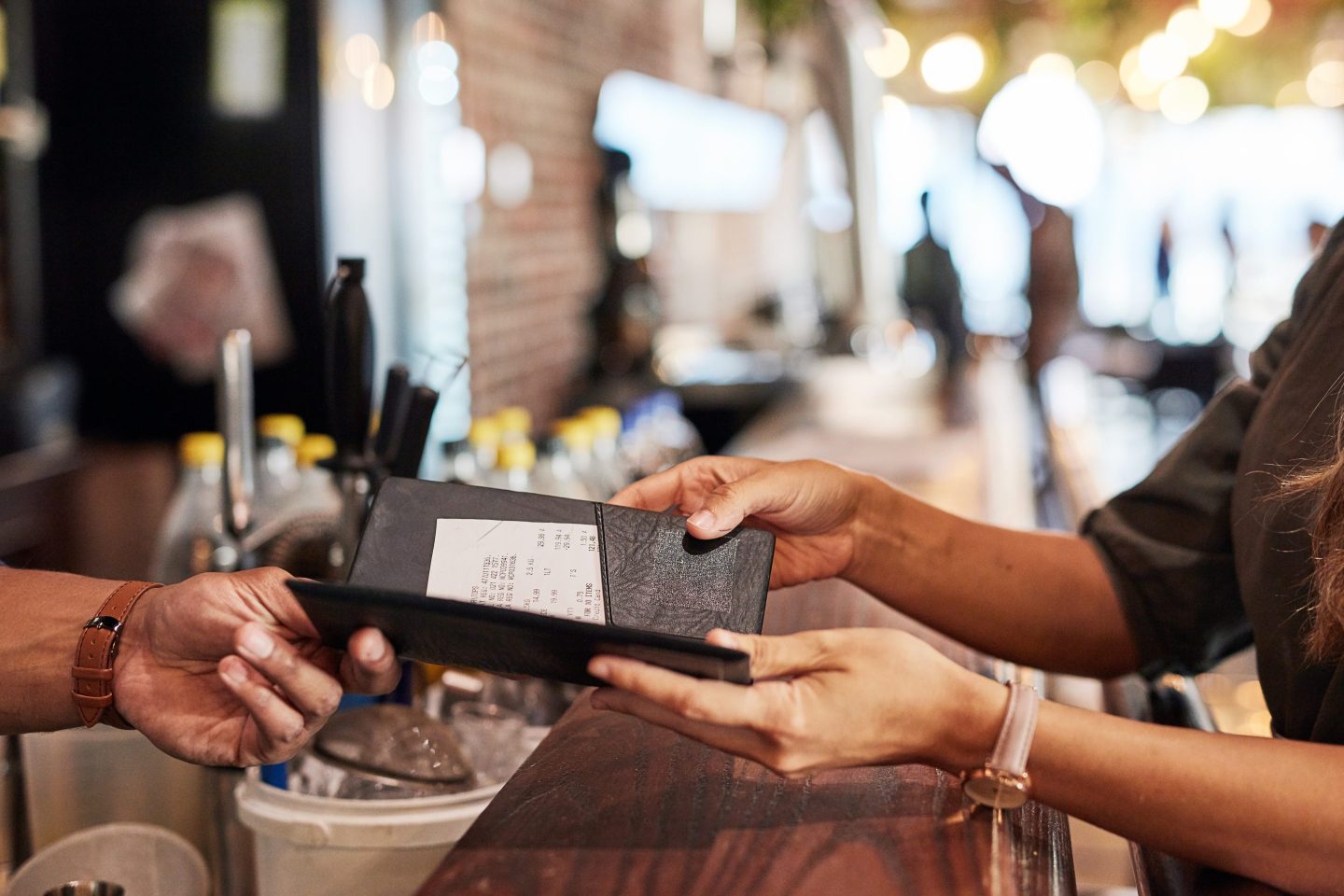
Two pairs of hands exchange a restaurant bill.
A billfold holding a suggested tip line.Getty Images

Tipping has gotten more complicated—and awkward—in North America.

Recommended Video

The ever-growing list of situations in which you might be invited to tip includes buying a smoothie, paying an electrician, getting a beer from a flight attendant, and making a political donation.

Should you always tip when someone suggests it? If yes, how do you calculate the right amount? And if you don’t, are you being stingy?

As marketing professors who specialize in customer interactions, we’re researching how digital payment technologies have changed how and when customers tip. Our research suggests that asking for tips before service and suggesting tip amounts that are too high can frustrate customers and be bad for business.

U.S. customers historically tipped people they assumed were earning most of their income via tips, such as restaurant servers earning less than the minimum wage. In the early 2010s, a wide range of businesses started processing purchases with iPads and other digital payment systems. These systems often prompted customers to tip for services that were not previously tipped.

Money in a tip jar in a Taos, New Mexico, coffee shop.
Robert Alexander—Getty Images

Today’s tip requests are often not connected to the salary and service norms that used to determine when and how people tip.

Customers in the past nearly always paid tips after receiving a service, such as at the conclusion of a restaurant meal, after getting a haircut, or once your pizza was delivered. That timing could reward high-quality service and give workers an incentive to provide it.

It’s becoming more common for tips to be requested beforehand. And new tipping technology may even automatically add tips.

Tip creep and tipflation

The prevalence of digital payment devices has made it easier to ask customers for a tip. That helps explain why tip requests are creeping into new kinds of services.

Customers now routinely see menus of suggested default options—often well above 20% of what they owe. The amounts have risen from 10% or less in the 1950s to 15% around the year 2000 to 20% or higher today. This increase is sometimes called tipflation – the expectation of ever-higher tip amounts.

The COVID-19 pandemic, which hastened the adoption of digital payments and increased sympathy for service workers, amplified both tip creep and tipflation.

Tipping has always been a vital source of income for workers in historically tipped services, like restaurants, where the tipped minimum wage can be as low as US$2.13 an hour. Tip creep and tipflation are now further supplementing the income of many low-wage service workers.
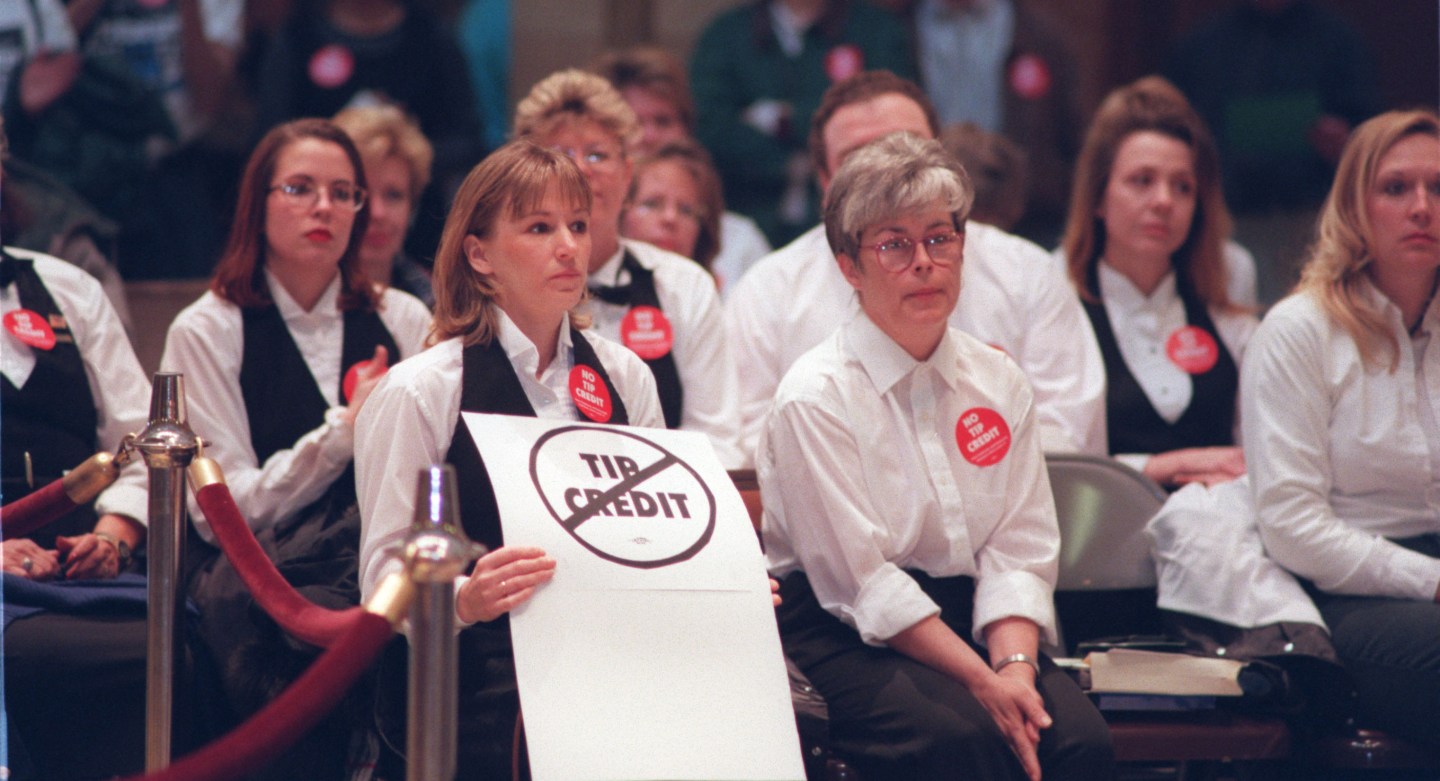
A group of waitress and waiters hold a sign with the words "tip credit" crossed out
Waiters and waitresses gather at the Capitol Rotunda in Minneapolis, Minnesota, in 1997, to protest proposed legislation letting employers pay them less than minimum wage in exchange for tips from customers.
David Brewster—Star Tribune/Getty Images

Notably, tipping primarily benefits some of these workers, such as waiters, but not others, such as cooks and dishwashers. To ensure that all employees were paid fair wages, some restaurants banned tipping and increased prices, but this movement toward no-tipping services has largely fizzled out.

So, to increase employee wages without raising prices, more employers are succumbing to the temptations of tip creep and tipflation. However, many customers are frustrated because they feel they are being asked for too high of a tip, too often. And, as our research emphasizes, tipping now seems to be more coercive, less generous and often completely dissociated from service quality.

While digital tipping can be an easy way for customers to help workers or express their gratitude for good service, many Americans feel uncertain about what to do when asked for a tip.

3 questions to always ask

Here are some questions you can ask yourself when faced with almost any tipping decision.

1. Should I tip?

It’s generally up to you to decide whether you will tip and how much.

To avoid being pressured into tipping when you don’t want to, establish your own norms for different services. That will make you less likely to be surprised by an unexpected or high-pressure tip request. Many customers do pay tips in those situations but get upset.

We advise you to always tip when there’s a clear tradition of doing so: dining at full-service restaurants or ordering a drink at a bar, traveling by taxi, having meals delivered to your door and getting a haircut.

We also recommend tipping employees you believe are being paid less than a fair wage. Though it can be difficult to determine whether employees are underpaid, learning whether your state or city guarantees a minimum wage that’s well above the federal requirement can help.

For many tipped services, quality varies widely. In these situations, you can use tips to reward better service, if you pay after receiving it; or you can give workers a tip beforehand as an incentive to treat you well.

Likewise, pay a tip if you’re likely use the service again. You will earn a reputation as a good or bad tipper, and employees will treat you accordingly.

There’s a wide range of services that may or may not require a tip. These include quick-service cafes and takeout, where customers order at a counter rather than being waited on at a table. You will need to decide what to do in those situations on a case-by-case basis. Tipping a barista who has skillfully prepared your fancy latte makes more sense to us than tipping a worker who rings up a can of soda.

In many instances, paying and tipping in cash makes the most sense because you can avoid coercive technology and ensure that the employee who helped you directly receives the tip. That way, the employee will know you appreciate their service, and you can be fairly certain that their employer is not somehow swiping their tip money.

A tip jar on the counter at Cafeza in Houston promises customers “instant good karma.”
Brett Coomer—Houston Chronicle/Getty Images

2. How much?

This question is especially important when preservice tips are requested. If service quality may vary based on your response, for example with food delivery, food trucks, bars and restaurants, we suggest tipping the middle or high default tip amount, which will often be around 20%, or a flat dollar amount that is the rough equivalent. That approach will avoid the possibility of getting poor service. Of course, this can result in frustration if service doesn’t meet your expectations.

An alternative strategy is to tip the lowest recommended option, which is often close to 10%, then add an additional cash tip if the service is good. While using this strategy risks bad service, it’s a wise way to go if you plan to be a repeat customer.

3. Can I skip it this time?

If a tip request comes as a surprise, that usually means there is no norm you’re familiar with for that service. We recommend that you don’t tip in that situation, despite the social pressure. If you wind up tipping anyway, we recommend either not returning to the business or writing a polite but critical review online describing your uncomfortable experience.

We don’t believe there’s a reason to feel guilty leaving no tip or a low tip when you are using a service that is not traditionally tipped or where service quality is not affected by the tip amount, such as when making a donation or ordering an office chair from an internet retailer.

Ultimately, tipping is voluntary, which makes it a personal choice.

But whether you tip or not, you should always treat service workers well, especially tipped service workers. They are often exposed to the worst customer behaviors, including harassment, which is never appropriate – no matter how much a customer tips.

Nathan B. Warren, Assistant Professor of Marketing, BI Norwegian Business School and Sara Hanson, Associate Professor of Marketing, University of Richmond

This article is republished from The Conversation under a Creative Commons license. Read the original article.

Join us at the Fortune Workplace Innovation Summit May 19–20, 2026, in Atlanta. The next era of workplace innovation is here—and the old playbook is being rewritten. At this exclusive, high-energy event, the world’s most innovative leaders will convene to explore how AI, humanity, and strategy converge to redefine, again, the future of work. Register now.
About the Authors
By Nathan B. Warren
See full bioRight Arrow Button Icon
By Sara Hanson
See full bioRight Arrow Button Icon
By The Conversation
See full bioRight Arrow Button Icon

Latest in Personal Finance

Finance
Lorem ipsum dolor sit amet, consectetur adipiscing elit, sed do eiusmod tempor incididunt ut labore et dolore magna aliqua. Ut enim ad minim veniam
By Fortune Editors
October 20, 2025
Finance
Lorem ipsum dolor sit amet, consectetur adipiscing elit, sed do eiusmod tempor incididunt ut labore et dolore magna aliqua. Ut enim ad minim veniam
By Fortune Editors
October 20, 2025
Finance
Lorem ipsum dolor sit amet, consectetur adipiscing elit, sed do eiusmod tempor incididunt ut labore et dolore magna aliqua. Ut enim ad minim veniam
By Fortune Editors
October 20, 2025
Finance
Lorem ipsum dolor sit amet, consectetur adipiscing elit, sed do eiusmod tempor incididunt ut labore et dolore magna aliqua. Ut enim ad minim veniam
By Fortune Editors
October 20, 2025
Finance
Lorem ipsum dolor sit amet, consectetur adipiscing elit, sed do eiusmod tempor incididunt ut labore et dolore magna aliqua. Ut enim ad minim veniam
By Fortune Editors
October 20, 2025
Finance
Lorem ipsum dolor sit amet, consectetur adipiscing elit, sed do eiusmod tempor incididunt ut labore et dolore magna aliqua. Ut enim ad minim veniam
By Fortune Editors
October 20, 2025

Most Popular

Finance
Lorem ipsum dolor sit amet, consectetur adipiscing elit, sed do eiusmod tempor incididunt ut labore et dolore magna aliqua. Ut enim ad minim veniam
By Fortune Editors
October 20, 2025
Finance
Lorem ipsum dolor sit amet, consectetur adipiscing elit, sed do eiusmod tempor incididunt ut labore et dolore magna aliqua. Ut enim ad minim veniam
By Fortune Editors
October 20, 2025
Finance
Lorem ipsum dolor sit amet, consectetur adipiscing elit, sed do eiusmod tempor incididunt ut labore et dolore magna aliqua. Ut enim ad minim veniam
By Fortune Editors
October 20, 2025
Finance
Lorem ipsum dolor sit amet, consectetur adipiscing elit, sed do eiusmod tempor incididunt ut labore et dolore magna aliqua. Ut enim ad minim veniam
By Fortune Editors
October 20, 2025
Finance
Lorem ipsum dolor sit amet, consectetur adipiscing elit, sed do eiusmod tempor incididunt ut labore et dolore magna aliqua. Ut enim ad minim veniam
By Fortune Editors
October 20, 2025
Finance
Lorem ipsum dolor sit amet, consectetur adipiscing elit, sed do eiusmod tempor incididunt ut labore et dolore magna aliqua. Ut enim ad minim veniam
By Fortune Editors
October 20, 2025
Fortune Secondary Logo
Rankings
  • 100 Best Companies
  • Fortune 500
  • Global 500
  • Fortune 500 Europe
  • Most Powerful Women
  • Future 50
  • World’s Most Admired Companies
  • See All Rankings
Sections
  • Finance
  • Fortune Crypto
  • Features
  • Leadership
  • Health
  • Commentary
  • Success
  • Retail
  • Mpw
  • Tech
  • Lifestyle
  • CEO Initiative
  • Asia
  • Politics
  • Conferences
  • Europe
  • Newsletters
  • Personal Finance
  • Environment
  • Magazine
  • Education
Customer Support
  • Frequently Asked Questions
  • Customer Service Portal
  • Privacy Policy
  • Terms Of Use
  • Single Issues For Purchase
  • International Print
Commercial Services
  • Advertising
  • Fortune Brand Studio
  • Fortune Analytics
  • Fortune Conferences
  • Business Development
About Us
  • About Us
  • Editorial Calendar
  • Press Center
  • Work At Fortune
  • Diversity And Inclusion
  • Terms And Conditions
  • Site Map
Fortune Secondary Logo
  • About Us
  • Editorial Calendar
  • Press Center
  • Work At Fortune
  • Diversity And Inclusion
  • Terms And Conditions
  • Site Map
  • Facebook icon
  • Twitter icon
  • LinkedIn icon
  • Instagram icon
  • Pinterest icon

Latest in Personal Finance

A man wearing a red hat shakes Trump's hand in a crows
Personal FinanceRetirement
Trump’s universal 401(k) architect on why lower-income people distrust retirement accounts: ‘they want to know what the catch is’
By Jacqueline MunisFebruary 28, 2026
6 hours ago
CybersecurityMeta
Trump’s FTC backs off social media regulation despite finding that nearly 20% of America’s children are online for 4 hours or more
By Catherina GioinoFebruary 27, 2026
19 hours ago
Personal FinanceInsurance
State Farm is doling out $100 checks to 49 million customers. Here’s who qualifies and how to get paid
By Sydney LakeFebruary 27, 2026
21 hours ago
Personal Financewealth management
The Great Wealth Transfer is already happening as millennials hitting their ‘Peak 35’ are richer than ever
By Catherina GioinoFebruary 27, 2026
22 hours ago
Personal Financegold prices
Current price of gold as of February 27, 2026
By Danny BakstFebruary 27, 2026
1 day ago
Current big bank CD rates as of Friday, February 27, 2026
Personal FinanceCertificates of Deposit (CDs)
Top CD rates from major banks on February 27, 2026: Chase CDs, Bank of America CDs, Citibank CDs, and more
By Joseph HostetlerFebruary 27, 2026
1 day ago

Most Popular

placeholder alt text
Success
Japanese companies are paying older workers to sit by a window and do nothing—while Western CEOs demand super-AI productivity just to keep your job
By Orianna Rosa RoyleFebruary 27, 2026
1 day ago
placeholder alt text
Success
Walmart exec says U.S. workforces needs to take inspiration from China where ‘5 year-olds are learning DeepSeek’
By Preston ForeFebruary 27, 2026
1 day ago
placeholder alt text
Law
China's government intervenes to show Michigan scientists were carrying worms, not biological materials
By Ed White and The Associated PressFebruary 26, 2026
2 days ago
placeholder alt text
Commentary
'The Pitt': a masterclass display of DEI in action 
By Robert RabenFebruary 26, 2026
2 days ago
placeholder alt text
Economy
Come 2030, the U.S. deficit will be worth 5.9% of GDP—more than spending on Social Security, and equal to major health programs
By Eleanor PringleFebruary 26, 2026
2 days ago
placeholder alt text
Personal Finance
Current price of gold as of February 27, 2026
By Danny BakstFebruary 27, 2026
1 day ago

© 2026 Fortune Media IP Limited. All Rights Reserved. Use of this site constitutes acceptance of our Terms of Use and Privacy Policy | CA Notice at Collection and Privacy Notice | Do Not Sell/Share My Personal Information
FORTUNE is a trademark of Fortune Media IP Limited, registered in the U.S. and other countries. FORTUNE may receive compensation for some links to products and services on this website. Offers may be subject to change without notice.