When you write about the stock market and the economy, you get a lot of hate mail. It’s just part of the job. Tempers tend to fray when money is on the line, and big names express their opinions, which are—at times—controversial. But over the past year, even with inflation fading and stocks rebounding, I’ve received a different type of correspondence from Fortune readers.
Simply put, they’re worried.
Ominous headwinds facing the U.S. economy and stock market, from rising public and private debts to commercial real estate woes, even left one reader asking plaintively: “How can I—as an average American and retail investor—protect my portfolio?”
To answer that question, reader, I reached out to one of the brightest minds on Wall Street. But I didn’t look for an eternal optimist to assuage your fears, leaving you burying your head in the sand and merely hoping for the best. Instead, I found a man known for consistently and meticulously preparing for (but not necessarily predicting) the next economic crisis: Mark Spitznagel, the founder and chief investment officer of the private hedge fund Universa Investments.
Spitznagel’s firm is dedicated to tail-risk hedging, a strategy that seeks to prevent losses from unforeseeable and unlikely economic catastrophes like wars or pandemics by purchasing insurance-like derivative contracts. The phrase “tail-risk hedging” is a reference to the skinny left tail of a bell curve (normal) distribution of outcomes, where really unlikely, but really bad, things happen. These are called, more proverbially, black-swan events, and Spitznagel has a long history with Nassim Taleb, who coined the famous financial phrase.
“Nassim and I formulated the nuts and bolts of this general idea 25 years ago. We were the first formal tail-risk hedge fund,” Spitznagel told Fortune. “We just bounced ideas off each other; we still do to this day. He’s been a big part of the thinking behind the growth of this.”
Taleb and Spitznagel’s repeated success using this somewhat controversial tactic is detailed in Wall Street Journal reporter Scott Patterson’s new book Chaos Kings, including the billions Universa earned from its crash protection during the Global Financial Crisis of 2008.
I hoped that Spitznagel would help me find a simple yet practical solution to protect your portfolio from worst-case scenarios (or tail risks). After all, that is his “bread and butter.” But his answer wasn’t what I anticipated.
When you ask the man who has written multiple books on risk mitigation—his latest is called Safe Haven: Investing for Financial Storms—how retail investors can protect their capital, you expect to hear a few of the typical options: gold, Treasuries, or maybe the Swiss franc.
Instead of all that, Spitznagel warned that when it comes to safe-haven investing, “the cure is often worse than the disease.” If risk mitigation isn’t cost effective and supportive of higher overall returns in the long term, then it’s not worth it. In his view, most of the classic safe-haven strategies used by retail investors fall into this category.
There is some good news, however. A recession or market downturn may come, and Spitznagel says he’s worried about what he calls the “greatest credit bubble in human history” and a “tinderbox” economy. But perhaps paradoxically, he doesn’t expect even that to be the end of the world for retail investors focused on building wealth for the future. It may take time, he said, but markets always recover, even from unexpected, economy-crushing black swan events.
In spite of the potential for economic disaster, Spitznagel believes that retail investors should probably just listen to the timeless advice of Berkshire Hathaway chairman Warren Buffett: Focus on the long haul and don’t bet against America.
You have to love to lose
Most 16-year-old boys spend their days chasing girls and finding ways to get into trouble, but life has always been a little different for Spitznagel. In high school, he became an apprentice to a veteran corn and soybean trader known as the “Babe Ruth” of the Chicago Board of Trade, Everett Klipp. “He was like a grandfather to me,” Spitznagel said of Klipp. “Really one of the greatest people that I’ve ever known. Meeting him when I was still just a kid was my positive black swan event.”
Klipp was born on an Illinois dairy farm during the Great Depression and served in the Navy during World War II. Known for mentoring dozens of up-and-comers throughout his 50-year career, he taught a young Spitznagel about the importance of disciplined trading at an age when most of us were more worried about what we were going to wear to prom.
“His enthusiasm for trading and the open outcry markets in Chicago was contagious,” Spitznagel said, recalling some of Klipp’s favorite sayings, including the sign that sat at the entrance to his firm: “Have an attitude of gratitude!”
For Klipp, who died in 2011, a trader’s job wasn’t to make prescient market forecasts, it was to profit. That meant taking a small loss and moving on to the next trade was often a far better option than losing it all in an unexpected market swing.
Spitznagel said that Klipp’s self-described “love to lose” strategy and unwillingness to rely on forecasts is at the root of everything he does today. Universa, which managed over $16.4 billion as of the end of the first quarter, specializes in a risk-mitigation strategy that involves taking small, steady losses for long periods in order to purchase insurance that pays handsomely during a stock market crash.
Another adherent to this philosophy, of course, is the financial mathematician and bestselling author Taleb, who has always stressed the importance of preparing for the worst and serves as Universa’s “distinguished scientific advisor.”
In his 2010 book The Black Swan, Taleb describes the impact of uncommon and unpredictable outlier events on economies and markets. It’s a theory that Spitznagel said has been “very instrumental” to his own investing philosophy.
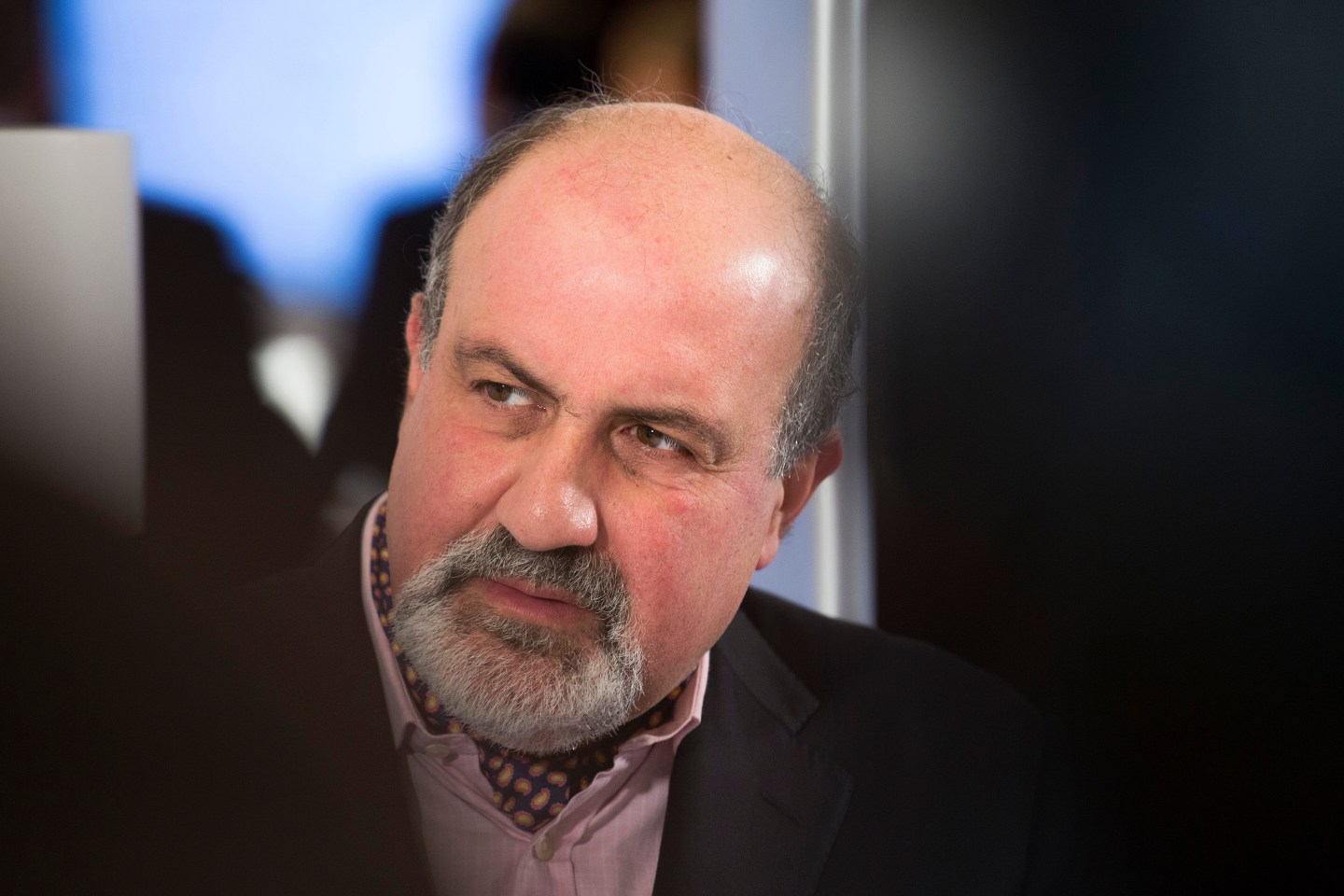
The pair met in 1999, when Spitznagel took a break from trading at the Chicago options exchange and enrolled in a master’s program for mathematical finance at New York University. Taleb, then an adjunct professor at NYU’s Courant Institute of Mathematical Sciences, became Spitznagel’s teacher, and the two quickly became friends and collaborators.
Spitznagel would go on to found Universa in 2007 and, with Taleb’s help, develop the firm’s now famous tail-risk hedging strategy, which, as previously discussed, relies on making explosive gains during serious market downturns through insurance-like options strategies, even if it means taking small losses to afford the insurance when times are good.
Spitznagel’s flagship fund, the Black Swan Protection Protocol, for example, made headlines when it profited from the COVID-induced downturn of 2020, with reporters latching onto a 4,144% return figure listed in a leaked letter to investors. The seemingly outlandish number led to criticism from multiple hedge fund peers, including Citadel’s former global head of fixed income, Derek Kaufman, who told Bloomberg earlier this year that Universa’s returns were probably “too good to be true.”
But Spitznagel clarified that the 4,144% return was derived not from the fund’s entire portfolio, but from the hedges (think: the insurance policy) that were acquired to profit during market downturns. It was an example of his explosive tail-risk protection strategy in operation, not a claim that his fund was returning over 4,000% per year to investors. Fortune was able to independently verify this claim after viewing the letter.
“I do hate that people think that we’re shrouded in mystery more than we need to be,” Spitznagel said. “These numbers are coming from a letter I wrote to my clients, all of whom have full transparency into their capital accounts. What do they think I’m getting away with?”
Universa is a private hedge fund, so it’s not required to disclose its flagship portfolio’s total returns, and Spitznagel declined to provide more recent return statistics to Fortune. But according to figures audited by EY, it posted a 105% life-to-date average annual return on invested capital between January 1, 2008, and December 31, 2019.
Those are impressive numbers, but there’s a problem for retail investors. This strategy—buying insurance-like protection against market crashes—is nearly impossible to pull off consistently. That’s why, even though Spitznagel is worried about the future of the stock market, he also says he doesn’t believe retail investors should try trading options or placing any form of bet against the market. That’s best left to the pros.
The greatest credit bubble in human history
Spitznagel doesn’t like to make predictions, because his fund is always prepared for a downturn, but the reality is, the hedge-funder hasn’t always shied away from forecasting. In 2013, he told Fortune that the stock market could lose 40% of its value in a coming crash. The call turned out to be a bit premature, at best, as the 2010s saw a “jobless recovery” that turned into one of the longest economic expansions in American history. But these days, Spitznagel is still worried about the economy, citing rising public and private debts as a key concern.
“We are in the greatest credit bubble in human history. And that’s not my opinion, that’s just numbers,” he said. “There is no question about the fact that we are living in an age of leverage, an age of credit, and it will have its consequences.”
To his point, total U.S. household debt hit a record $17 trillion in the first quarter, New York Fed data shows. And global public debt surged to an all-time high of $92 trillion last year, a 400% increase since 2000, according to a United Nations report released this month.
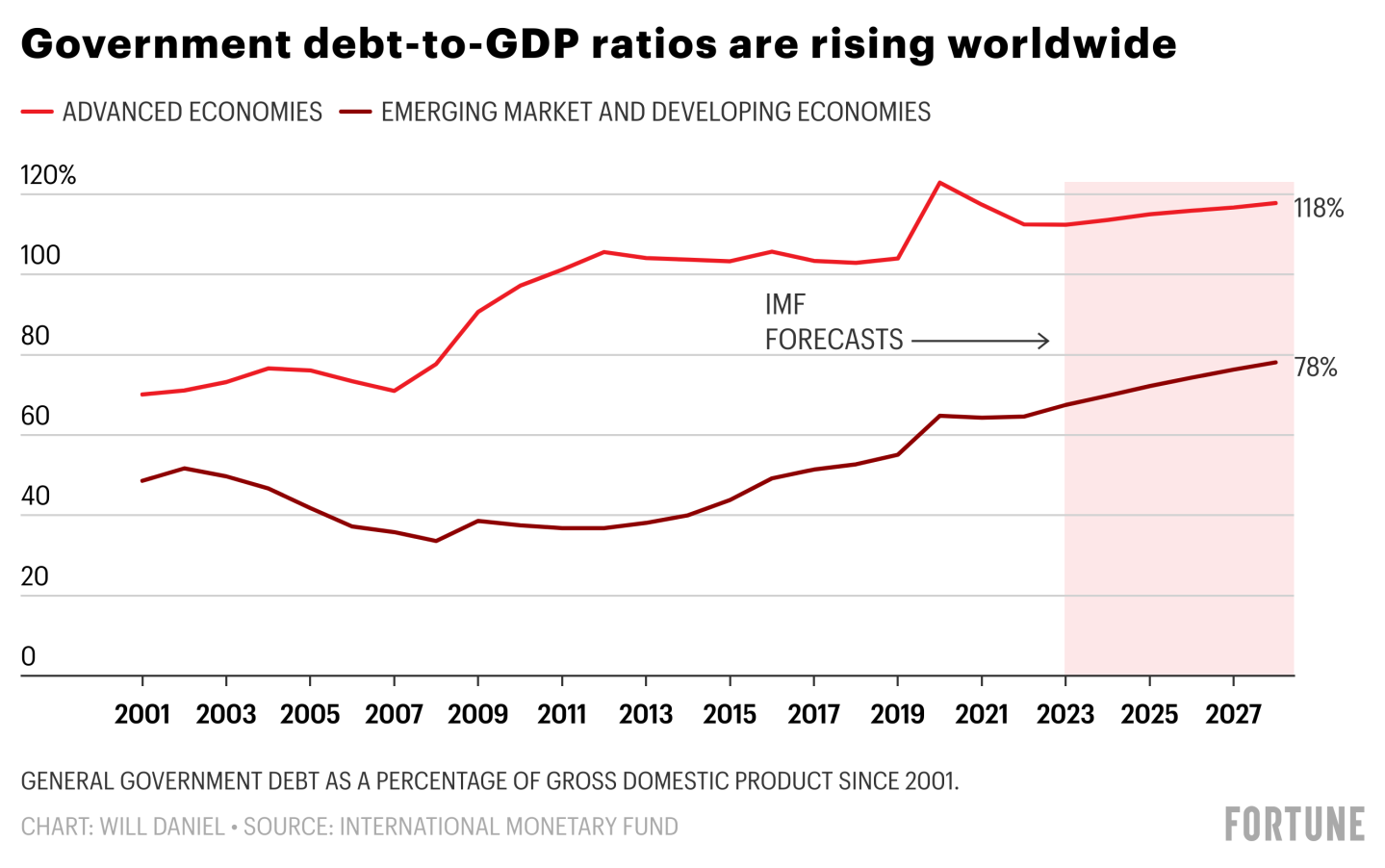
On top of that, government-debt-to-GDP ratios have been steadily climbing for decades worldwide. In the U.S., the total public-debt-to-GDP ratio hit 118% in the first quarter, according to Federal Reserve data.
Spitznagel believes the rising interest expense on federal government debts will ultimately constrain fiscal spending, slow economic growth, and force central banks to keep interest rates lower than many now forecast. He pointed to the fact that net interest payments on U.S. government debt are estimated to total $395.5 billion this fiscal year, or 6.8% of the entire 2023 federal budget, according to the Office of Management and Budget.
Backing up his view, the U.S.’s rising federal budget deficit and an “erosion of governance” led Fitch Ratings to downgrade the U.S. government credit rating this week to AA+, from its top-tier AAA rating. And another hedge fund titan, the billionaire Ray Dalio, sounded a similar tune about the government’s balance sheet in a newsletter posted to his LinkedIn on Wednesday.
Rising public and private debts are a major issue, but the Fed is also to blame for creating an economic “tinderbox,” according to Spitznagel. The hedge-funder equated the Fed’s interventionist policies since the Global Financial Crisis—including its decision to slash interest rates to nearly zero and buy government bonds and mortgage-backed securities (a policy called quantitative easing, or simply “QE”) during COVID—to firefighters mismanaging a wilderness area. When smaller forest fires aren’t allowed to burn away excess vegetation, it can lead to even bigger, more uncontrollable fires down the road.
Similarly, by not allowing the economy to fall into recession (i.e., face a small fire) through the use of near-zero interest rates and QE, the Fed boosted asset prices and debts to an unsustainable level and created a financial “tinderbox” that is ready to burn, according to Spitznagel.
“We’ve never seen anything like this level of total debt and leverage in the system. It’s an experiment,” he said. “But we know that credit bubbles have to pop. We don’t know when, but we know they have to. So I think that my tinderbox metaphor holds.”
With this potential credit bubble set to burst, Spitznagel said he’s concerned that stock market investors will be caught off guard.
Irrational exuberance in a brief “Goldilocks zone”
Fading inflation and resilient corporate earnings, even in the face of the Federal Reserve’s aggressive interest rate hikes, have led the S&P 500 to jump nearly 18% year to date. This rise has Spitznagel worried about valuations amid record public and private debts.
He pointed to a valuation metric called the Warren Buffett Indicator, which compares the total market value of publicly traded stocks in the U.S. to the country’s economic output. In the 2001 Fortune article where Buffett and legendary journalist Carol Loomis discussed the indicator (and effectively rechristened it after the Oracle of Omaha), Buffett called it “the best single measure of where valuations stand at any given moment,” and it’s been flashing warning signals (see chart below) for months now.
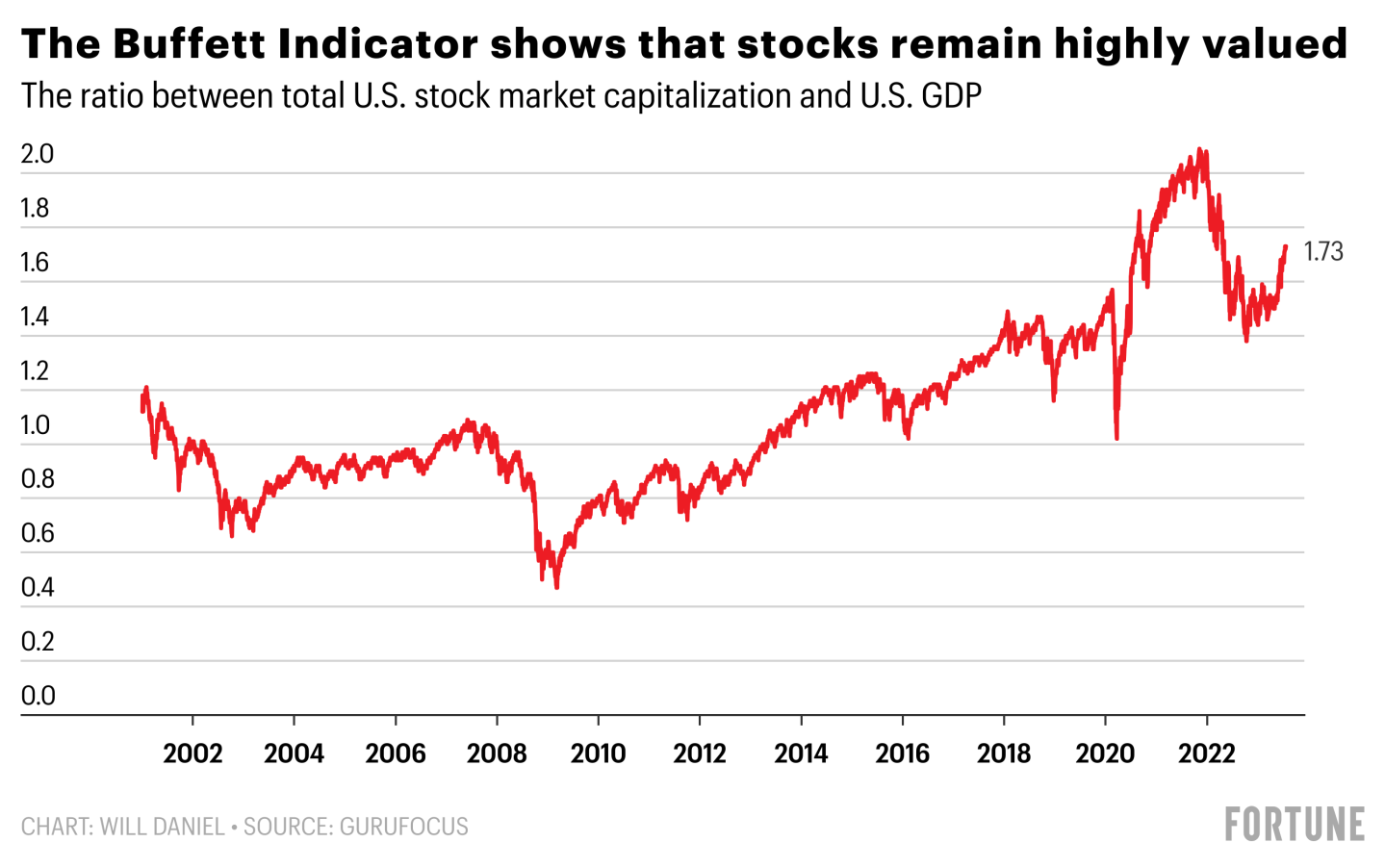
Spitznagel said the indicator shows that if stocks were properly valued, they “would be way lower right now,” but many investors are mesmerized by the short-term trend of fading inflation and steady economic growth. “They’re just looking into the here and now, which looks a little bit like a Goldilocks zone. It has nothing to do with long-term fundamentals,” he warned.
An unexpected message for retail investors: Just listen to Buffett
So if the market is a “tinderbox,” why should you stay invested?
It all comes down to the lesson that Klipp taught a young Spitznagel decades ago on the trading floor of the Chicago options exchange: Predicting the future is a fool’s errand.
The stock market could crash, but that’s not guaranteed. Spitznagel, talking to Fortune, paraphrased the great economist John Maynard Keynes’ quote that markets can remain irrational for longer than most expect as investors often become exuberant about the latest narrative, whether that’s artificial intelligence or blockchain technology. So the risk mitigation expert is recommending that you, well, avoid risk mitigation.
“My advice to a retail investor would be to understand that risk mitigation can be the most costly thing that they do. It probably isn’t going to be the cockamamie investment that they just made that will hurt them. It’s probably going to be the things that they do when they think that something bad is going to happen. It’s the knee-jerk reaction,” he said.
Spitznagel, ever a critic of modern portfolio theory, which holds that “risk-adjusted returns” (a measure of profit compared to a portfolio’s expected risk) are paramount to net returns, believes there is not a lot retail investors can do to mitigate risk in a cost-effective way.
“Modern finance is about maximizing what they call risk-adjusted returns. And I say these are the three most deceptive, disingenuous words in all of investing,” he said. “It’s sort of a cover or pretense: ‘Risk-adjusted returns’ is meant to almost distract from what really matters, which, of course, is maximizing wealth over time. That’s the only thing that ultimately matters.”
Spitznagel criticizes modern portfolio theory tactics used to reduce risk—including diversification, which he has taken to calling “diworsification”—arguing they reduce overall portfolio returns in the long run.
For retail investors, Spitznagel believes that risk mitigation should be less about protecting your portfolio against market crashes, using options or safe-haven assets like gold, and more about protecting it from your own actions.
“They should think of risk mitigation not as protecting you against the markets or systematic risk in the world or some horrific thing. Really, they should think of it as being there to protect you against yourself, and the stupid things you’re going to do when you’re scared,” he said.
If you’re still worried, the hedge-funder recommended reducing your exposure to stocks and bolstering your cash savings so you can feel comfortable riding out any market downturn.
But ultimately, most retail investors would be better off if they listened to Buffett and simply bought an index fund that tracks the S&P 500 to hold through thick and thin, adding to the position during any market downturn, Spitznagel said, calling the Oracle of Omaha his “hero as an investor.”
“Just buy a low-cost, broad index, and make sure you’re not putting yourself in a position where you’re going to sell it if the market drops 20%,” he said. “It sounds like the advice that Buffett gives, and if he’s the greatest investor that has ever lived and probably ever will live—and he is—then that’s probably pretty good advice.”