• Home
  • Latest
  • Fortune 500
  • Finance
  • Tech
  • Leadership
  • Lifestyle
  • Rankings
  • Multimedia

Trendingnow

1

The millennial generation has split, new Fed research shows: Those over 35 are edging toward boomer-style wealth, while everyone else falls behind

2

Mark Cuban says he has the solution to growing income inequality, and it's to reward every employee—from CEO to janitor—with company stock

3

Scott Bessent casually says the U.S. has more than $1 trillion in gold—and that it doesn’t matter for the dollar

1

The millennial generation has split, new Fed research shows: Those over 35 are edging toward boomer-style wealth, while everyone else falls behind

2

Mark Cuban says he has the solution to growing income inequality, and it's to reward every employee—from CEO to janitor—with company stock

3

Scott Bessent casually says the U.S. has more than $1 trillion in gold—and that it doesn’t matter for the dollar
FinanceBook Excerpt

How Wall Street’s ‘Chaos Kings’ learned to thrive amid the great bond massacre of the 1994—and the Black Swan was born

By
Scott Patterson
Scott Patterson
Down Arrow Button Icon
By
Scott Patterson
Scott Patterson
Down Arrow Button Icon
June 13, 2023, 7:00 AM ET
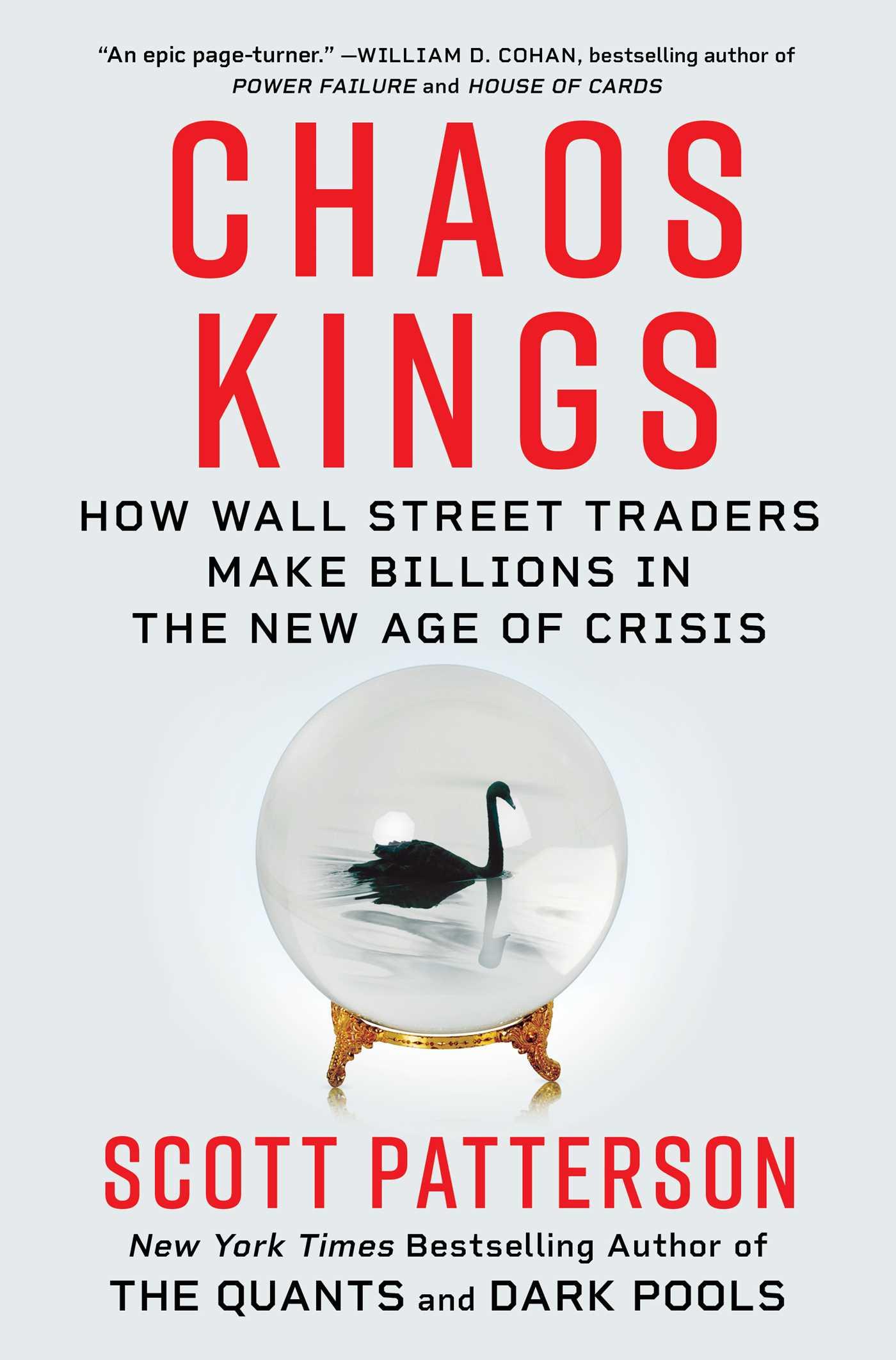
Chaos Kings
"Chaos Kings" by Scott Patterson.Scribner/Simon & Schuster
Add Fortune on Google for similar content.

Wall Street watchers have heard of “the Black Swan,” an event unplanned for that shakes every assumption and upends entire ways of life—not to mention investing strategies. Falling house prices around 2007 was one, so was a disruptive new coronavirus in late 2019. Wall Street Journal reporter Scott Patterson’s new book, Chaos Kings: How Wall Street Traders Make Billions in the New Age of Crisis, takes readers back to the 1980s and captures the rise of a renegade pair of traders—Mark Spitznagel and Nassim Nicholas Taleb—and how they created a unique strategy that produces explosive returns when markets crash. From Chicago, where Spitznagel got his start on the floor of the Chicago Board of Trade, and New York, when Taleb worked for banking houses such as First Boston, through first flush with fortune in the October 1987 “Black Monday” market collapse, and into the 1990s when they honed their strategies, this is where the Black Swan began.

Recommended Video

Spitznagel got his first taste of a severe market crisis as an active trader in 1994. The economy had been expanding for three years. The bond market was on fire. And a new factor, the rise of the quants—traders or risk managers who use advanced mathematics and computers to predict the market or build complex financial products such as derivatives—was making things ever more complicated. The bond market wasn’t just bigger, it was becoming more opaque as Wall Street’s financial wizards learned to hide risk in these secretive mathematized fun-house machines. Derivatives also had the habit of magnifying volatility as the risk ramified from the underlying asset— interest rates, commodities, bonds—into the derivatives like a fuse setting off a bomb. Derivatives had another trait that made the quants giddy: Their growth was theoretically infinite. A company could only issue so many bonds, but a bank could sell a limitless number of derivative contracts linked to a single basket of bonds or commodity. 

As the economy gained strength, Federal Reserve chairman Alan Greenspan began to fret about inflation. Slowly at first, he started cranking up short-term rates to stifle growth, dealing incremental pain to bond investors (as interest rates rise, the value of bonds declines). By August, the Fed had boosted rates nearly two percentage points. Then, in November, Greenspan swung for the fences: a staggering three-quarters of a percentage point increase, bringing the federal funds rate to 5½%. 

The surprise move sparked a global bond-market panic. Traders all around Spitznagel blew up, including his idol, Tom Baldwin, who fought a losing battle against the unstoppable force of the crash. They’d grown complacent. Stanley Druckenmiller, one of the world’s biggest hedge fund managers, lost $650 million in two days. Famously, the rate hikes bankrupted Orange County, California, which had made ludicrous bets on interest-rate derivatives. At the time, it was America’s biggest municipal bankruptcy. 

For Spitznagel, the great bond massacre of 1994 was when Klipp’s lessons truly paid off. He never held on to a position after it took a small loss, which meant he was never at risk of losing everything. He even managed to eke out a healthy profit. The calm markets of the previous few years, he realized, had been an illusion—one that deceived some of the most sophisticated traders on the floor. It was an important lesson. 

He’d survived his first test. After a few years, Spitznagel rose to the second highest stair in the pit, a hair’s breadth from the Big Dogs like Baldwin. But he wasn’t a Big Dog himself. Not yet.

Spitznagel looked at the numbers and scratched his head. A quiet, eerie panic had broken out all around him. It was late October 1997. Figures flickered across his Bloomberg Terminal. Stocks worldwide were in free fall. Hong Kong’s Hang Seng Index was down 10%, bringing a four-day decline to a total of 23%. Shock waves from the fall rippled across global markets, sending indexes in China, Japan, Germany, France, UK, and the U.S. down sharply. “There’s global shock,” a Morgan Stanley strategist said. 

Markets had been wobbling up and down for months amid widespread currency turmoil in Asia. Currencies in Thailand, Malaysia, South Korea, Hong Kong, and elsewhere were cratering as the countries’ economies buckled under the weight of the truckloads of debt they’d incurred during a red-hot expansion in the 1990s. The financial tailspin was later dubbed “the Asian flu.” 

Spitznagel was sitting amid rows of seasoned traders in the Manhattan office of Eastbridge Capital, a major dealer in U.S. Treasury bonds. He glanced at the trader next to him, a white-haired guy in his mid-forties who, on a daily basis, traded hundreds of millions in bonds. All across his screen: red numbers. His positions were getting crushed. He was losing millions. And yet, Spitznagel marveled, you couldn’t tell if he was winning or losing. His face was a cipher. 

Spitznagel had moved to New York City earlier that year. He’d given up his dream of being a pit trader, sensing that the rise of computer trading would have a profound impact on open-outcry trading. (It did.) He also sensed bigger fish at the money-center banks in New York—the ones that sent to the CBOT Big Dogs the massive orders that swept through the pits like a tornado. He’d branched out into other markets, such as options and Eurodollars, which were U.S. dollars in the accounts of the overseas branches of American banks, usually European branches. Since they sat outside the U.S., they weren’t subject to the oversight of the Federal Reserve. That made them easier to trade. 

As a proprietary or “prop” trader, Spitznagel was buying cheap options that would pay off in a market crash as investors piled into safe-haven assets such as Eurodollars. He’d come a long way from scalping corn futures on the floor of the CBOT. But it was still, at bottom, the Klipp trade, with small losses and the chance of a big gain, only now made through more exotic options. 

It was a complex trade, fiendishly hard to manage, requiring constant attention. He’d gotten married that September. On his honeymoon in Santorini, Greece, he was constantly trading from his portable Bloomberg machine as global markets throbbed with the worsening turmoil of the Asian flu. Spitznagel’s new wife, Amy, gave him endless grief about it. 

Spitznagel made a mint on his market-crash bet when stocks collapsed in October. While the other traders around him at Eastbridge blew up, one by one, his positions surged as the crisis worsened and investors fled to safety. It wasn’t enough to save the firm—Eastbridge shut down a year later—but it was enough to satisfy Spitznagel that his strategy had worked. His “trial and error” experiments, as he liked to call them, were proving themselves with the certainty provided by cold hard cash. His next experiment, the following year, made even more money when the giant quant-packed hedge fund Long-Term Capital Management blew up, triggering more panic. 

That gave him the financial cushion to quit trading for a while and—hoping to add some scientific rigor to his pit-trader experiments— take what he called a “learning sabbatical.” He enrolled in New York University’s elite Courant Institute of Mathematical Sciences, one of the world’s top applied mathematics schools and home to some of the brightest quantitative minds on Wall Street— including a freshly minted professor of finance, Nassim Nicholas Taleb.

Excerpted from CHAOS KINGS: How Wall Street Traders Make Billions in The New Age of Crisis. Copyright © 2023 by Scott Patterson. Excerpted with permission by Scribner, a division of Simon & Schuster, Inc.

About the Author
By Scott Patterson
See full bioRight Arrow Button Icon
Add Fortune on Google for similar content.

Latest in Finance

Finance
Lorem ipsum dolor sit amet, consectetur adipiscing elit, sed do eiusmod tempor incididunt ut labore et dolore magna aliqua. Ut enim ad minim veniam
By Fortune Editors
October 20, 2025
Finance
Lorem ipsum dolor sit amet, consectetur adipiscing elit, sed do eiusmod tempor incididunt ut labore et dolore magna aliqua. Ut enim ad minim veniam
By Fortune Editors
October 20, 2025
Finance
Lorem ipsum dolor sit amet, consectetur adipiscing elit, sed do eiusmod tempor incididunt ut labore et dolore magna aliqua. Ut enim ad minim veniam
By Fortune Editors
October 20, 2025
Finance
Lorem ipsum dolor sit amet, consectetur adipiscing elit, sed do eiusmod tempor incididunt ut labore et dolore magna aliqua. Ut enim ad minim veniam
By Fortune Editors
October 20, 2025
Finance
Lorem ipsum dolor sit amet, consectetur adipiscing elit, sed do eiusmod tempor incididunt ut labore et dolore magna aliqua. Ut enim ad minim veniam
By Fortune Editors
October 20, 2025
Finance
Lorem ipsum dolor sit amet, consectetur adipiscing elit, sed do eiusmod tempor incididunt ut labore et dolore magna aliqua. Ut enim ad minim veniam
By Fortune Editors
October 20, 2025

Most Popular

Finance
Lorem ipsum dolor sit amet, consectetur adipiscing elit, sed do eiusmod tempor incididunt ut labore et dolore magna aliqua. Ut enim ad minim veniam
By Fortune Editors
October 20, 2025
Finance
Lorem ipsum dolor sit amet, consectetur adipiscing elit, sed do eiusmod tempor incididunt ut labore et dolore magna aliqua. Ut enim ad minim veniam
By Fortune Editors
October 20, 2025
Finance
Lorem ipsum dolor sit amet, consectetur adipiscing elit, sed do eiusmod tempor incididunt ut labore et dolore magna aliqua. Ut enim ad minim veniam
By Fortune Editors
October 20, 2025
Finance
Lorem ipsum dolor sit amet, consectetur adipiscing elit, sed do eiusmod tempor incididunt ut labore et dolore magna aliqua. Ut enim ad minim veniam
By Fortune Editors
October 20, 2025
Finance
Lorem ipsum dolor sit amet, consectetur adipiscing elit, sed do eiusmod tempor incididunt ut labore et dolore magna aliqua. Ut enim ad minim veniam
By Fortune Editors
October 20, 2025
Finance
Lorem ipsum dolor sit amet, consectetur adipiscing elit, sed do eiusmod tempor incididunt ut labore et dolore magna aliqua. Ut enim ad minim veniam
By Fortune Editors
October 20, 2025
Fortune Secondary Logo
Rankings
  • 100 Best Companies
  • Fortune 500
  • Global 500
  • Fortune 500 Europe
  • Most Powerful Women
  • World's Most Admired Companies
  • See All Rankings
  • Lists Calendar
Sections
  • Finance
  • Fortune Crypto
  • Features
  • Leadership
  • Health
  • Commentary
  • Success
  • Retail
  • Mpw
  • Tech
  • Lifestyle
  • CEO Initiative
  • Asia
  • Politics
  • Conferences
  • Europe
  • Newsletters
  • Personal Finance
  • Environment
  • Magazine
  • Education
Customer Support
  • Frequently Asked Questions
  • Customer Service Portal
  • Privacy Policy
  • Terms Of Use
  • Single Issues For Purchase
  • International Print
Commercial Services
  • Advertising
  • Fortune Brand Studio
  • Fortune Analytics
  • Fortune Conferences
  • Business Development
  • Group Subscriptions
About Us
  • About Us
  • Press Center
  • Work At Fortune
  • Terms And Conditions
  • Site Map
  • About Us
  • Press Center
  • Work At Fortune
  • Terms And Conditions
  • Site Map
  • Facebook icon
  • Twitter icon
  • LinkedIn icon
  • Instagram icon
  • TikTok icon
  • YouTube icon

Latest in Finance

t
North AmericaWhite House
Trump signed a nuclear deal with Saudi, then rewrote its terms on social media to include Israel
By Aamer Madhani, Collin Binkley, Michelle L. Price and The Associated PressJuly 23, 2026
7 minutes ago
Amazon founder Jeff Bezos
SuccessBillionaires
Amazon’s Jeff Bezos could be the latest American billionaire to buy into European soccer clubs—he’s eyeing up a stake in Liverpool FC
By Emma BurleighJuly 23, 2026
47 minutes ago
t
EconomyWhite House
Trump dismissed affordability as a word ‘made up by the Democrats’ and promised oil would come ‘tumbling down’—then it hit $100 a barrel
By Nick LichtenbergJuly 23, 2026
1 hour ago
Japanese Prime Minister Sanae Takaichi and U.S. President Donald Trump sit in the Oval Office.
Economynational debt
The $39 trillion U.S. national debt isn’t as high as Japan’s and Singapore’s relative to economy size—and yet it’s still worse somehow
By Sasha RogelbergJuly 23, 2026
1 hour ago
Current price of gold as of July 23, 2026
Personal Financegold prices
Current price of gold as of July 23, 2026
By Danny BakstJuly 23, 2026
3 hours ago
MoonPay to launch universal AI shopping wallet for non-technical Claude and ChatGPT consumers
CryptoAI agents
MoonPay to launch universal AI shopping wallet for non-technical Claude and ChatGPT consumers
By Jeff John RobertsJuly 23, 2026
4 hours ago

Most Popular

The millennial generation has split, new Fed research shows: Those over 35 are edging toward boomer-style wealth, while everyone else falls behind
Real Estate
The millennial generation has split, new Fed research shows: Those over 35 are edging toward boomer-style wealth, while everyone else falls behind
By Nick LichtenbergJuly 22, 2026
24 hours ago
Mark Cuban says he has the solution to growing income inequality, and it's to reward every employee—from CEO to janitor—with company stock
Success
Mark Cuban says he has the solution to growing income inequality, and it's to reward every employee—from CEO to janitor—with company stock
By Sasha RogelbergJuly 20, 2026
3 days ago
Scott Bessent casually says the U.S. has more than $1 trillion in gold—and that it doesn’t matter for the dollar
Economy
Scott Bessent casually says the U.S. has more than $1 trillion in gold—and that it doesn’t matter for the dollar
By Sasha RogelbergJuly 22, 2026
21 hours ago
Mathematicians grapple with a ‘very rapid and very unsettling change’ as AI cracks yet another century-old problem
AI
Mathematicians grapple with a ‘very rapid and very unsettling change’ as AI cracks yet another century-old problem
By Eva RoytburgJuly 21, 2026
2 days ago
Despite a $156 million contract, Knicks star Jalen Brunson still calls his parents for financial advice any time he makes a big purchase
Success
Despite a $156 million contract, Knicks star Jalen Brunson still calls his parents for financial advice any time he makes a big purchase
By Emma BurleighJuly 21, 2026
2 days ago
'The man who dies rich dies disgraced': The last time America had such wealth inequality, Andrew Carnegie knew he had to give it all away
Success
'The man who dies rich dies disgraced': The last time America had such wealth inequality, Andrew Carnegie knew he had to give it all away
By Nick LichtenbergJuly 22, 2026
24 hours ago

© 2026 Fortune Media IP Limited. All Rights Reserved. Use of this site constitutes acceptance of our Terms of Use and Privacy Policy | CA Notice at Collection and Privacy Notice | Do Not Sell/Share My Personal Information
FORTUNE is a trademark of Fortune Media IP Limited, registered in the U.S. and other countries. FORTUNE may receive compensation for some links to products and services on this website. Offers may be subject to change without notice.