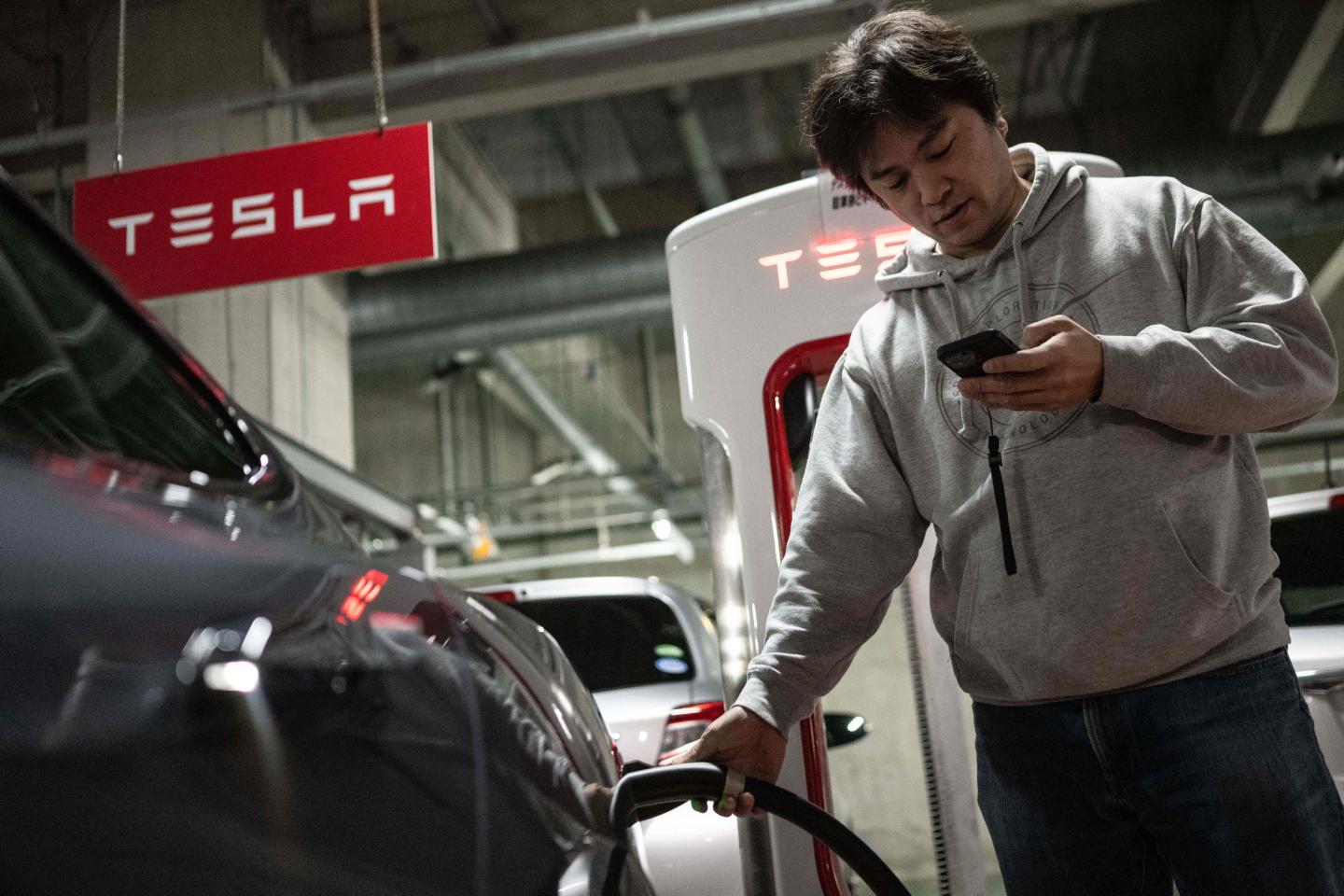
The avalanche of wins for Tesla in the electric vehicle (EV) charging wars keeps rolling in. In May, Ford Motor Company announced that it would incorporate Tesla’s charging ports into its future EV models. General Motors soon followed, despite initially saying it was committed to a rival charging port. Stellantis (Chrysler), the remaining Big Three American automaker, said it was evaluating Tesla’s charging standard, as were Toyota and other Japanese carmakers who said they were still exploring a variety of charging options. Even last week’s big announcement about dual-charger stations acknowledges that Tesla’s charging system will eventually become standard.
How could this have happened? After all, for years, the traditional automakers had been rallying around the Combined Charging System (CCS) format. Tesla was essentially alone with its North American Charging Standard (NACS). The goal was for everyone to unite around the same standard and thereby promote the spread of charging stations across the United States and elsewhere.
Companies saw the scarcity of charging stations as a key barrier to the rapid adoption of electric vehicles. Policymakers agreed, and the federal government not only backed the CCS standard but is also now offering billions of dollars to subsidize a CCS network. Conventional carmakers have long argued that building scale is very difficult in their industry, and they pointed to the charging problem as one reason their EVs would eventually blow past Tesla and other johnny-come-latelys. But now they seem to be giving up-and giving in to the Tesla standard.
There could be several explanations. One is that Tesla’s NACS chargers have been more reliable than CCS, partly because Tesla could simplify processes, just as Apple simplifies its proprietary Mac OS software better than Microsoft’s PC software. Another is that Tesla shrewdly invested in thousands of superchargers that “fill up” car batteries in only half an hour, as opposed to CCS’ one to two hours. A third is that Tesla continues to be seen as “cool,” and the traditional automakers hope to gain some of that coolness by joining the market leader rather than fighting it.
Those factors surely play a part, but even where they apply, they beg the question: How did this upstart company, only two decades old, get so far ahead of carmakers that have had the technology for electric vehicles since the 1990s? (GM offered the EV-1 in 1996.)
You could argue that Elon Musk and other founders just got lucky, that they came up with a smarter strategy, or that their persistence throughout the 2000s and 2010s has paid off. But legacy automakers have been working on electric vehicles for several years. How could Tesla still be outwitting them?
How Tesla went on the offense
The answer is that Tesla operates quite differently from traditional carmakers, even now when it produces tens of thousands of vehicles. I studied dozens of companies from 2006 to 2022 in order to learn about agile innovators–those that repeatedly came out with major advances, despite changing markets. My research team narrowed the main factors down to eight drivers, and Tesla was among the companies with nearly all eight.
The eight drivers were: existential purpose, obsession with what customers want, a Pygmalion-style influence over colleagues, a startup mindset even after scaling up, the readiness to control the tempo, operating bimodally, a bias for boldness, and radical collaboration. We can see the roots of Tesla’s charging success, particularly in three of these:
Existential purpose
Tesla aims to accelerate the world’s transition away from fossil fuels, so it’s committed to promoting electric vehicles. This is deeper than the usual corporate mission statement that serves mainly as window dressing–people really believe this.
Musk and others realized early on that plentiful charging stations were essential to the wide adoption of cars, so they invested heavily in both the technology and the placement of these stations. They did this even though the profitability of those investments wasn’t clear at first. They even consciously turned down sales in order to get the charging in place. Tesla was known to hold off on providing cars in a market because it hadn’t built enough charging stations. They were focused on spurring adoption, so they wanted whatever they sold to offer a near-magical experience.
That’s also why Tesla is now willing to allow other carmakers to use its ports. Musk himself said that expanding access to the NACS stations was “morally right; whether it’s financially smart remains to be seen.” Some of that may be posturing (after all, the company’s stock has jumped 40% since Ford’s announcement), but Tesla’s existential purpose enforces a clarity and commitment that the other automakers lack.
Customer obsession
Tied to its existential purpose, Tesla has focused on giving customers what they want. Because EVs had enormous initial costs, Musk and others had to start with the luxury end, but the higher price point enabled them to give buyers a delightful experience–and spread a positive vibe about this strange new technology.
Over time, in the usual practice of carmakers, that delightful experience could happen even for buyers of mid-price vehicles, and that’s where scale, and results for the world, can happen. If Tesla had gone for scale immediately with a mid-price vehicle, its EVs would have developed a mediocre reputation and scared off adoption.
Something similar happened with superchargers, which Tesla developed even as EV makers saw them as premature. Isn’t it hard enough to just get the basic charging down? But Tesla, like Apple, knew that reducing friction was essential to driving widespread adoption, especially for luxury buyers who have more cash than time. And now even middler buyers want access to the superchargers.
Radical collaboration
This is harder to see, because it’s entirely internal, but Tesla operates with a different sense of hierarchy than conventional automakers. Musk says he specifically tells people to ask for help from anyone, even if that colleague is three levels higher in the organization. Respect at Tesla comes from expertise, not rank, and people are willing to pass on insight to anyone who asks, without worrying about losing stature from talking to underlings.
Musk himself notoriously goes around to people working on problems and offering unsolicited advice or insight. One former Tesla manager told me he remembers studying an issue extensively and then talking about it to Musk, who knew little about it. But the conversation yielded a surprising amount of value from Musk’s fresh but sympathetic perspective. What the leader does, others do too. The traditional carmakers have tried to loosen their hierarchies, but they still have a long way to go–which is why Tesla can continue to out-innovate them.
Because of these and other factors, it’s no surprise that Tesla is still outmaneuvering companies with a century of experience in their industry. The real question is whether Tesla can continue its impressive streak of agile innovation even as it becomes large and profitable. We’ve been seeing one-time darlings like Google/Alphabet fall behind after becoming fat and happy. Can Tesla avoid this fate?
Behnam Tabrizi has been teaching Leading Organizational Transformation at Stanford University’s Department of Management Science and Engineering and executive programs for more than 25 years. An expert in organizational and leadership transformation, he has helped thousands of CEOs and leaders plan, mobilize, and implement innovative transformational initiatives. He has written ten books, most recently Going on Offense: A Leader’s Playbook for Perpetual Innovation.
More must-read commentary published by Fortune:
- ‘The global economy is due for a reality check,’ warns the central banks‘ bank
- Demand for urban real estate will be challenged for the rest of the decade. Here’s how the world’s superstar cities are projected to fare by 2030
- ‘The Feckless 400’: These companies are still doing business in Russia–and funding Putin’s war
- Great Place To Work CEO: ‘It’s time to acknowledge why diversity makes us uncomfortable’