
• Home
  • Latest
  • Fortune 500
  • Finance
  • Tech
  • Leadership
  • Lifestyle
  • Rankings
  • Multimedia
Successreturn to office

Billionaire Mike Bloomberg is tired of remote work ‘excuses’—especially when it comes to civil servants: ‘This has gone on too long. The pandemic is over’

Eleanor Pringle
By
Eleanor Pringle
Eleanor Pringle
Senior Reporter, Economics and Markets
Down Arrow Button Icon
Eleanor Pringle
By
Eleanor Pringle
Eleanor Pringle
Senior Reporter, Economics and Markets
Down Arrow Button Icon
August 3, 2023, 10:27 AM ET
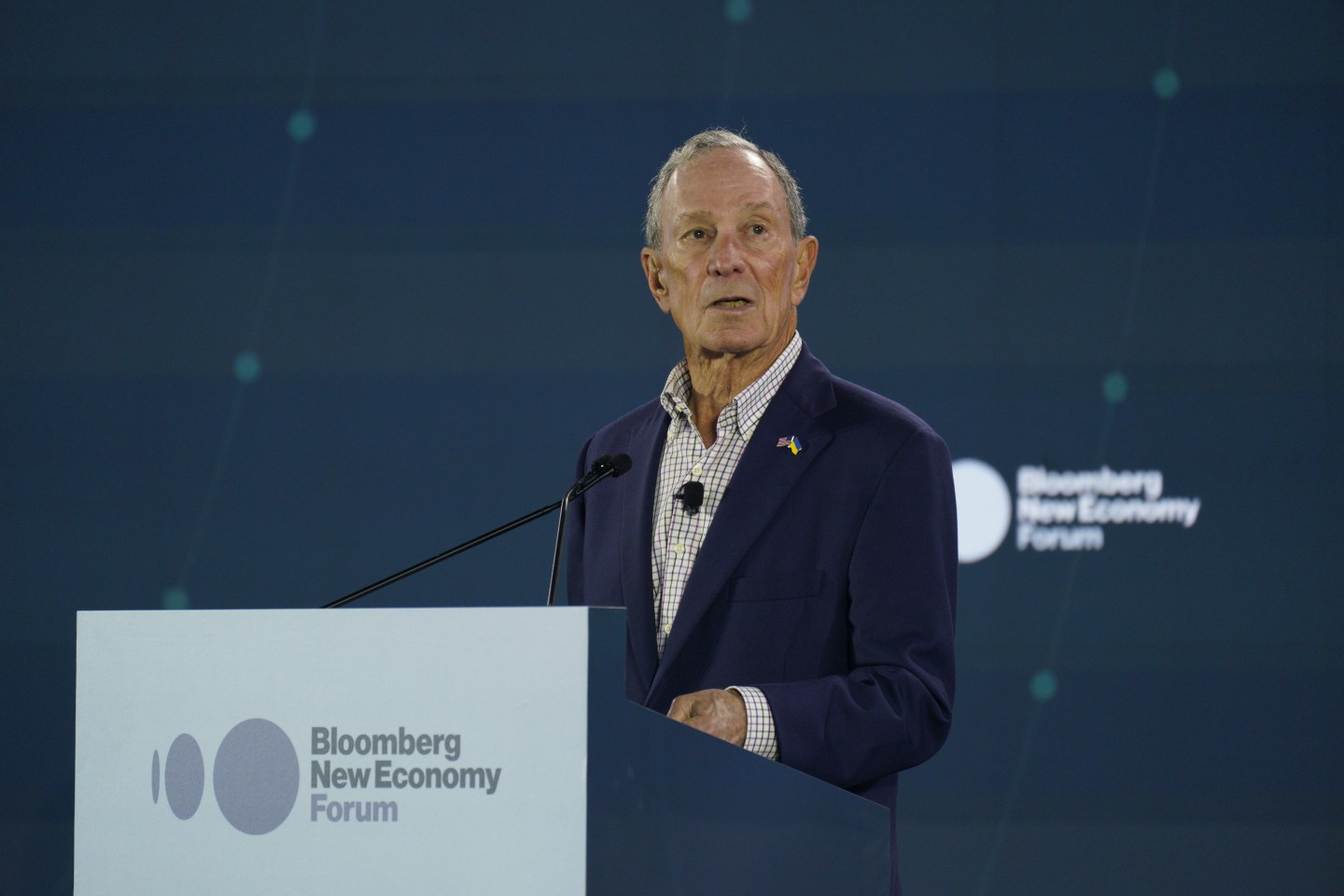
Michael Bloomberg, founder of Bloomberg LP, speaks during the Bloomberg New Economy Forum in Singapore, on Tuesday, Nov. 15, 2022.
Michael Bloomberg is fed up with federal agencies enabling remote work. Bryan van der Beek—Bloomberg/Getty Images

Media titan Michael Bloomberg has had it with federal employees logging in from home, saying taxpayers are footing the bill for empty offices.

Recommended Video

Bloomberg’s cofounder, CEO, and majority shareholder delivered a scathing view of federal agencies that are still allowing staff to work from home the majority of their time in an article for the Washington Post.

The man worth $94.5 billion describes the capital city as a “shadow of its former self,” claiming tax money is being wasted on empty offices and the public is getting worse service.

“This has gone on too long. The pandemic is over. Excuses for allowing offices to sit empty should end, too,” Bloomberg—who was mayor of New York from 2002 to 2013—wrote.

A report from the United States Government Accountability Office published in July revealed that federal agencies spend around $5 billion a year to lease office buildings, and a further $2 billion on maintaining and operating offices regardless of utilization.

However, the analysis, which worked with 24 government agencies, found that 17 of the organizations were using the sites less than 25% of the time.

Although the report found that agency managers were reluctant to share office space with other federal teams, it pointed out that any reduction in office space would reduce both costs and energy consumption.

As Bloomberg puts it: “Some people argue that remote work for federal employees isn’t a problem. Tell that to the taxpayers who are footing the bill for empty floor space and the costs of maintenance, as the GAO emphasizes.

“Tell it to the small businesses that are suffering, whose tax payments fund city services. Tell it to the many residents who rely on those services, especially poor people and elderly people.”

The Biden administration has been pushing federal employees back to their office chairs—though Bloomberg, who himself harbored ambitions to become president in 2020, feels not hard enough.

In April the Executive Office of the President said there was an “expectation” that “agency headquarters and equivalents [plan to] generally continue to substantially increase meaningful in-person work in federal offices.”

It caveated this with, “Agencies should still use flexible operational policies as an important tool in talent recruitment and retention.”

Private offices are another matter

The argument for talent retention and recruitment is acknowledged by Bloomberg as reasonable—but more relevant to the private sector.

The difference between federal employees and private staff is choice, he points out: “Remote work by civil servants is especially troubling because the federal government is a monopoly supplier.

“In the private sector, if remote workers do a poor job, business suffers, and customers take their spending elsewhere. In the public sector, people just have to put up with poor service.”

According to a new report from workplace utilization specialists XY Sense—which took into account approximately 25,000 office spaces across 17 countries—private sector office use is faring just as badly as its public counterpart.

In North America average utilization for Q1 of 2023 was 21%—33% lower than the average recorded across the rest of the globe.

Empty offices are a problem that could result in another run on the banks, some economists have warned, with swaths of new office buildings financed on short-term loans with no leases taken out to pay for it. Morgan Stanley estimates that $1.5 trillion in commercial real estate loans are due to be repaid by 2025.

With 176 offices across the world—some of which cost more than $1 billion to build—it’s perhaps not a surprise that Bloomberg is keen to get his own staff back through the doors, a sentiment echoed by JPMorgan CEO Jamie Dimon.

More than 80% of staff are in more than three days a week Bloomberg said—though added “there will always be exceptions” to this rule—and in the fall the majority will go back four days a week.

Bloomberg concluded that hybrid work offers could even be valuable in order to increase competition in the job market—especially when recruitment and retention is a challenge.

But he finished: “There’s no good reason why government workers have been so much slower than everyone else to get back to the office at least a few days a week.

“Taxpayers deserve immediate action and hard deadlines—and the better service and stronger capital city that will result.”


Join us at the Fortune Workplace Innovation Summit May 19–20, 2026, in Atlanta. The next era of workplace innovation is here—and the old playbook is being rewritten. At this exclusive, high-energy event, the world’s most innovative leaders will convene to explore how AI, humanity, and strategy converge to redefine, again, the future of work. Register now.
About the Author
Eleanor Pringle
By Eleanor PringleSenior Reporter, Economics and Markets
LinkedIn icon

Eleanor Pringle is an award-winning senior reporter at Fortune covering news, the economy, and personal finance. Eleanor previously worked as a business correspondent and news editor in regional news in the U.K. She completed her journalism training with the Press Association after earning a degree from the University of East Anglia.

See full bioRight Arrow Button Icon

Latest in Success

Nicholas Thompson
C-SuiteBook Excerpt
I took over one of the most prestigious media firms while training for an ultramarathon. Here’s what I learned becoming CEO of The Atlantic
By Nicholas ThompsonDecember 13, 2025
19 hours ago
Lauren Antonoff
SuccessCareers
Once a college dropout, this CEO went back to school at 52—but she still says the Gen Zers who will succeed are those who ‘forge their own path’
By Preston ForeDecember 13, 2025
21 hours ago
Ryan Serhant lifts his arms at the premiere of Owning Manhattan, his Netflix show
Successrelationships
Ryan Serhant, a real estate mogul who’s met over 100 billionaires, reveals his best networking advice: ‘Every room I go into, I use the two C’s‘
By Dave SmithDecember 12, 2025
2 days ago
Apple CEO Tim Cook
SuccessBillionaires
Apple CEO Tim Cook out-earns the average American’s salary in just 7 hours—to put that into context, he could buy a new $439,000 home in just 2 days
By Emma BurleighDecember 12, 2025
2 days ago
Tensed teenage girl writing on paper
SuccessColleges and Universities
40% of Stanford undergrads receive disability accommodations—but it’s become a college-wide phenomenon as Gen Z try to succeed in the current climate
By Preston ForeDecember 12, 2025
2 days ago
SuccessHow I made my first million
Hinge CEO says he bribed students with Kit Kats to get the $550-million-a-year business off the ground: ‘I had to beg and borrow a lot‘
By Orianna Rosa RoyleDecember 12, 2025
2 days ago

Most Popular

placeholder alt text
Success
Apple cofounder Ronald Wayne sold his 10% stake for $800 in 1976—today it’d be worth up to $400 billion
By Preston ForeDecember 12, 2025
2 days ago
placeholder alt text
Economy
Tariffs are taxes and they were used to finance the federal government until the 1913 income tax. A top economist breaks it down
By Kent JonesDecember 12, 2025
2 days ago
placeholder alt text
Success
40% of Stanford undergrads receive disability accommodations—but it’s become a college-wide phenomenon as Gen Z try to succeed in the current climate
By Preston ForeDecember 12, 2025
2 days ago
placeholder alt text
Economy
The Fed just ‘Trump-proofed’ itself with a unanimous move to preempt a potential leadership shake-up
By Jason MaDecember 12, 2025
1 day ago
placeholder alt text
Success
Apple CEO Tim Cook out-earns the average American’s salary in just 7 hours—to put that into context, he could buy a new $439,000 home in just 2 days
By Emma BurleighDecember 12, 2025
2 days ago
placeholder alt text
Economy
For the first time since Trump’s tariff rollout, import tax revenue has fallen, threatening his lofty plans to slash the $38 trillion national debt
By Sasha RogelbergDecember 12, 2025
1 day ago
Rankings
  • 100 Best Companies
  • Fortune 500
  • Global 500
  • Fortune 500 Europe
  • Most Powerful Women
  • Future 50
  • World’s Most Admired Companies
  • See All Rankings
Sections
  • Finance
  • Leadership
  • Success
  • Tech
  • Asia
  • Europe
  • Environment
  • Fortune Crypto
  • Health
  • Retail
  • Lifestyle
  • Politics
  • Newsletters
  • Magazine
  • Features
  • Commentary
  • Mpw
  • CEO Initiative
  • Conferences
  • Personal Finance
  • Education
Customer Support
  • Frequently Asked Questions
  • Customer Service Portal
  • Privacy Policy
  • Terms Of Use
  • Single Issues For Purchase
  • International Print
Commercial Services
  • Advertising
  • Fortune Brand Studio
  • Fortune Analytics
  • Fortune Conferences
  • Business Development
About Us
  • About Us
  • Editorial Calendar
  • Press Center
  • Work At Fortune
  • Diversity And Inclusion
  • Terms And Conditions
  • Site Map

© 2025 Fortune Media IP Limited. All Rights Reserved. Use of this site constitutes acceptance of our Terms of Use and Privacy Policy | CA Notice at Collection and Privacy Notice | Do Not Sell/Share My Personal Information
FORTUNE is a trademark of Fortune Media IP Limited, registered in the U.S. and other countries. FORTUNE may receive compensation for some links to products and services on this website. Offers may be subject to change without notice.