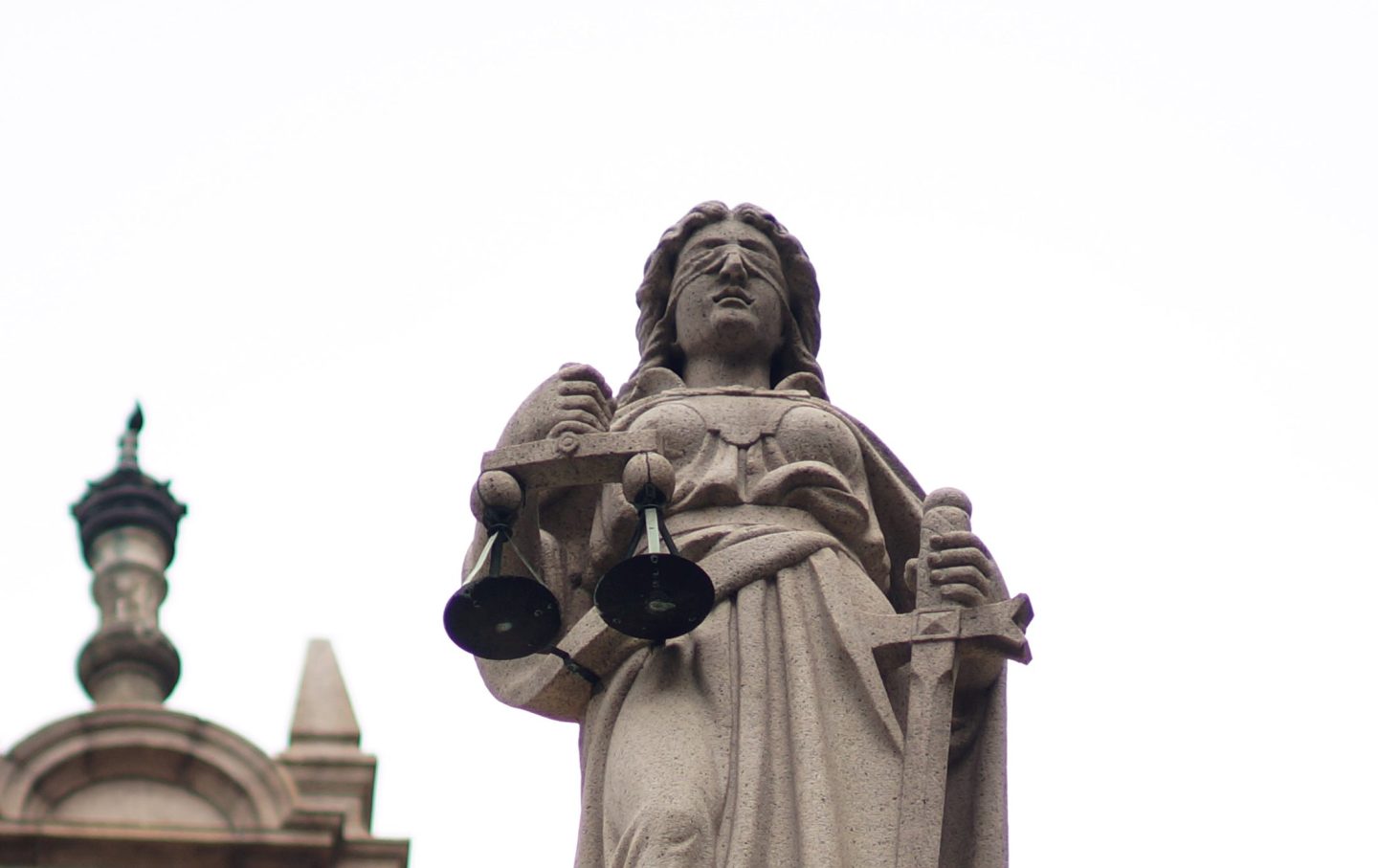
Justice is supposed to be blind, rendered without passion or prejudice, but women and people of color are being discriminated against by the systematic lack of “blinding”–the removal of irrelevant details such as a person’s name, race, and gender–in both the criminal justice system and the labor market. As a college professor who routinely anonymizes student papers before grading them to avoid being biased by personal impressions from class, I know that blinding is an effective technique based on a common-sense principle: decision-makers cannot be biased by information they do not have.
Few of us set out to discriminate, yet without blinding, when choosing among job candidates or handing down prison time, our decisions are often biased. In the job market, résumés with white-sounding names receive twice the amount of callbacks for interviews as African American ones, such that some racial minority job applicants attempt to “whiten” their résumés by concealing or downplaying information that identifies their race. And, potential investors ask women entrepreneurs tougher questions than they ask men, limiting the women’s ability to raise capital.
In the U.S. criminal justice system, prosecutors exercise broad discretion over whom to charge and with what crime, and they disproportionately incarcerate people of color with longer sentences than their white peers. They also control plea bargaining, the process through which the vast majority of criminal cases are resolved with virtually no judicial involvement or oversight. A review of 34 empirical studies examining prosecutorial decision-making found that at each stage of the process, minorities receive disproportionately harsher judgments.
Everyone deserves to be treated fairly, yet decision-makers’ conscious and unconscious biases often work against equitable treatment. So far, little has been done to systematically tackle this problem. My colleagues and I proposed a comprehensive policy proposal outlining an intervention that could help a great deal: Removing irrelevant details like name, race, and gender from the decision-making process.
By decreasing bias, blinding policies increase trust and confidence in the legitimacy of consequential decisions. They are already used widely in medical trials of new drugs and in academic peer reviews of research. Blinding also has been proven to reduce bias in employment and criminal justice contexts.
When employers proactively blind themselves to potentially biasing information about job candidates, they produce fairer and more accurate assessments. For instance, when musicians auditioned for a symphony orchestra behind a screen concealing their identity from the panel, the proportion of women musicians being hired significantly increased. Blinding enforced impartiality among the selectors, substantially reducing gender bias.
Despite the effectiveness of blinding policies, less than 20% of organizations currently implement blinding to reduce bias in hiring. Simple changes such as removing names, images, and any other potentially identifying information from candidates’ résumés before evaluation could go a long way toward reducing gender and racial bias in hiring. Although in most recruitment situations, the decisions may eventually become “unblinded” before final selection, initial blinding eliminates bias at the early stages increasing the diversity of candidates that make the short list.
Turning to the criminal justice system, prosecutors rarely come into direct contact with suspects; instead, they typically consult police files and defense attorneys rather than the defendants themselves when deciding whom to charge and how. Although it is standard practice to include a suspect’s race and mugshots in their police file, this could easily be redacted by case-management software or office assistants. Blinding prosecutors to defendants’ race could meaningfully reduce unconscious bias and help increase public trust in the legitimacy of the criminal justice system.
The Yolo County District Attorney in California has tried out blinding, with encouraging results. Using software developed by Stanford University that removes names, locations, and any other racially identifying information from police reports, prosecutors are able to make truly “race-blind” charging decisions on incoming misdemeanor and felony cases. The success of this pilot as well as others led legislators in California to pass a new bill, which mandates the use of race-obscured charging decisions across the state by 2025.
Unfortunately, while people often acknowledge the benefits of blinding, they still often choose to receive irrelevant and potentially biasing information. They may believe in their ability to remain objective, but such claims don’t hold up, and confidence in one’s ability to remain impartial can even further bias in decision-making. Rather than being an individual choice, blindness must be adopted as policy to improve equality in both our labor market and criminal justice systems.
Sunita Sah, M.D., MBA, Ph.D. is the director of Cornell University Academic Leadership Institute and a professor of management and organizations at the Cornell SC Johnson College of Business.
The opinions expressed in Fortune.com commentary pieces are solely the views of their authors and do not necessarily reflect the opinions and beliefs of Fortune.