Imagine you need to find a room in an expansive, labyrinthine house. Each hallway branches into several smaller hallways, and at the end of each segmenting branch is a room. Worse yet, imagine you urgently need to fix a problem in the house’s architecture, and have to search through countless halls and rooms to first find the problem. What you’d need most is a map.
A brain is like the house in question. To be exact, a human brain has 86 billion branching neurons and is by far the most complex organ in the body. The seat of intelligence and all complex thought, the brain dictates a huge part of an organism’s health, relationships with its species, and individuality. And there hasn’t ever been a map of the neural pathways inside a brain for any adult animal until now—and it was made possible by A.I.
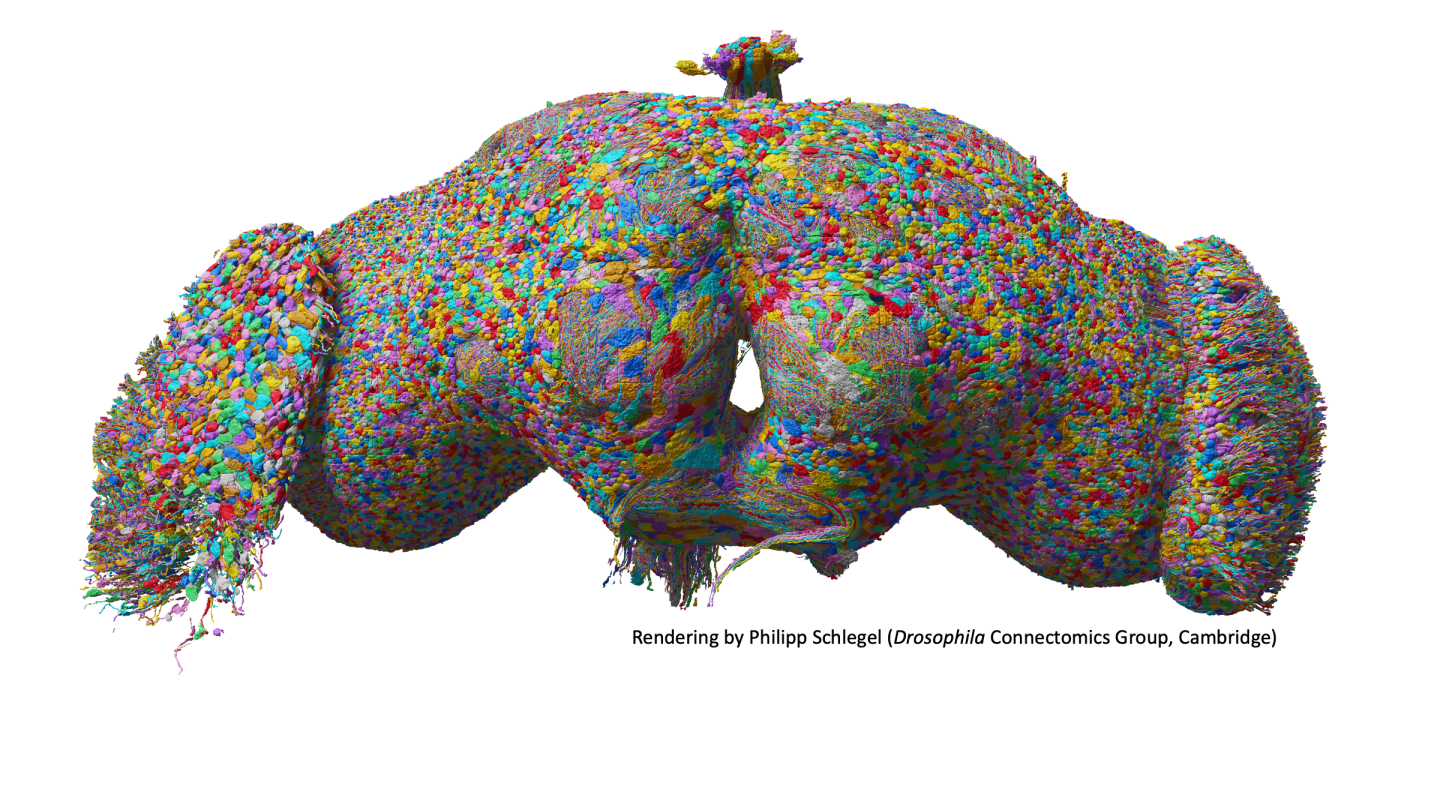
An interdisciplinary team of neuroscientists and computer scientists from schools including Cambridge and Princeton recently made a breakthrough in brain-mapping using A.I., and they told Fortune it could be the first step in a revolution in neuroscience and medicine. The team created a connectome, or a map of all neural pathways, of a fruit fly’s brain, the first whole-brain connectome created for any adult animal.
“It gives a kind of ground truth about what is actually connected in the brain,” Sven Dorkenwald, a computer science researcher at Princeton who worked on the project, told Fortune. “It is foundational for designing experiments, and it allows other scientists to to look at what their neuron of interest is connected to, and that allows them to be more efficient in how they want to experiment and test their hypothesis.”
In the past, if neuroscientists wanted to interrogate how a fruit fly made decisions and navigated the world, they wouldn’t know exactly what area of the brain to look at in their experiment, Dr. Alexander Bates, a neuroscientist at Harvard who worked on the project while at Cambridge, said.
There was no way to see exactly which neurons were connected to each other, so they would base their insights on past findings. The fruit fly connectome provides a complete blueprint of these neurons, so that future research can pinpoint and isolate their area of interest.
“The benefit is similar to having an encyclopedia or a lookup table,” Bates said. “You just have a lot more information about anything you would like to know about the anatomy of the brain and how the brain is built.”
A.I. acceleration
The team used A.I. to build the model by feeding it 2D images of microscopic brain slices, Dorkenwald said. The A.I. then combined the 2D images into a 3D image block, tracing how the neurons connected and branched through the brain slices, and also finding the synapses between them (the sites where neurons connect and talk to each other). The A.I.’s work was done at a nanometer resolution, and had to be meticulously checked by human researchers. It was crucial to catch any error the A.I. made, because an erroneous neuron would continue to branch incorrectly and would not be recoverable later.
For context, a fruit fly brain has about 150,000 neurons (compared to 86 billion for a human), and its entire brain is smaller than a single large neuron in the human brain. Without A.I., the researchers would’ve had to trace the path of every neuron by clicking manually on a computer, which would’ve taken roughly 2,000 collective years distributed across the team, Dr. Gregory Jefferis, a Cambridge neuroscientist who worked on the project, said. Using A.I. to trace the neural pathways made the process about 50 to 100 times faster, taking only 30 collective years. Much of that time was spent making almost 3 million edits to fix the A.I.’s mistakes.
“A.I. is very important. It’s a game-changer for the field. It’s indispensable,” Dorkenwald said, “but it’s not a silver bullet.”
“It helps us make huge progress, but in the end, especially when you work with biological data, there are real artifacts, things that you have never shown to an A.I. during training, and so it will make errors,” he added. Dorkenwald said that correcting those errors is really important when you work on datasets that have to be used for foundation analysis and additional research later.
Other labs are continuously working to improve the A.I. used to construct the connectome, and over time the technology’s rate of error will decline, meaning humans will be able to spend less time correcting it.
A revolutionary potential
Despite the subject of the research being the size of a poppy seed, the findings could be the first step in a great advancement in neuroscience and medicine.
“I think it could be a turning point for our understanding of how neuron circuits process information, not just in the fly but eventually also in other animals and probably also for diseases that we currently haven’t any grasp on,” Dr. Adrian Wanner, an expert in neurobiology at Switzerland’s Paul Scherrer Institut, said of the fly connectome.
Many neurodegenerative diseases remain a mystery to scientists and doctors, and a comprehensive structural model could provide crucial insight into what causes these diseases. Granted, a whole-brain human connectome is likely decades away.
If a fruit fly brain were a house, a mouse brain would be a city, and the human brain a nation or even a world.
“We’re talking about 1,000 times bigger, just from the fly to the mouse, and 1,000 times bigger again from the mouse to the human,” Jefferis said. “So even just storing that data would be a huge endeavor. We estimate around 50,000 hard drives to store a mouse brain, or 50 million for a human brain.”
So the creation of a whole human brain connectome will be an arduous feat many years in the making, but when it’s created, it will shake the world of science and medicine in the way the sequencing of the human genome did, Wanner said.
Similar to the Human Genome Project, the fruit fly connectome project faced initial doubts within the neuroscience community. According to Wanner, some doubt that its utility could extend beyond the study of flies.
“It was a huge effort to get the first human genome and many thought that it was not going to be that useful, maybe even a waste of money, effort, and talent,” Wanner said. “But now no one questions the usefulness of it, and I think it will be very similar” for the fruit fly connectome. “Once we have other connectomes of similar detail, it will become an invaluable tool that [scientists] will basically use in their everyday neuroscience work.”
It would fundamentally change the way neuroscience is done, Bates said, because it would allow researchers to see how different parts of the brain speak to each other. For example, if doctors knew that a specific brain region was damaged by a disease, they could easily look at the connectome to see what other areas were linked to the damaged area. They would be able to come up with hypotheses about diseases and dysfunctions more quickly and easily. For instance, Bates said, people have a good understanding of the physiology of the heart because it’s been dissected and its parts studied.
Right now, scientists can scan brains with techniques like fMRI (functional magnetic resonance imaging) which shows what areas of the brain light up when a person is doing a particular task or thinking about something, which is a very crude level of resolution compared to what a connectome could reveal.
A future human connectome could also be a beacon for mental health research, because researchers suspect that many mental health disorders are caused by disruptions in neural connections, Jefferis said. Identifying those disruptions, and which parts of the brain they occur in, could be a launchpad for new kinds of mental health treatment.
The next step toward such transformative technology is breaking ground in the mammalian world. Neuroscientists are “dreaming” about a mouse connectome, Jefferis said, which itself would be a great leap.
For the time being, the fruit fly scientists, called the Drosophila community, are abuzz with the impact of the new connectome. According to Wanner, there are 40 to 60 labs currently working with the new map, and it has already become an “extremely valuable tool.”
“We want to get to a point where this technology can be used by every lab,” Wanner said. “I hope that this will create momentum in the community so that more people join the challenge and try to further push the technology on all fronts.”