Dead languages are famously hard to decipher. It took 23 years to crack the Egyptian hieroglyphics on the Rosetta Stone. It took nearly two centuries to understand Mayan glyphs. And it took over 3,000 years to reveal Linear B, the earliest form of Greek. When techno-optimists talk about the game-changing potential of A.I., they cite difficult problems like this, and even for languages that have already been translated, challenges remain. Consider Akkadian cuneiform, one of the world’s oldest written languages. There are so few people who can read the extinct language that nearly a million Akkadian texts still haven’t been translated to date—but now an A.I. tool can decode them within seconds.
An interdisciplinary group of computer science and history researchers published a journal article in May describing how they had created an A.I. model to instantly translate the ancient glyphs. The team, led by a Google software engineer and an Assyriologist from Ariel University, trained the model on existing cuneiform translations using the same technology that powers Google Translate.
A beacon to weary translation travelers
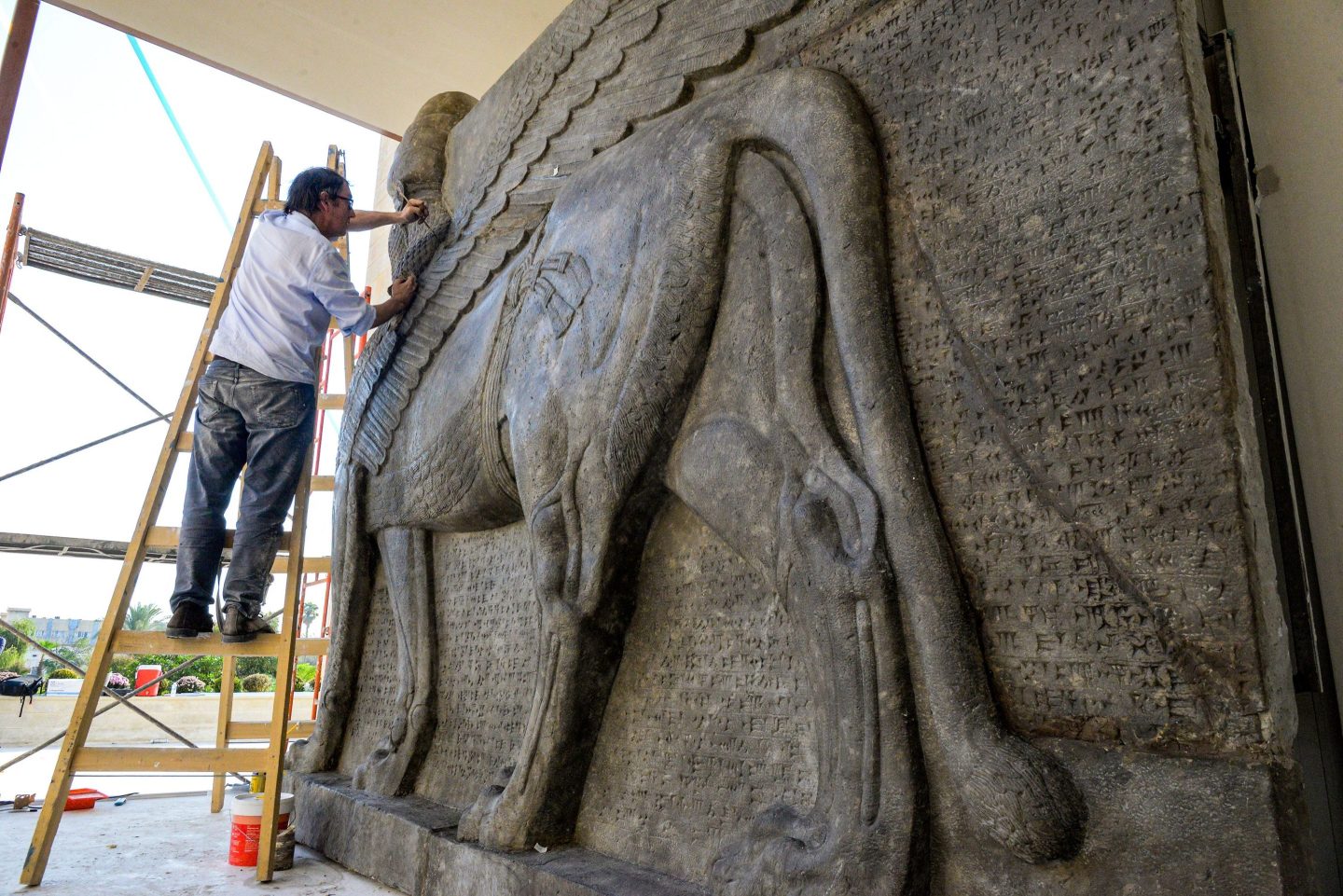
In translating dead languages, especially those with no descendant languages, piecing together meaning without a wealth of cultural context can be like traveling without a North Star. Akkadian is just such a language. The tongue of the Akkadian Empire, located in present-day Iraq during the 24th to 22nd centuries BCE, Akkadian existed as both a spoken and written language. Its cuneiform writing system used an alphabet of sharp, intersecting triangular figures. Akkadians typically wrote by marking a clay tablet with the wedge-shaped end of a reed (cuneiform literally means “wedge shaped” in Latin). Hundreds of thousands of these tablets, due to the durability of their material, have weathered the centuries and now populate the halls of various universities and museums.
Translation is often misunderstood as a one-to-one decryption of a foreign word or phrase. But many times, a statement in one language doesn’t have an exact or easy equivalent in another, accounting for cultural nuance and difference in the languages’ construction. High-quality translation requires a deep knowledge of both languages’ structures, their surrounding cultures, and the histories that anchor those cultures. Translating a text while preserving its original tone, cadence, and even humor is a delicate craft—and an incredibly difficult one when the language’s culture is largely unknown.
The number of existing cuneiform texts is overwhelming compared to the small number of linguists who are able to translate Akkadian. This means that troves of knowledge on the significant early civilization, sometimes considered the first empire in history, are completely untapped. Right now, the number of existing tablets and the rate of new tablets being excavated by archaeologists outpace linguists’ translation efforts. But that could change with the integration of A.I. into the cuneiform interpretation process.
“Hundreds of thousands of clay tablets inscribed in the cuneiform script document the political, social, economic, and scientific history of ancient Mesopotamia,” the team wrote. “Yet, most of these documents remain untranslated and inaccessible due to their sheer number and limited quantity of experts able to read them.”
The A.I. can perform two types of translation—translating cuneiform to English, and transliterating cuneiform (rewriting it phonetically). The A.I.’s skill at the two translation types of translation scored 36.52 and 37.47, respectively, on the Best Bilingual Evaluation Understudy 4 (BLEU4), a measure of translation quality. These scores were above the team’s target, and are both high enough to be considered high-quality translations. BLEU4 scores on a scale of 0 to 100 (or 0 to 1) with 70 being the highest that could be realistically achieved by a very skilled human translator.
For decades, computer-generated translations were brittle and unreliable, Tom McCoy, a computational linguist at Princeton University, said. Translation programs embedded with grammatical rules always missed the richness of meaning in idioms and nonliteral language that slip through the cracks of formal grammar. But recently, A.I. programs like the cuneiform translator have been able to get at the “fuzzier” areas of language. It heralds an exciting new period of A.I.-propelled computational linguistics.
“In recent A.I., the big new thing is statistical processing, which is another type of math but not the sort of rigid rules that people were working with before,” McCoy said. “Statistics got us kind of over the hump of previous methods. We’re now working with machine learning and deep learning. Machines are able to learn all these idiosyncrasies, idioms, and exceptions to rules, which is what was missing in the previous generation of A.I.”
“You can never really trust the output”
The cuneiform A.I.’s translations still had mistakes—and had “hallucinations” as is common with A.I. In one example, it translated “Why should we (also) conduct the lawsuit before a man from Libbi-Ali?” as “They are in the Inner City in the Inner City.”
Despite occasional errors, the tool still saved huge amounts of time and human labor in its initial processing of the texts.
“A.I. currently is remarkable but unreliable. So it can do really amazing things, but you can never really trust the output it produces,” McCoy said of using A.I. for translation. “This means that the best case for using A.I. is something where it’s very labor intensive, hard for humans to do, but once A.I. has given you some output, it’s easy for humans to verify it.”
The model was most accurate when translating shorter sentences and formulaic texts like administrative records. It was also—surprisingly to the researchers—able to reproduce genre-specific nuances in translation. In the future, the A.I. will be trained on larger and larger samples of translations to further improve its accuracy, the researchers wrote.
For now, it can assist researchers by producing preliminary translations that humans can then check for accuracy and refine in nuance.
“A promising future scenario would have the [model] show the user a list of sources on which they based their translations, which would also be particularly useful for scholarly purposes,” the researchers wrote.