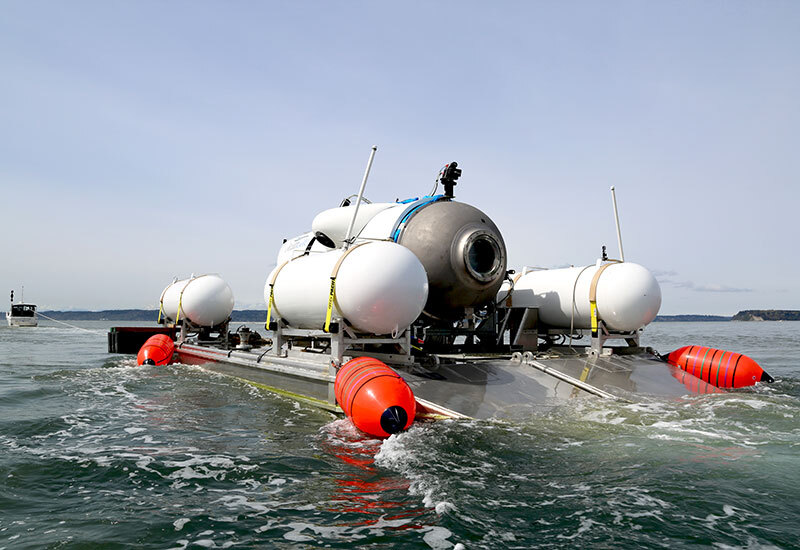
The deadly implosion of the Titan submersible raises questions about whether the vessel exploring the Titanic wreckage was destined for disaster because of its unconventional design and its creator’s refusal to submit to independent checks that are standard in the industry.
All five people aboard the Titan died when it was crushed near the world’s most famous shipwreck, U.S. Coast Guard Rear Adm. John Mauger said Thursday, bringing an end to a massive multinational search that began Sunday when the vessel lost contact with its mother ship in the unforgiving North Atlantic.
The Titan, owned and operated by OceanGate Expeditions, first began taking people to the Titanic in 2021. It was touted for a roomier cylinder-shaped cabin made of a carbon-fiber — a departure from the sphere-shaped cabins made of titanium used by most submersibles.
The sphere is “the perfect shape,” because water pressure is exerted equally on all areas, said Chris Roman, a professor at the University of Rhode Island’s Graduate School of Oceanography. Roman had not been on the Titan but has made several deep dives in Alvin, a submersible operated by the Woods Hole Oceanographic Institute in Massachusetts.
The 22-foot long (6.7-meter long), 23,000-pound (10,432-kilogram) Titan’s larger internal volume — while still cramped with a maximum of five seated people — meant it was subjected to more external pressure.
Elongating the cabin space in a submersible increases pressure loads in the midsections, which increases fatigue and delamination loads, said Jasper Graham-Jones, an associate professor of mechanical and marine engineering at the University of Plymouth in the United Kingdom.
Fatigue, he said, is like bending a wire back and forth until it breaks. Delamination, he said, is like splitting wood down the grain, which is easier than chopping across the grain.
Furthermore, the Titan’s 5-inch thick (12.7 centimeters) hull had been subjected to repeated stress over the course of about two dozen previous dives, Graham-Jones said.
Each trip would put tiny cracks in the structure. “This might be small and undetectable to start but would soon become critical and produce rapid and uncontrollable growth,” he said.
OceanGate promoted the Titan’s carbon fiber construction — with titanium endcaps — as “lighter in weight and more efficient to mobilize than other deep diving submersibles” on its website. It also said the vessel was designed to dive four kilometers (2.4 miles) “with a comfortable safety margin,” according to court documents.
But carbon composites have limited life when subject to excessive loads or poor design which leads to stress concentrations, Graham-Jones said.
“Yes, composites are extremely tough. Yes, composites are extremely long lasting. But we do have issues with composites and the fact that composites fail in slightly different ways than other materials,” he said.
OceanGate was also warned that a lack of third party scrutiny of the vessel during development could pose catastrophic safety problems.
David Lochridge, OceanGate’s then-director of marine operations, said in a 2018 lawsuit that the company’s testing and certification was insufficient and would “subject passengers to potential extreme danger in an experimental submersible.”
He advocated for “nondestructive testing,” such as ultrasonic scans, but the company refused.
Ultrasonic testing can help spot areas inside the structure where the composites are coming apart, said Neal Couture, executive director of a professional organization called the American Society for Nondestructive Testing.
“Once this thing is going down and going under stress, it’ll affect those materials, it’ll affect those composites,” Couture said Friday. “Nondestructive testing is how you would then assess those structures and say, ‘OK, they’re still viable,’ or, ‘they’re still susceptible.’”
The Marine Technology Society, an organization of ocean engineers, technologists, policymakers and educators, also expressed concern to OceanGate about the size of the Titan, the construction material and the fact that the prototype wasn’t being examined by a third party.
“We were very afraid that without that certification process, they might be missing something,” Will Kohnen, the organization’s chairman said Friday. He sent a letter to the company in 2018 warning that its “current experimental approach … could result in negative outcomes (from minor to catastrophic) that would have serious consequences for everyone in the industry.”
Graham-Jones said it’s standard procedure in engineering to seek outside expertise the ensure that vessels conform to the highest industry standards.
In a 2019 company blog post, OceanGate criticized the third-party certification process as one that is time-consuming and stifles innovation.
“Bringing an outside entity up to speed on every innovation before it is put into real-world testing is anathema to rapid innovation,” the post said.
Famed undersea explorer Robert Ballard, who first located the Titanic wreckage in 1985, called the lack of outside certification and classification a “smoking gun” in the vessel’s failure.
“We’ve made thousands and thousands and thousands of dives with other countries as well to these depths and have never had an incident,” he said Friday on ABC’s “Good Morning America.”
“Titanic” director James Cameron, who has made multiple descents to the wreck, said there are several possible reasons for the submersible’s destruction, but the most likely is a failure of the composite hull.
“The question is, was it the primary failure, or a secondary failure from something else happening?” he told “Good Morning America” on Friday. “And I’m putting my money on the composite because you don’t use composites for vessels that are seeing external pressure.”