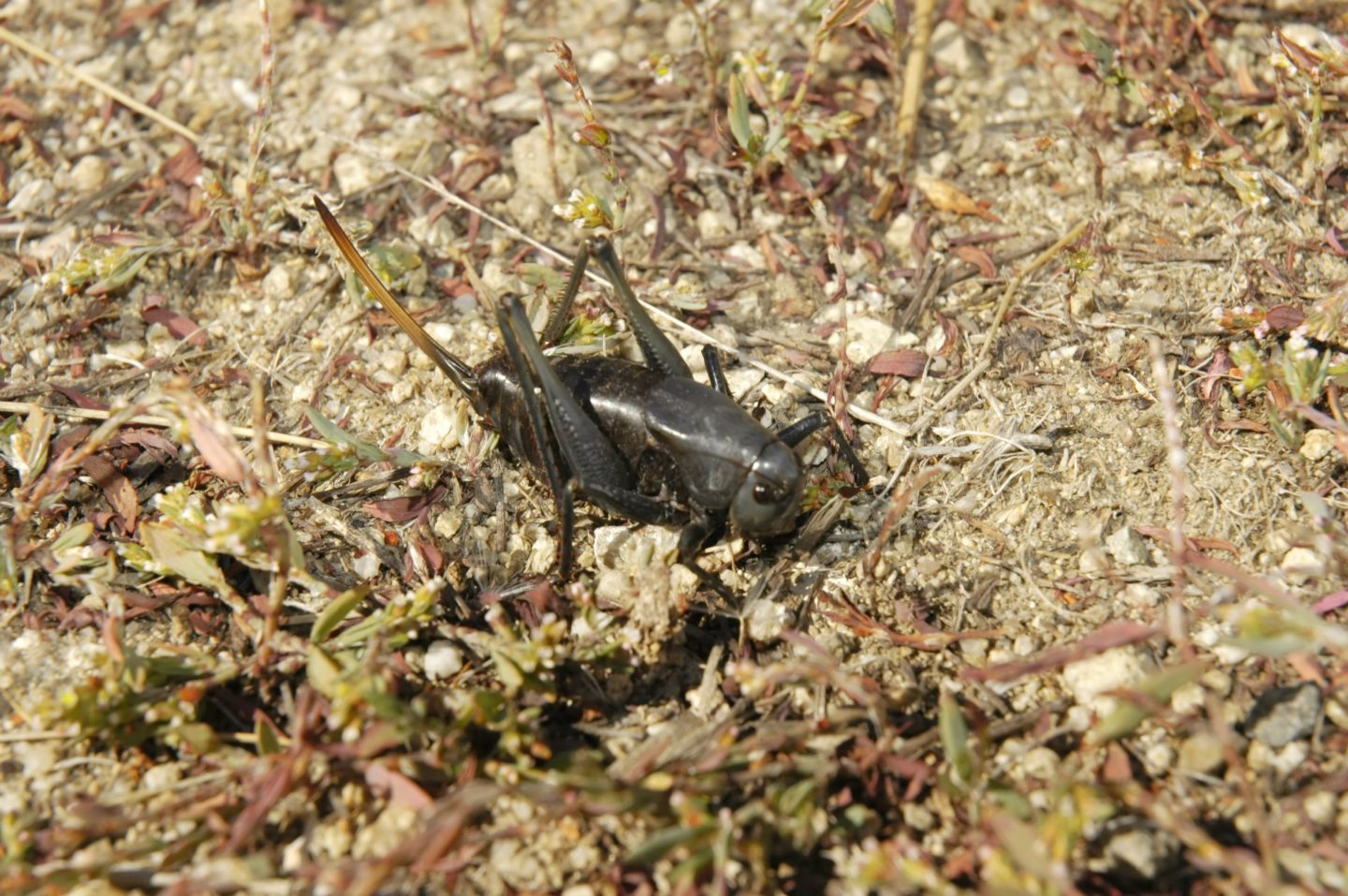
Dana Dolan was driving through her small Nevada hometown when she thought she had come upon a gory crash. The ground surrounding Elko’s stretch of Interstate 80 looked as if it had been covered in blood. As the red color shifted and moved, she realized instead it was an infiltration of crickets, some bigger than her thumb.
“It’s almost like a biblical plague,” Dolan told The Associated Press last week, laughing at the absurdity of the situation that is playing out in Elko, where she’s lived for six years.
Tens of thousands of Mormon cricket eggs buried about an inch deep in the soil began to hatch in late May and early June. For weeks, the red critters have been invading swaths of northern Nevada and causing chaos, said the state’s longtime entomologist Jeff Knight.
The invasion of the cannibalistic crickets has hit especially hard in Elko, a small town of about 20,000 near Idaho and Utah known for its gold mining.
The big red bugs leave behind a stench so horrible, akin to burning flesh, that it forces residents to plug their noses while driving. The critters stick to tires and the bottoms of shoes, and their carcasses are everywhere, even in gyms. When they move, it sounds like rain, Dolan says.
Residents and workers have tried to use brooms, leaf blowers, pressure washers and snow plows to get rid of the crickets, only for them to return. State officials have erected signs throughout Elko County warning drivers of slick highways, a popular hangout spot for insects that won’t think twice about eating their dead friends.
The red creatures blanket highways and scuttle over barriers, seeking food. They crackle and pop under the wheels of trucks, creating something like an oil slick, said Jeremiah Moore of Spring Creek, whose vehicle slid off the road after a highway encounter with the Mormon crickets.
“I … was coming home and as I came around the corner, I came around a little too fast and I about ended up in the ditch full of water,” Moore said. “It was pretty intense.”
One hospital even hired four temporary, part-time employees whose main duty was to clear the campus of the crickets long enough for patients to enter the building. The group called itself the Cricket Patrol.
“We’re just trying to keep them moving on their way,” said Steve Burrows, a spokesperson for Northeastern Nevada Regional Hospital.
When the Cricket Patrol wasn’t on duty, Burrows said, other hospital employees stepped in.
There was the medical worker in the cardiology unit who, still in his black scrubs, went outside the hospital’s ambulance bay between seeing patients to swat crickets away with a broom, Burrows said. And the IT specialists who helped with clean-up efforts.
Outbreaks of Mormon crickets, which are native to the Great Basin and Intermountain West, have been recorded throughout history across the west — from Nevada and Montana to Idaho, Utah and Oregon. There are records of infestations dating to the 1930s, according to entomologist Knight.
Legend has it the insects got their name when they started devastating crops planted by Mormon settlers who had moved into the Salt Lake valley in Utah, Knight said.
“The settlers prayed for relief,” Knight said. “That came in the form of seagulls. Seagulls ate the crickets…That’s also why they’re the state bird of Utah.”
In Oregon, state lawmakers in recent years have allocated millions of dollars to assess the problem and set up a Mormon cricket and grasshopper “suppression” program.
The Mormon cricket is not a true cricket but a shield-backed katydid. They are flightless but travel together in “bands” that can range in size from 5 acres (2 hectares) acres to hundreds of acres, Knight said.
Yet the invasion in Elko this year isn’t unprecedented for its size but for its timing.
The crickets hatched far later than their usual springtime birth, delayed by an especially wet spring and snow-packed winter in northern Nevada, Knight said.
Each spring — or summer, in this case — the crickets born that year will mate and lay a new generation of eggs in the soil. Those eggs are meant to hatch the following spring, but some will lay dormant in the soil for up to 11 years, Knight said. Eggs can accumulate in the dirt for years until a drought comes along, triggering the sleepy eggs to hatch all at once. And then the cycle repeats.
In his nearly 40 years working for the Nevada Department of Agriculture — 32 of those as the state entomologist — Knight said he can recall four invasions. The infestation in the early 2000s “was most impressive in my mind, looking at the overall scope,” he said.
Knight remembers one time driving from Reno to Utah on Interstate 80 and being surrounded by a swarm of red nearly the entire drive.
“Then we can go almost 10, 15 years without hardly seeing any,” Knight said of the crickets. “From about 2008, we hardly had any crickets, until about 2019. ”
Elko’s new red residents won’t be moving out until at least mid-August, much to everyone’s despair.
But where do the crickets go when they leave?
They die, Knight said. The male crickets after they mate. The female crickets after laying their eggs.