U.S.-China tensions have been called a repeat of Cold War-era dynamics. But a more apt comparison may be the years preceding World War I, when much of Europe was sitting on a powder keg of hostilities and overlapping territorial claims that required only two bullets to ignite. The difference now is that the great rivals have access to nuclear weapons, and with artificial intelligence they could be on the cusp of creating another tool that could wipe out mankind, according to former Secretary of State Henry Kissinger.
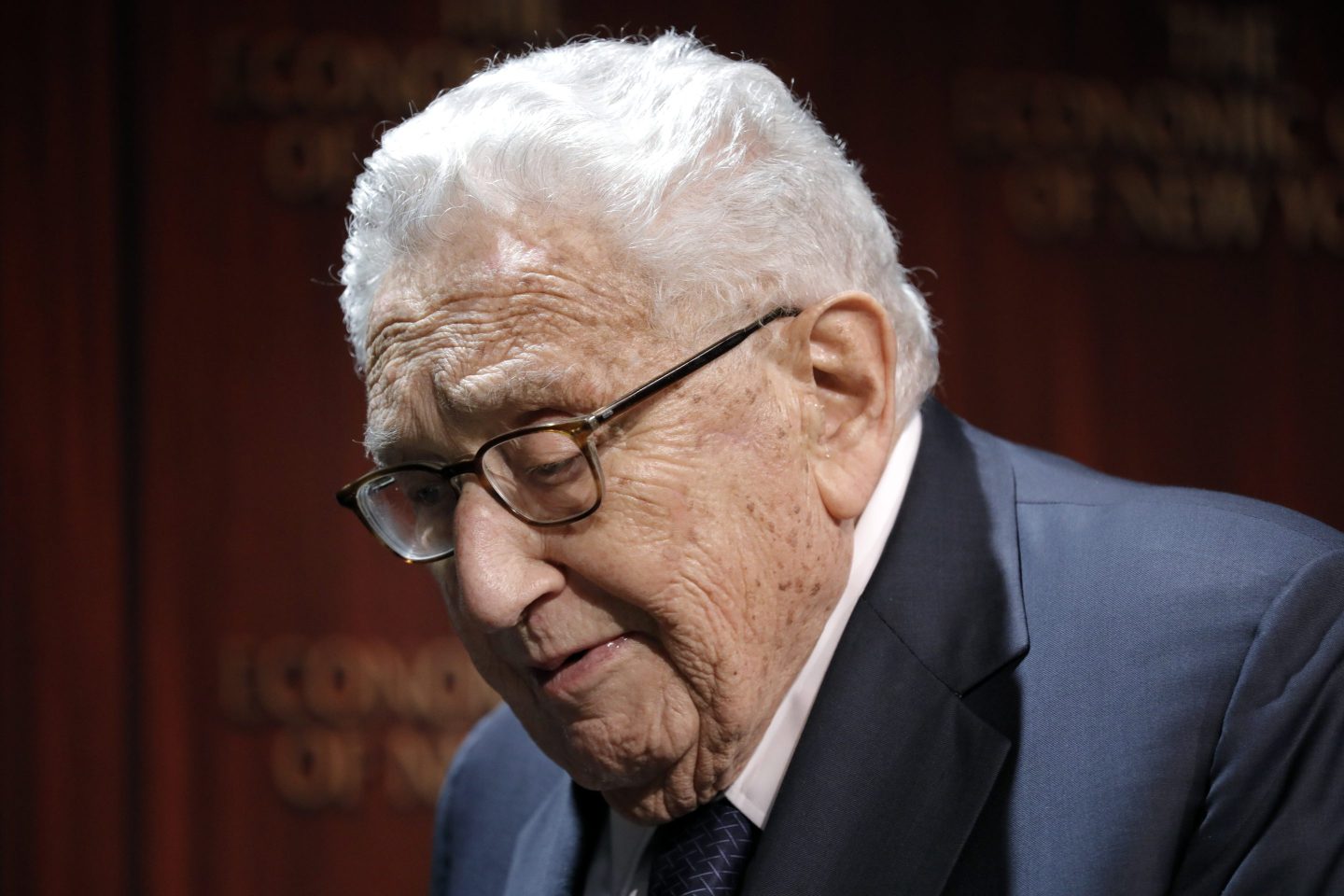
The U.S. and China represent the “greatest dangers to peace right now” if their animosities escalate to a military confrontation, Kissinger said in an interview with The Economist published Wednesday. The two countries are heading toward a major confrontation, he said, as both nations have “convinced themselves that the other represents a strategic danger.”
Tensions over Taiwan are likely to be a major flashpoint for future conflict, as President Joe Biden has signaled the U.S. would aid the island nation if China invades to reconquer what it considers a breakaway state. But much like with nuclear weapons during the Cold War, the world is now perfecting a new technology—A.I.—that may be too dangerous to even consider deploying militarily.
“[China and America] are two powers of the type where, historically, a military confrontation was inevitable. But this is not a normal circumstance, because of mutually assured destruction and artificial intelligence,” Kissinger said.
Delicate state of affairs
U.S.-China relations are now at a low point. They started declining after the Trump administration imposed strict trade tariffs on China that have continued under the Biden administration. More recently, the two sides have clashed over China’s intellectual property theft from U.S. companies, Chinese President Xi Jinping’s close relationship with Russian counterpart Vladimir Putin, and the rising risk of China invading Taiwan.
“We’re in the classic pre-World War I situation, where neither side has much margin of political concession and in which any disturbance of the equilibrium can lead to catastrophic consequences,” Kissinger said.
The world, in general, is becoming more dangerous, Kissinger said. He reluctantly supports Ukraine joining the military alliance NATO once the war ends, after years spent pushing back on the idea. India is another rising power, and Kissinger advocated strengthening its military in case occasional border skirmishes with China escalate to an all-out invasion.
Meanwhile, Taiwan isn’t the only East Asian country concerned about China’s rise, as Japanese officials have long warned that China poses an existential threat to the region. Last year, Japan announced a $320 billion military build-up plan, ending decades of pacifism. The plan includes missiles capable of reaching China, but the build-up could go even further, as Kissinger predicted that Japan is “heading towards becoming a nuclear power in five years.”
A.I.’s magnifying threat
Just as superpowers settled into an unspoken detente from mutual destruction during the Cold War, A.I. might be weaponized with similar implications.
“We are at the very beginning of a capability where machines could impose global pestilence or other pandemics—not just nuclear, but any field of human destruction,” Kissinger said. “The circumstances require responsible leaders, who at least make an attempt to avoid conflict.”
Current A.I. systems like OpenAI’s ChatGPT have threatened economic disruption and widespread layoffs by making certain jobs obsolete, but some computer science experts have warned that the technology could still be in its infancy, and keeping up with it will likely get a lot harder in the future.
The U.S. and China are racing to dominate A.I. because of its potential economic importance, although former Google CEO Eric Schmidt—who earlier this year compared A.I.’s impact on warfare to that of nuclear weapons—warned this week that the U.S. is only “slightly ahead” of China on A.I.
Some A.I. experts have cautioned that the world is simply not ready for A.I. being refined to a more sophisticated level known as artificial general intelligence. AGI, as it’s also called, when the technology can match human capabilities and reasoning, may be achieved in only a few years. If computers become capable that level of intelligence, humans might lose control and the technology could threaten the world, Kissinger said.
“We may well wind up destroying ourselves. And a point is now quite reachable where the machines can refuse to be shut off. I mean once the machines recognized this possibility, they can build it into their advice prior to the contingency. Many genius scientists believe that—and they know more than I do.”
Kissinger called for restraint in developing new technologies with civilization-ending potential, adding that as the world returns to being a more dangerous place, it’s essential that responsible governance prevails over hot heads.
“When we’re in an adversarial world with mutually assured destruction, you owe it morally to your society to avoid it,” he said.