• Home
  • Latest
  • Fortune 500
  • Finance
  • Tech
  • Leadership
  • Lifestyle
  • Rankings
  • Multimedia
TechAI

CEO of Google’s DeepMind says we could be ‘just a few years’ from A.I. that has human-level intelligence

Tristan Bove
By
Tristan Bove
Tristan Bove
Down Arrow Button Icon
Tristan Bove
By
Tristan Bove
Tristan Bove
Down Arrow Button Icon
May 3, 2023, 5:32 PM ET
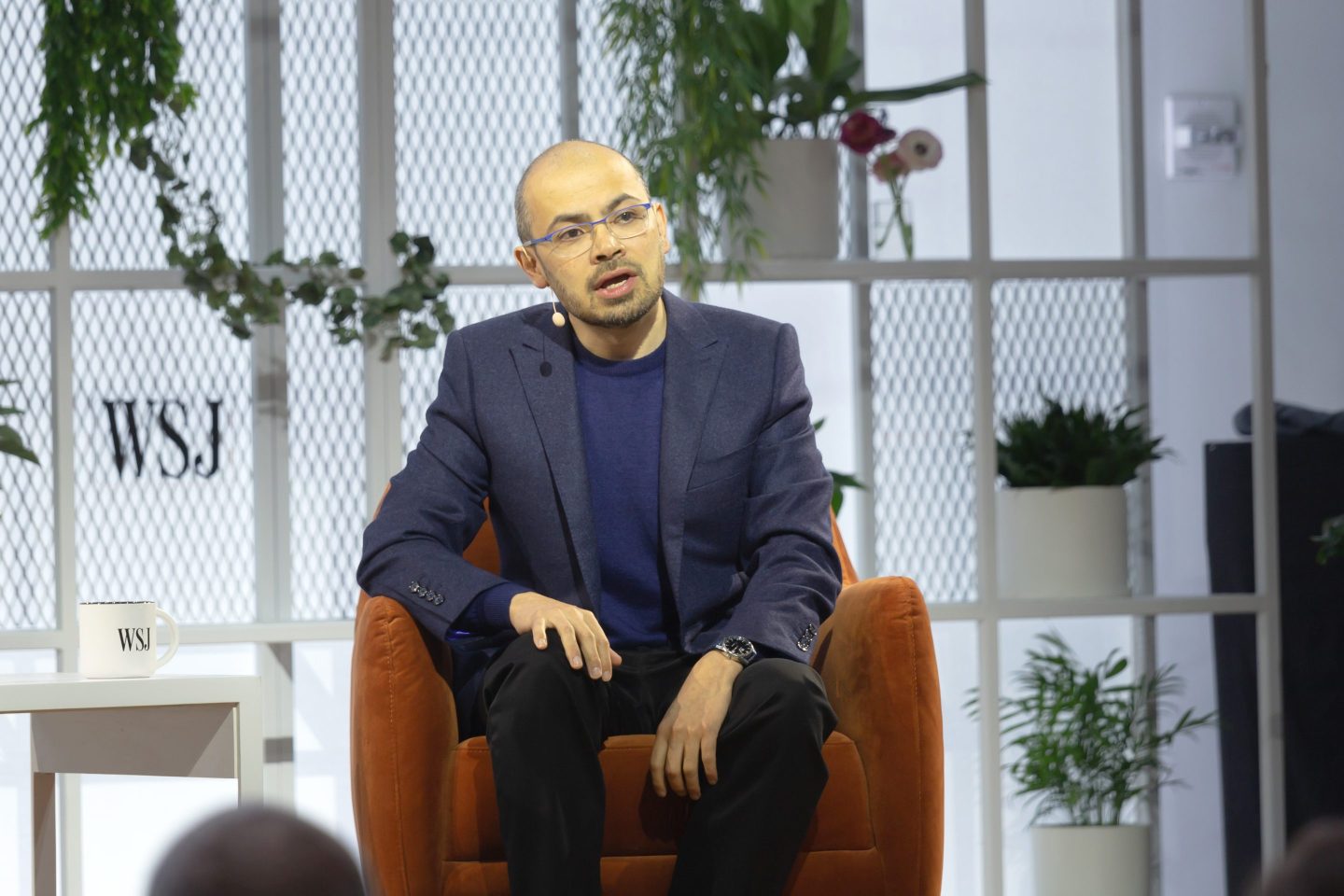
DeepMind CEO Demis Hassabis
DeepMind CEO Demis Hassabis at the 2023 WSJ Future of Everything Festival.Joy Malone—Getty Images

While artificial intelligence like OpenAI’s ChatGPT promises to revolutionize every aspect of the economy, the true holy grail for A.I. researchers—artificial general intelligence, or AGI—has been elusive. It’s when a machine can understand the world at least as well as a human. Experts say it will take a few years to a few decades to achieve the goal, if it can even truly exist. The head of Google’s main A.I. research lab, for one, leans toward sooner rather than later. 

Recommended Video

“I think we’ll have very capable, very general systems in the next few years,” Demis Hassabis, CEO of DeepMind, a subsidiary of Google parent Alphabet, said Tuesday during a conference hosted by the Wall Street Journal. 

“The progress in the last few years has been pretty incredible,” he continued. “I don’t see any reason why that progress is going to slow down. I think it may even accelerate. So I think we could be just a few years, maybe within a decade away.”

A.I. has been the exception to the tech sector’s downturn over the past year, with companies and venture capital firms doubling down on the technology. Much of that money is flowing to develop generative A.I., algorithms that can generate text or images based on specific prompts.  

Yet research, which looks even farther ahead, is already moving on from generative A.I. to AGI, according to 56% of computer scientists and A.I. researchers polled in a Stanford University survey last month. AGI would be significantly more sophisticated because it would be aware of what it says and does. Theoretically, it would be far less likely to spit out the inaccuracies and confused statements that tarnish the image of the current technology, which relies on large amounts of training data and predictive models to help it anticipate the most likely answer to what it’s asked to do. 

DeepMind, acquired by Google in 2014, made headlines in 2021 when it publicized the results of its A.I. system AlphaFold, which predicted the structure of every known protein in the human genome. The milestone has huge implications for disease and medicinal research. And last year, the company made headlines again by analyzing the structure of almost every protein known to science, releasing over 200 million predictions in a free-to-access database. DeepMind has also developed A.I. that is capable of diagnosing complex eye diseases; systems that cut its parent company’s energy bills by 40%; and software that turns text into speech. 

Last month, Google announced it was integrating its core A.I. research team with DeepMind and appointing Hassabis as the combined unit’s CEO to accelerate the company’s push toward AGI. Google and Alphabet CEO Sundar Pichai said in a statement that the overhaul would “help power the next generation of our products and services.”

Fast-tracked AGI development is not without its critics, however. Around 58% of A.I. experts called AGI an “important concern” in the Stanford survey, with 36% saying it could lead to a “nuclear-level catastrophe.” Some experts said AGI could represent a technological singularity, a hypothetical future moment when machines irreversibly surpass human abilities and could pose a threat to civilization.

Over 1,000 technologists and A.I. experts including Elon Musk and Apple cofounder Steve Wozniak signed an open letter in March calling for a six-month halt on advanced A.I. development to reprioritize ethics research.  One of the signatories’ concerns was dangers from unrestrained superhuman A.I. 

Other observers have argued that advanced A.I. could cause severe damage to society if it is not reined in and aligned with human values. Paul Christiano, an A.I. researcher who formerly led safety and alignment work at OpenAI, cautioned last week that unchecked AGI development could lead to a “full-blown A.I. takeover scenario” that destroys humanity. Yuval Harari, author of the popular science book Sapiens and one of the open letter’s signatories, also wrote in The Economistlast week that A.I. was akin to a poorly understood “alien intelligence, here on Earth” that could represent the “end of democracy” if used unethically.

Speaking on stage Tuesday, Hassabis promised DeepMind’s work on AGI won’t put civilization at risk anytime soon, as the company’s current priority is to integrate A.I. with more products, which he predicted would be as game-changing as the first iPhone. 

Hassabis also said Google would responsibly develop AGI, and asserted his view that the technology should be used in “a cautious manner using the scientific method where you try and do very careful controlled experiments to understand what the underlying system does.”


Join us at the Fortune Workplace Innovation Summit May 19–20, 2026, in Atlanta. The next era of workplace innovation is here—and the old playbook is being rewritten. At this exclusive, high-energy event, the world’s most innovative leaders will convene to explore how AI, humanity, and strategy converge to redefine, again, the future of work. Register now.
About the Author
Tristan Bove
By Tristan Bove
LinkedIn iconTwitter icon
See full bioRight Arrow Button Icon

Latest in Tech

Sarandos
Arts & EntertainmentM&A
It’s a sequel, it’s a remake, it’s a reboot: Lawyers grow wistful for old corporate rumbles as Paramount, Netflix fight for Warner
By Nick LichtenbergDecember 13, 2025
3 hours ago
Oracle chairman of the board and chief technology officer Larry Ellison delivers a keynote address during the 2019 Oracle OpenWorld on September 16, 2019 in San Francisco, California.
AIOracle
Oracle’s collapsing stock shows the AI boom is running into two hard limits: physics and debt markets
By Eva RoytburgDecember 13, 2025
4 hours ago
robots
InnovationRobots
‘The question is really just how long it will take’: Over 2,000 gather at Humanoids Summit to meet the robots who may take their jobs someday
By Matt O'Brien and The Associated PressDecember 12, 2025
17 hours ago
Man about to go into police vehicle
CryptoCryptocurrency
Judge tells notorious crypto scammer ‘you have been bitten by the crypto bug’ in handing down 15 year sentence 
By Carlos GarciaDecember 12, 2025
18 hours ago
three men in suits, one gesturing
AIBrainstorm AI
The fastest athletes in the world can botch a baton pass if trust isn’t there—and the same is true of AI, Blackbaud exec says
By Amanda GerutDecember 12, 2025
19 hours ago
Brainstorm AI panel
AIBrainstorm AI
Creative workers won’t be replaced by AI—but their roles will change to become ‘directors’ managing AI agents, executives say
By Beatrice NolanDecember 12, 2025
19 hours ago

Most Popular

placeholder alt text
Economy
Tariffs are taxes and they were used to finance the federal government until the 1913 income tax. A top economist breaks it down
By Kent JonesDecember 12, 2025
1 day ago
placeholder alt text
Success
Apple cofounder Ronald Wayne sold his 10% stake for $800 in 1976—today it’d be worth up to $400 billion
By Preston ForeDecember 12, 2025
23 hours ago
placeholder alt text
Success
40% of Stanford undergrads receive disability accommodations—but it’s become a college-wide phenomenon as Gen Z try to succeed in the current climate
By Preston ForeDecember 12, 2025
22 hours ago
placeholder alt text
Economy
For the first time since Trump’s tariff rollout, import tax revenue has fallen, threatening his lofty plans to slash the $38 trillion national debt
By Sasha RogelbergDecember 12, 2025
18 hours ago
placeholder alt text
Economy
The Fed just ‘Trump-proofed’ itself with a unanimous move to preempt a potential leadership shake-up
By Jason MaDecember 12, 2025
16 hours ago
placeholder alt text
Success
At 18, doctors gave him three hours to live. He played video games from his hospital bed—and now, he’s built a $10 million-a-year video game studio
By Preston ForeDecember 10, 2025
3 days ago
Rankings
  • 100 Best Companies
  • Fortune 500
  • Global 500
  • Fortune 500 Europe
  • Most Powerful Women
  • Future 50
  • World’s Most Admired Companies
  • See All Rankings
Sections
  • Finance
  • Leadership
  • Success
  • Tech
  • Asia
  • Europe
  • Environment
  • Fortune Crypto
  • Health
  • Retail
  • Lifestyle
  • Politics
  • Newsletters
  • Magazine
  • Features
  • Commentary
  • Mpw
  • CEO Initiative
  • Conferences
  • Personal Finance
  • Education
Customer Support
  • Frequently Asked Questions
  • Customer Service Portal
  • Privacy Policy
  • Terms Of Use
  • Single Issues For Purchase
  • International Print
Commercial Services
  • Advertising
  • Fortune Brand Studio
  • Fortune Analytics
  • Fortune Conferences
  • Business Development
About Us
  • About Us
  • Editorial Calendar
  • Press Center
  • Work At Fortune
  • Diversity And Inclusion
  • Terms And Conditions
  • Site Map

© 2025 Fortune Media IP Limited. All Rights Reserved. Use of this site constitutes acceptance of our Terms of Use and Privacy Policy | CA Notice at Collection and Privacy Notice | Do Not Sell/Share My Personal Information
FORTUNE is a trademark of Fortune Media IP Limited, registered in the U.S. and other countries. FORTUNE may receive compensation for some links to products and services on this website. Offers may be subject to change without notice.