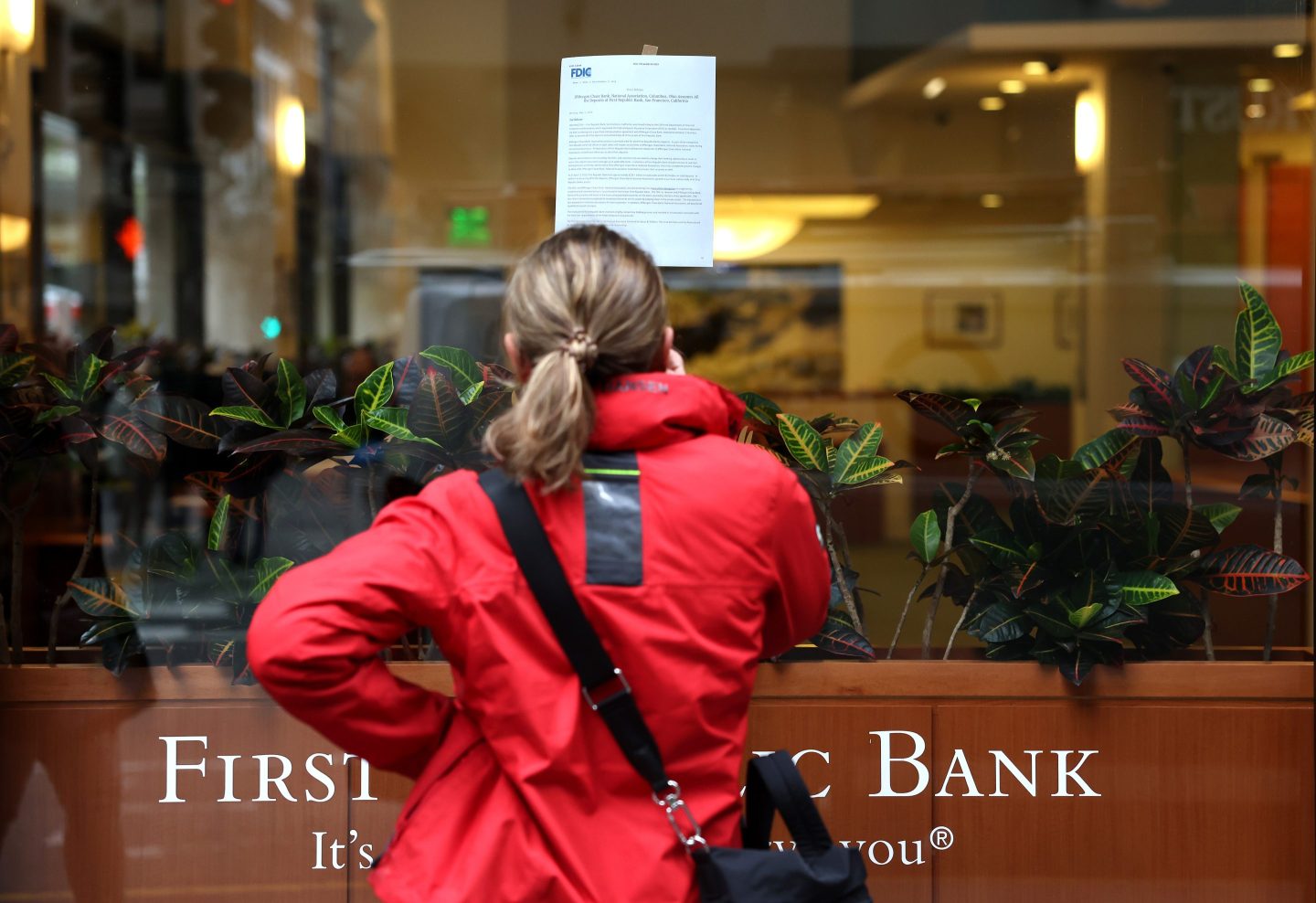
The latest series of bank failures is testing trust in banks and fracturing the illusion that customers’ deposits are sitting there waiting for them. For even the savviest of bank customers, it is easy to make a deposit and forget it. Startups, VCs, and even individuals kept millions of dollars in their Silicon Valley Bank accounts, not thinking twice about the risks being taken with that money on their behalf.
I learned the secrets of the industry firsthand in 2008 as a Wall Street quant trader who joined Goldman Sachs as a mathematician a few months before Lehman Brothers unraveled. I am sharing those secrets so bank customers can ask better questions and make better decisions about where to store their money.
Your cash is not sitting in the bank
As soon as a paycheck or a business deposit reaches a bank, it’s put to work. Most people think they are safely parking money in a vault, but in reality, they are investing in a bank’s portfolio of investments, mostly loans.
There’s a good reason for this. The more than 9,000 banks in the U.S. provide a critical service of lending to consumers and businesses. I sit on the board of a community bank and have seen firsthand how local bankers help their local businesses and customers.
The situation gets more complicated when deposits are used for bigger and riskier leverage.
Big banks make the biggest bets
Essentially all banks make bets. They bet on a homeowner to pay back a mortgage. They bet on new businesses with credit lines. They bet on what they know about the economy to buy Treasury bonds. The bigger the banks, the bigger the bets as they seek larger returns from complicated, riskier financial instruments.
As a Wall Street quant trader during the 2008 financial collapse, I saw how the repo markets (which represent lending between banks) collapsed overnight as nearly worthless mortgage-backed securities destroyed Lehman Brothers. The bets were massive—and built on a hollow foundation of bad loans.
The history of Big Bank excesses keeps repeating itself. Silicon Valley Bank’s bad bet on long-term Treasury bonds looks quaint compared to what happened in 2012 at JPMorgan Chase. One infamous trader, known as the London Whale, lost more than $6 billion through risky trades including complex hedging strategies with credit default swaps.
Banks need to fail sometimes
It’s inherent in the banking system and its business model that some banks will fail during moments of economic or financial shock. Bank busts are the release valve in the system.
History is riddled with crises, from the Great Depression to the savings-and-loan failures in both the 1980s and 1990s, as well as one-off failures. That’s why banks are heavily regulated. However, those regulations are imperfect. They evolve and must catch up with the latest financial risk-taking strategy behind a new cycle of failures and crises.
The Great Depression led to depositor insurance. The 2008 financial crisis led to stricter capital requirements through Basel III. The current shock is leading to discussions about bringing back stricter requirements for regional banks and increasing the amount covered by depositor insurance.
While no one wants to see bank failures, they need to be accepted in a healthy system in order to shine a light on what is broken. What needs to be protected is the depositor’s day-to-day operations.
Banks cannot take unlimited deposits
The more money banks take in, the more places they need to find to lend, invest, and make money. That looks good on the surface, until one digs into a bank’s balance sheet: As they lend and invest more, they need more capital to meet regulatory requirements.
Put another way, a bank cannot go viral. Banks typically are required to hold capital representing nearly 10% of their assets (though the exact ratios vary). That means for every $10 million of new deposits, they would need to find $1 million of new capital. If the numbers rise too quickly, they simply cannot keep up.
What does this mean for deposits? Just as a bank run can lead to insolvency as withdrawals exceed reserves, a deposit rush hurts business as cash exceeds a bank’s ability to lend and raise capital. Following the pandemic, banks awash in deposits were even asking businesses to deposit less and redirecting them to money-market accounts with different requirements.
Banks run on borrowed money
Banks don’t have your money. Every day, as deposits flow in and withdrawals flow out, each bank has an excess or deficit of cash. To make sure that the trillions of dollars in daily wire transfers and payments arrive on time, they lend to each other.
There is an enormous overnight lending market built on complex tools to manage liquidity across all the banks. One of the most common is repurchase agreements, which require the posting of short-term assets such as ultrasafe Treasury bills or high-grade commercial paper as collateral.
One weak spot in this system is the potential for bank runs among the banks themselves. When other banks lose faith in one of their peers, they may halt their overnight lending with that player. The dominoes then fall swiftly, as happened with Lehman Brothers in 2008. The at-risk bank can no longer operate, and its collapse risks causing a massive contagion across the industry.
What’s next?
The recent bank failures may have felt like 2008 déjà vu because they similarly expose the weak spots in the system that have not been resolved. While the circumstances are always different, the reality is that we constantly go through cycles—from credit booms to credit busts—that both spur economic growth and test the limits of the banking system.
This latest test is sparking again a much-needed conversation on how to protect depositors and avoid the potential for a wider contagion. Regulators and bankers are examining a range of possible solutions, such as the need for higher or unlimited FDIC insurance, the launch of a digital dollar, more direct depositor access to the U.S. Treasury, and even a role for stablecoins.
As we search for solutions, let’s not forget what really matters: disentangling everyday paychecks and payrolls from the risk on any given bank’s balance sheet.
All of us deserve to know that the money we rely on to pay bills and run our businesses is there when we need it.
Stephane Lintner, Ph.D., is the cofounder and CEO of Jiko and a former quant trader at Goldman Sachs.
The opinions expressed in Fortune.com commentary pieces are solely the views of their authors and do not necessarily reflect the opinions and beliefs of Fortune.
More must-read commentary published by Fortune:
- IBM CEO: ‘Today’s workforce should prepare to work hand in hand with A.I.’
- Is it smart to be a ‘stupid genius’ like Elon Musk?
- Credit scoring is pseudoscience–and it perpetuates the consequences of slavery and segregation
- America’s ‘disease burden’ is getting heavier by the day–and it’s unevenly distributed across states