For those who have been loosely following the unfolding banking crisis that began with a bank run on SVB in mid-March, you might be seeing the headlines about the meltdown of First Republic and thinking: Wait a second, wasn’t that whole bank crisis fixed a few weeks ago? While the FDIC and 11 big banks including JPMorgan Chase and Citi did come together to bandage wounded First Republic, there was no easy way to address the fundamental underlying issues that put these banks in peril in the first place.
Below, all the pressing questions about First Republic, answered.
Why is First Republic Bank’s stock falling?
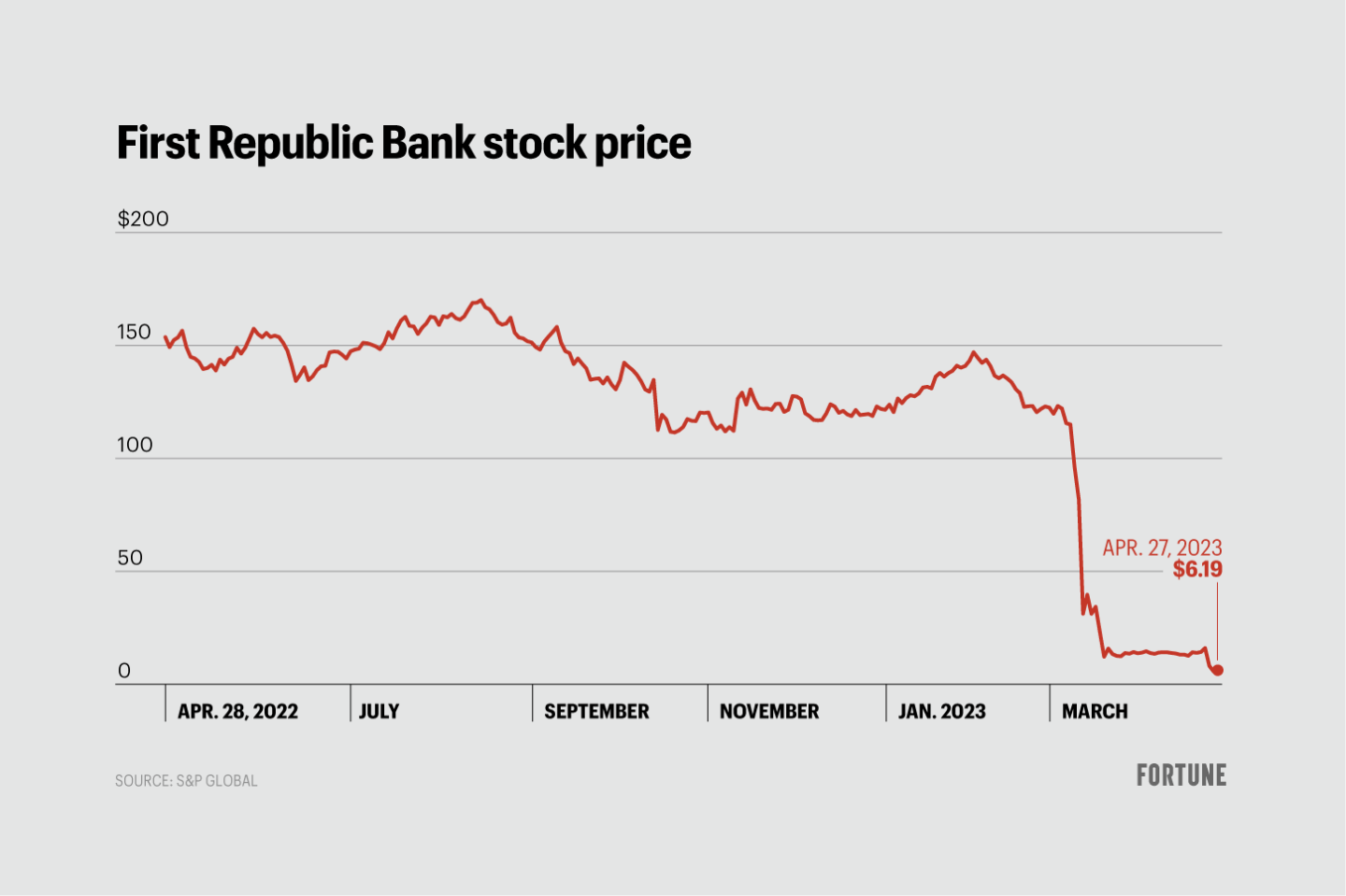
On Monday April 24, the company announced its first-quarter earnings results and admitted that it has lost $102 billion in customer deposits since March. On Tuesday, the stock tanked 49%, and on Wednesday it fell another 30%, driving the price $150 lower than it was a year ago. Trading was even paused on the New York Stock Exchange early Thursday. The bank announced that it was laying off up to 25% of its staff and cutting executive compensation, though they did not say by how much.
Now, some analysts are declaring the show is over for First Republic. “Even in March, when a ‘bank run’ sent two well-known regional banks into receivership, it was not clear that FRC was toast,” said Gordon Haskett analyst Don Bilson on Wednesday in a note to clients. “Well, it’s becoming clearer each day, and the only question that really needs to be answered is whether the FDIC moves in before the weekend or during the weekend, which is when it usually does its thing,” added Bilson.
What went wrong at First Republic?
The root of the issue is twofold: Similar to SVB, First Republic had many of its holdings in long-term bonds that were bought back when interest rates were low, and when interest rates went up, those were suddenly worth far less, which was the piece of information that triggered the bank run at SVB.
Also akin to SVB, First Republic is a regional, Silicon Valley–based bank that caters largely to wealthy businesses and high-net-worth individuals. Why is this an issue? Well, because so many of its depositors are businesses, it means that the bank had a far higher amount of uninsured deposits compared with most banks because their accounts are higher than the FDIC $250,000 limit. According to its recent balance sheet, on Dec. 31, 2022, 67% of its total deposits were uninsured. By March 31, that number was 48%, including its big bank backers, as uninsured depositors pulled out their funds during the SVB panic.
The vast majority of these uninsured customers are businesses. While the bank does not disclose a list of its core customer base, it said in its 8-K filing from March 10 that its business clients have an average account size of less than $500,000, while consumers have an average of about $200,000 in their accounts, which means the vast majority of individuals with money in First Republic are covered by the FDIC. They also added that no one sector represents over 9% of its total deposits—not that this helps them much when clients from every sector are jumping ship.
Wealthy business clients also have the resources to pull their money out as soon as they start seeing alarm bells. And when they do pull their money out, it’s not a bunch of smaller depositors emptying their last few paychecks from their checking account—these are big fish moving as millions at once out of the bank.
Why wasn’t First Republic rescued?
Why didn’t First Republic fold along with SVB then if it had many of the same underlying pitfalls? At first, when SVB went down in March, First Republic looked like it might topple down with it. However, 11 large U.S. banks coordinated with one another, and reportedly the government, to deposit $30 billion into First Republic, including JPMorgan Chase, Citi, Wells Fargo, and Goldman Sachs. Bloomberg reported in March that Janet Yellen and Jamie Dimon had a discussion about JPMorgan Chase stepping in to help. The coordinated effort was meant to stop the hemorrhaging of deposits and backstop the bank, but those efforts have not led to any improvement in the financial institution’s underlying fiscal health.
To make up for its loss in deposits, First Republic borrowed $92 billion from the Federal government and its backed lending group. While this extended the bank’s life span, it has meant that the bank has to pay the government interest instead of being the one to collect interest.
While executives and advisors at First Republic have been trying to engineer a sale for weeks, the bank is not an attractive buy. Last week, the bank tried to persuade some of its big bank backers to buy $100 billion in assets, to no avail. Bigger banks are hesitant to rescue First Republic again unless they have assurance from the FDIC that their deposits will be made whole—which they don’t.
Who else is leaving First Republic?
Meanwhile, as the stock tanks and depositors flee, the bank’s wealth management division is bleeding clients as well. Teams of advisors managing billions are packing up and hopping ship—taking their high-net-worth clients with them to new employers. One advisor team that managed $13 billion left this week. When these advisors leave, they’re not only taking clients with deposits in the bank with them, but an entire pillar of First Republic’s business—wealth management—that it worked to build up is now crumbling.
What happens now to First Republic?
One thing is for sure, nobody is getting out of this mess unscathed. But who—between the investors, depositors, and the government—takes the biggest loss depends on what happens next.
Wedbush equities analyst David Chiaverini explained that there were three most likely cases for the path forward. The one that is the most speculated about is that the financial institution goes into receivership and the FDIC takes over, which is similar to what happened with SVB.
In the case of the bank going into receivership, this is bad news for the bank’s investors. In this case, it is still unclear if the FDIC would make whole the uninsured depositors, like JPMorgan Chase and the other big banks. “If First Republic goes into receivership, I would be shocked if depositors are not made whole, especially since reports indicate that Janet Yellen orchestrated that deposit infusion by the big banks. It would be very surprising if First Republic goes into receivership and deposits are not backstopped by the FDIC, even the uninsured deposits,” Chiaverini added.
Yet nobody knows for sure that the FDIC would assume the loss taken by the big banks if it takes over the company. If it does, the FDIC would be accused of bailing out big corporate banks. If it doesn’t, it could also trigger panic among depositors at other regional banks that have so far avoided a meltdown.
Another option is that the bank continues to “muddle” along with liquidity it still does have. For the bank’s shareholders, this is the path they’re hoping for. While the bank would continue to struggle, it could in theory continue operating for years off its liquidity if it lives long enough to see proceeds from its original loans. “As those securities mature, the proceeds from those maturities could be used to pay down borrowings, and in the process it would reduce the size of the balance sheet and bring their net interest margin,” Chiaverini said, noting that this positive scenario would take years to play out.
There’s also a third “creative” solution to sell the bank. Despite the bank listing $233 billion of assets on its balance sheet, those assets are far less valuable than they were last year because of rising interest rates. So any buyer who acquired them at fair value, likely closer to $200 billion, would take a loss so big that the bank’s capital would be at lower than regulatory thresholds and could get shut down.
However, a bank or private equity firm could buy the bank’s assets for above market value, at a price that’s more like what’s listed on First Republic’s balance sheet than what the assets are actually worth. But why would anyone do that? According to Chiaverini, First Republic could potentially reward a bank or private equity buyer for paying over fair market value by issuing the buyer preferred equity. “So, for example, let’s say the buyer is giving First Republic 10 cents of value by paying a higher amount than what the fair value is of the loans and then in return receive 15 cents of value of preferred equity. That could be an interesting scenario to get First Republic out of this bind,” he said.
The issue is that in order for the bank to issue a buyer an amount of preferred equity that would make the purchase worth it, it would need to pay dividends that would result in the common stock being diluted. This is part of the reason the stock has been driven so low, according to Chiaverini—investors are fleeing at the potential dilution of their stake. Yet this scenario is the best case for JPMorgan Chase and other banks that deposited. In this case, they would be made whole because the proceeds from the loan and securities sales could help them pay back their $30 billion.
Yet with the bank’s assets looking unattractive to potential buyers, many analysts and experts are pointing to the government taking over as the likely path ahead. On Friday morning, Reuters reported that U.S. officials were in talks to figure out a way a forward for the sinking ship.