President Joe Biden faced intense pressure last year after Russia’s invasion of Ukraine sent gasoline prices soaring. Voters, already angry over skyrocketing inflation for everyday products, demanded relief at the pump as the crucial midterm elections approached that could swing the Congressional power from Democrats to Republicans.
In the end, Biden decided to intervene by tapping the Strategic Petroleum Reserve (SPR), which was created in the wake of the 1973-74 oil embargo for use in emergencies. His administration released 180 million barrels of oil—the most in U.S. history—from the network of underground salt caves in Louisiana and Texas that makes up the SPR.
The strategy was largely a success, helping to reduce U.S. retail gasoline prices by 17 to 42 cents per gallon, according to the Treasury Department. And because the oil sold at an average of $96 per barrel, the Biden administration argues it will be able to secure a windfall profit as it refills the reserve at a lower price—$67 to $72 per barrel—in the coming years.
“This approach is a win for taxpayers… And it is a win for energy security,” the White House said in a statement, arguing the refilling process will ensure steady oil demand and spur increased production “at a time when Putin’s war continues to disrupt global energy markets.”
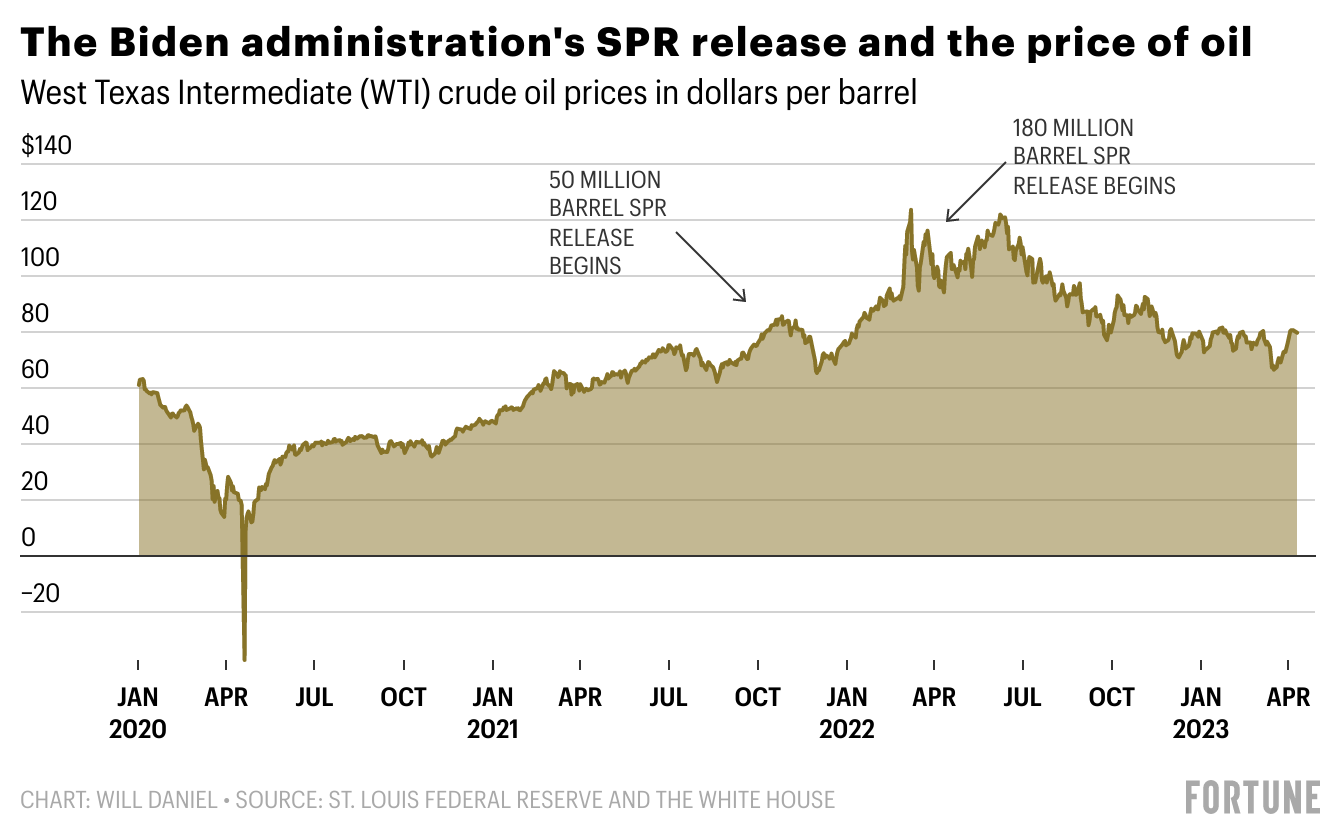
But oil prices are still far higher than the administration’s target. On Friday, Brent crude, the international benchmark, traded at around $81 per barrel, and some analysts warn that prices will likely remain high for years in what’s known as a supercycle.
The potential consequences are serious. If the federal government refills the reserve at a higher price, it would mean far lower profits when the oil is resold later. Normally, those profits either go to the Treasury to be used in other government programs, or are tapped to replenish the SPR’s reserves and fund its upkeep. And if the government waits until prices fall to buy oil, it could put the U.S. at risk in the event of another oil price shock. Either way, there are no easy choices.
Jay Hatfield, CEO of the investment manager Infrastructure Capital Advisors, told Fortune that he believes the Biden administration will wait, partly because he expects oil prices to average between $75 and $95 in 2023. On top of that, Energy Secretary Jennifer Granholm told lawmakers recently that it would be “difficult” to refill the SPR this year due to ongoing maintenance at storage sites and pre-planned, Congressionally-mandated sales of 26 million barrels this year.
“We will begin that process this year but to refill the full amount is impossible,” she explained.
For Hatfield, that means the odds that the SPR will be refilled to pre-pandemic levels are slim at best. “I’m not sure that I really believe they will even try [to fully refill it],” he added, noting that the administration is “opposed to hydrocarbons” and Biden has said he will “transition” the country from oil towards renewable energy. “I would say the chances of the SPR being refilled before the next election is less than 10%.”
A bull market for oil and a missed opportunity
If the Biden administration wants to refill the SPR and net a profit for taxpayers in the future, it will have to avoid what some investment banks have labeled the “commodity bull supercycle.”
Wells Fargo’s head of real asset strategy, John LaForge, explained his view that this supercycle—or period of sustained high commodity prices that typically lasts 15 to 20 years—began in March 2020 and could keep oil prices elevated for years to come.
In the last commodity bull supercycle, from 1999 to 2011, oil prices jumped from $10 to $150 per barrel. “Super-cycles are like black holes,” LaForge wrote in a recent note to clients. “Escaping the gravity of a super-cycle is difficult for the individual commodity.”
Infrastructure Capital Advisors’ Hatfield added that predicting oil prices over the long-term is “tough, to say the least,” but with the transition to clean energy in full swing, lower prices seem unlikely. “If the world wants to reduce carbon, the price of carbon [fuel sources] will have to rise. That’s the only real way to address climate change or global warming,” he said.
Peter McNally, global sector lead for energy at the research firm Third Bridge, told Fortune that another reason to expect higher prices is that the Organization of Petroleum Exporting Countries (OPEC)—which produces about 40% of the world’s crude oil—is unlikely to let them sink below $70 per barrel.
“We’ve got a pattern that has emerged here where OPEC is cutting production to keep [oil] prices from falling further,” he said. “When that Brent [crude oil] price gets into the $70s, that seems to be their pain point.”
There was a brief moment of opportunity for the Biden Administration to buy back oil reserves recently, however. Banking instability, headlined by the collapse of Silicon Valley Bank, spooked traders and sent oil prices to a low of around $66 per barrel last month, but the Energy Department was unable to take advantage of the drop.
Amos Hochstein, Biden’s energy security adviser, said in December that oil prices must be in the lower price range “on a consistent basis” for the refilling process to begin. And true to his word, even as prices fell amid multiple bank failures, Hochstein told Bloomberg that he wasn’t in a rush to start buying oil. “We should take a deep breath and wait and see,” he said.
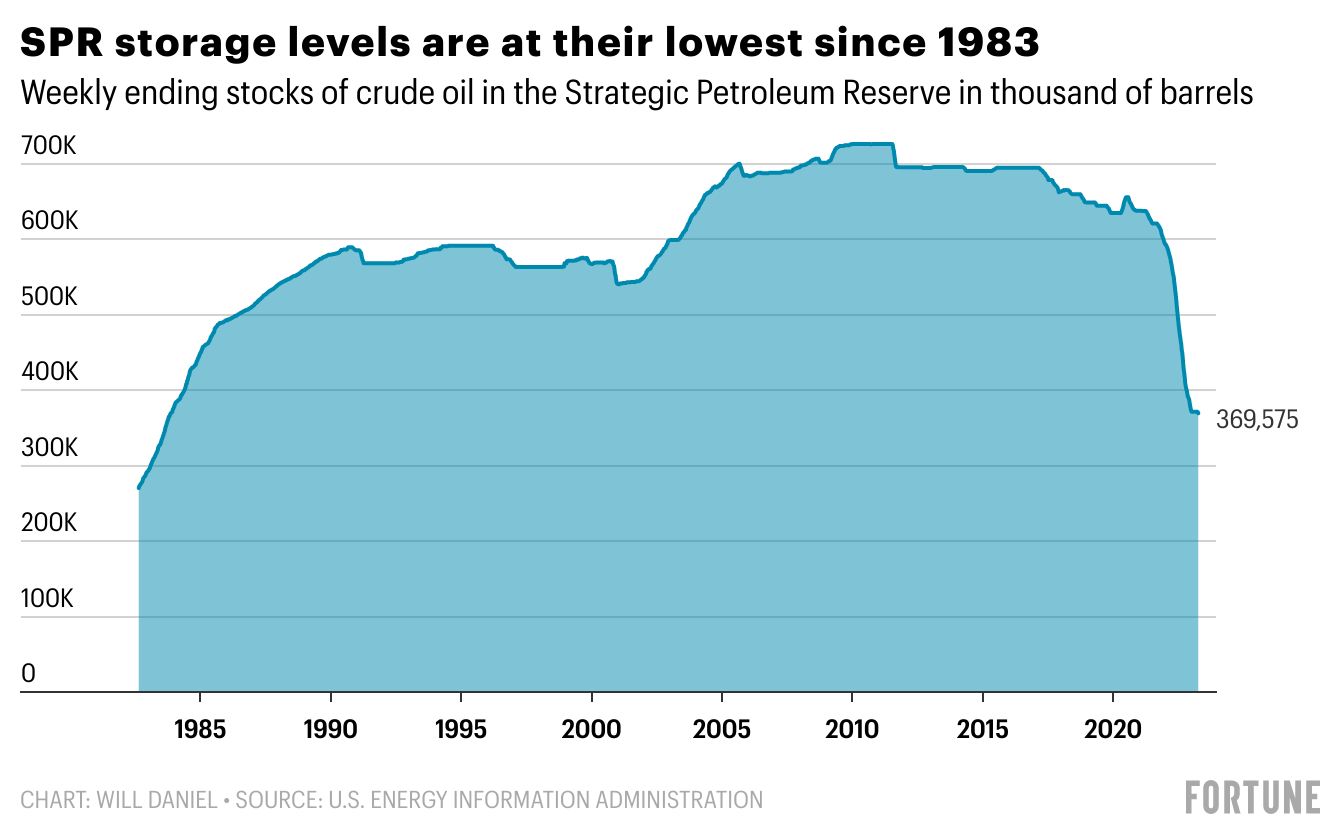
But this missed opportunity could end up being a problem considering how low current oil reserves are compared to their peak of over 700 million in 2012. The SPR currently has just over 369 million barrels stockpiled, the lowest level since 1983.
Was the gamble worth it?
While the Biden administration may have trouble refilling the SPR at its desired price, that doesn’t mean the gamble to release reserves didn’t pay off. “I’d say it was worth it, because it did attenuate oil prices increases slightly,” Hatfield said, arguing that it was also politically wise for Biden as it “helped Democrats outperform in the midterms.” Democrats lost control of the House, but managed to maintain control of the Senate and won more seats than analysts, who predicted a “red tsunami,” had expected.
Hatfield added that because the U.S. is a net energy exporter, and “global import-export capacity is way higher than it was before,” the SPR may not also be as critical as it once was.
“We’re less dependent on the Middle East, much more diversified, and we are a major producer so it’s arguably not as important anymore. And I don’t think it’s gonna get refilled before the end of 2024, even 2025,” he said.
Third Bridge’s McNally also believes that it may take longer than expected to refill the SPR, but he noted that the government has a surprisingly good long-term track record when it comes to buying oil. “Historically, they’ve been able to buy low and sell high. And in this case, again, they sold oil at higher prices.”
McNally argued Biden’s oil release gamble was one of the factors that helped prices fall since last spring and is an example of the SPR being used as intended—to reduce volatility in oil markets. “It [the SPR release] really was a force in the biggest market in the world. The timing on how that gets refilled still remains to be seen, but eventually some of the oil has to be put back,” he said. “I don’t think all of it will be, but certainly some of it, because we need it to keep doing what it was always intended to do.”