By his own admission, the car salesperson in Stockholm knew nothing about BYD last September, when his boss offered him a chance to work in the new showroom of China’s biggest electric-car company. “I was like, ‘BYD? Never heard of it,’ ” says Benhur Hiyabu, standing inside the showroom on a snowy March morning. After selling Subarus for years, Hiyabu decided he had little to lose: “I thought, ‘Okay, I’m going to try something new,’ ” he says.
BYD is betting that customers in Europe, the Americas, and across Asia will also try something new, especially if the price is right. More than 20 years after inaugurating its first auto plant in Shenzhen, BYD—or Build Your Dreams, to use its fanciful full name—is pushing to expand passenger car sales beyond its comfort zone in China. Over the past year, the company has spent huge amounts of money opening showrooms in major cities worldwide, establishing offices in key countries, and setting up a complex system to ship its relatively low-cost electric cars overseas. If successful, BYD would become the first Chinese global automotive giant.
But the ambitious plan comes with major challenges. To make inroads, BYD must chip away at the established automaking Goliaths that already dominate the world’s fast-growing electric car market. Chief among those rivals, of course, is Tesla, which has nearly ubiquitous consumer name recognition and a long track record. BYD must somehow get the attention of car buyers and then prove that its models are good enough.
Europe is a key battleground in this new war. Last fall, BYD opened its doors in six European countries, encroaching on some of Tesla’s stronghold markets, as well as those of far better-known players like Volkswagen and Stellantis (maker of Chrysler, Jeep, and Peugeot)—all of which are fiercely competing in the EV revolution.
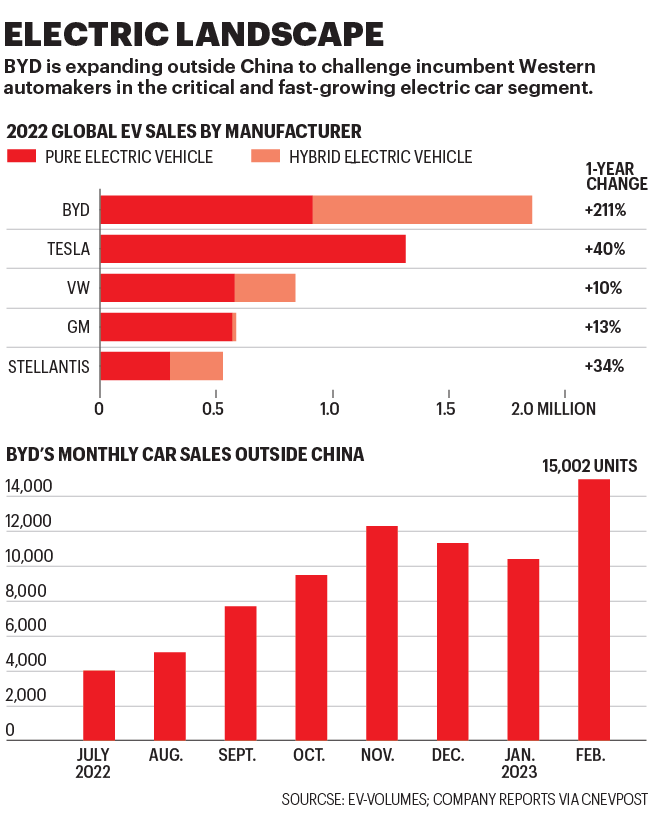
For automakers, this is a high-stakes fight, in the biggest energy transition in a century. EVs represented one in seven new cars sold globally in 2022, up from one in 70 just five years earlier. The blazing acceleration looks set to continue.
The question is: Which companies will seize the momentum? In the minds of some experts—and even auto execs—BYD seems better placed than most. That’s because it started in 1995 by producing batteries, the most valuable component in EVs. China controls more than 70% of the world’s battery supply, giving its auto industry a crucial edge over Western competitors.
In 2010, BYD debuted China’s first pure-electric cars, and it quickly became a thriving business. Last year, the company sold more than 911,000 pure-electric cars plus another 946,000 hybrids. Almost all of those sales were in China. But the company’s new overseas business is growing rapidly. In February, BYD sold 15,002 cars outside China—more than triple the number in July, the first month it reported those figures.
Matthias Schmidt, an auto industry analyst in Berlin, says China has an advantage over Western countries because it already has a strong domestic EV market. Its strategy is to use that momentum and know-how to expand globally. “They are one step ahead of legacy makers,” he says.
Western automakers sound increasingly nervous, with some blaming Europe’s relatively low import tariffs compared with China’s high tariffs for foreign companies. “It’s a very bleak scenario,” Stellantis CEO Carlos Tavares told German auto publication Automobilwoche in January. Without EU action, he said, “there will be a terrible fight.” Tesla CEO Elon Musk, who produces more Teslas in Shanghai than anywhere else, told investors in January that Chinese automakers were his fiercest rivals. “They work the hardest, and they work the smartest,” he said.
That much has long been clear in the Stockholm headquarters of Einride, a freight transportation startup. Last year, Einride agreed to buy about 200 BYD electric trucks and vans. Einride, which embeds its software into electric vehicles and runs trucking operations for clients like General Electric, already has BYDs on the road in the U.S. Now it is negotiating to buy over 1,000 more of BYD’s vehicles for its U.S. business, says Niklas Reinedahl, Einride’s regional general manager.
When asked why the company passed on buying vehicles from a U.S. company such as Freightliner Trucks, he says BYD has unbeatable advantages. “They’ve been building battery technologies for a number of years,” Reinedahl notes. “They have been through teething problems.”
With passenger electric cars, BYD may convert even more buyers as EVs go more mass-market. “Chinese quality has risen beyond anyone’s expectations,” industry analyst Schmidt says. Perhaps in response to the growing challenge from BYD and other Chinese competitors, Musk has cut Tesla prices in recent months.
Yet in BYD’s Stockholm showroom, all three floor models remain priced below the equivalent Teslas. BYD’s Atto 3 crossover, for example, costs 520,000 Swedish kronor (about $49,380) versus 610,000 kronor (about $57,925) for a comparable Tesla Model 3.
So far, BYD’s business in Stockholm seems to be going well. Within two months of opening in October, the store sold more than 1,000 cars—“a flying start,” says Magnus Matsson, spokesman for BYD’s sole Swedish distributor, Hedin Bil. “There’s a strong demand for smaller, less expensive EVs,” he says.
However, there is stiff competition. A few doors down is the showroom of Guangzhou EV maker XPeng, which opened early last year. On one recent morning, three customers crowded around two models on display. And a little farther away is Tesla’s store. There, in a deserted space with no staff, a Model 3 and Model S sit, while a sign tells shoppers to “schedule a test-drive by scanning the QR code.”
BYD’s sales in Sweden remain below those of Volvo, Volkswagen, Tesla, and others. But BYD salesperson Hiyabu says customer attitudes are changing fast: “They see the price, and that it’s Chinese. They expect it to be a little junky.” Then, after test-driving the vehicles, he says, “it feels like a good car.”
This article appears in the April/May 2023 issue of Fortune with the headline, “Fake news 2.0: China’s Tesla takes on the world.”