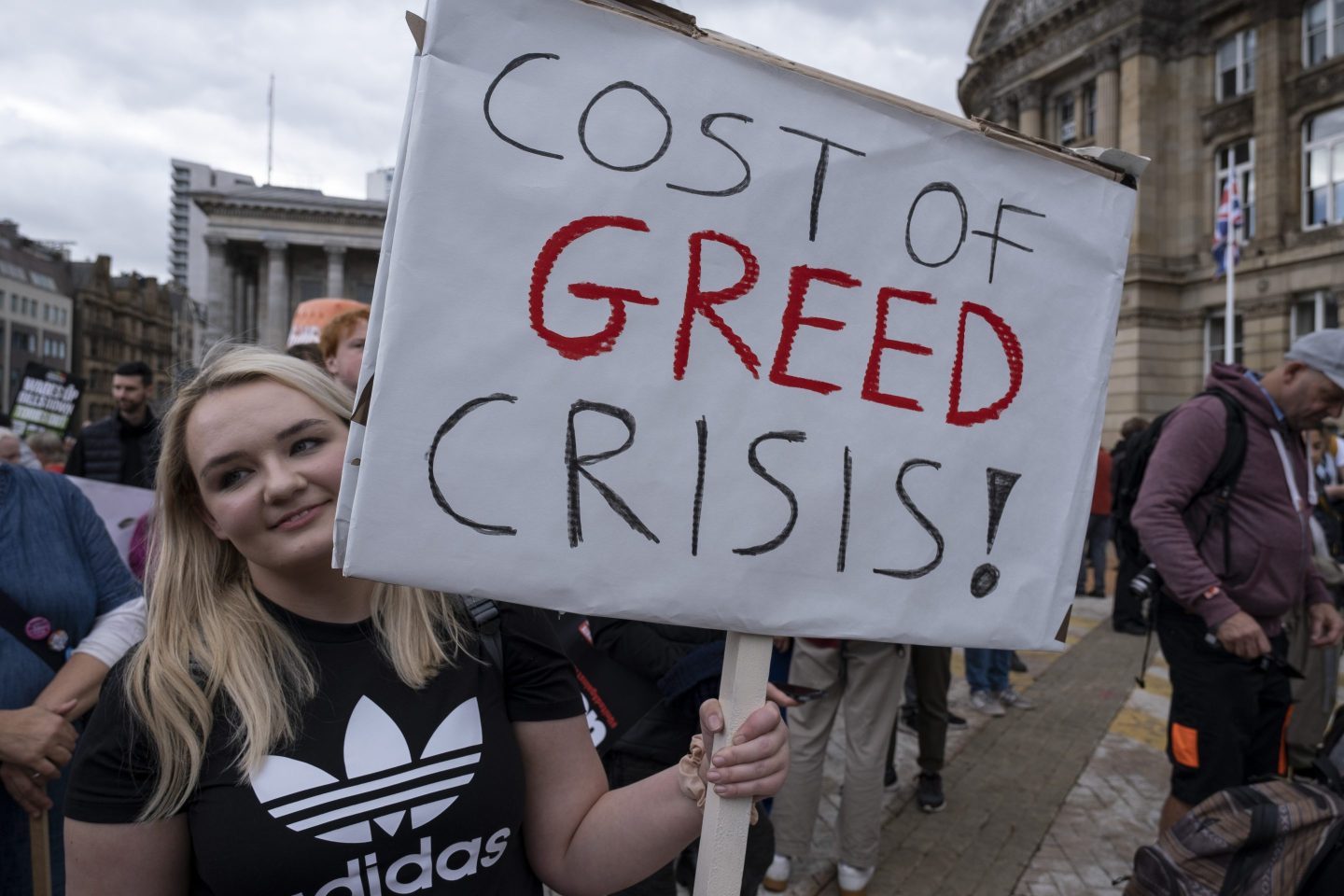
When costs go up, so do profits? That’s not how capitalism is supposed to work, but that is the recent trend. For over a year now, consumers and businesses, both in the U.S. and worldwide, have struggled with stubborn inflation. But the soaring costs haven’t prevented corporations from raking in record profits. The companies in last year’s Fortune 500 alone generated an all-time high $1.8 trillion in profit on $16.1 trillion in revenue. Voices largely on the left side of the political spectrum have been sounding the alarm on this—think: Bernie Sanders in Congress or Jon Stewart’s recent grilling of former Treasury Secretary Larry Summers—but now an economist at one of the world’s oldest and greatest investment banks is singing the same tune.
Albert Edwards, a global strategist at the 159-year-old bank Société Générale, just released a blistering note on the phenomenon that has come to be called Greedflation. Corporations, particularly in developed economies like the U.S. and U.K., have used rising raw material costs amid the pandemic and the war in Ukraine as an “excuse” to raise prices and expand profit margins to new heights, he said. And the French investment bank isn’t just historic: It’s one of the select banks considered to be “systemically important” by the Financial Stability Board, the G20’s international body dedicated to safeguarding the global financial system.
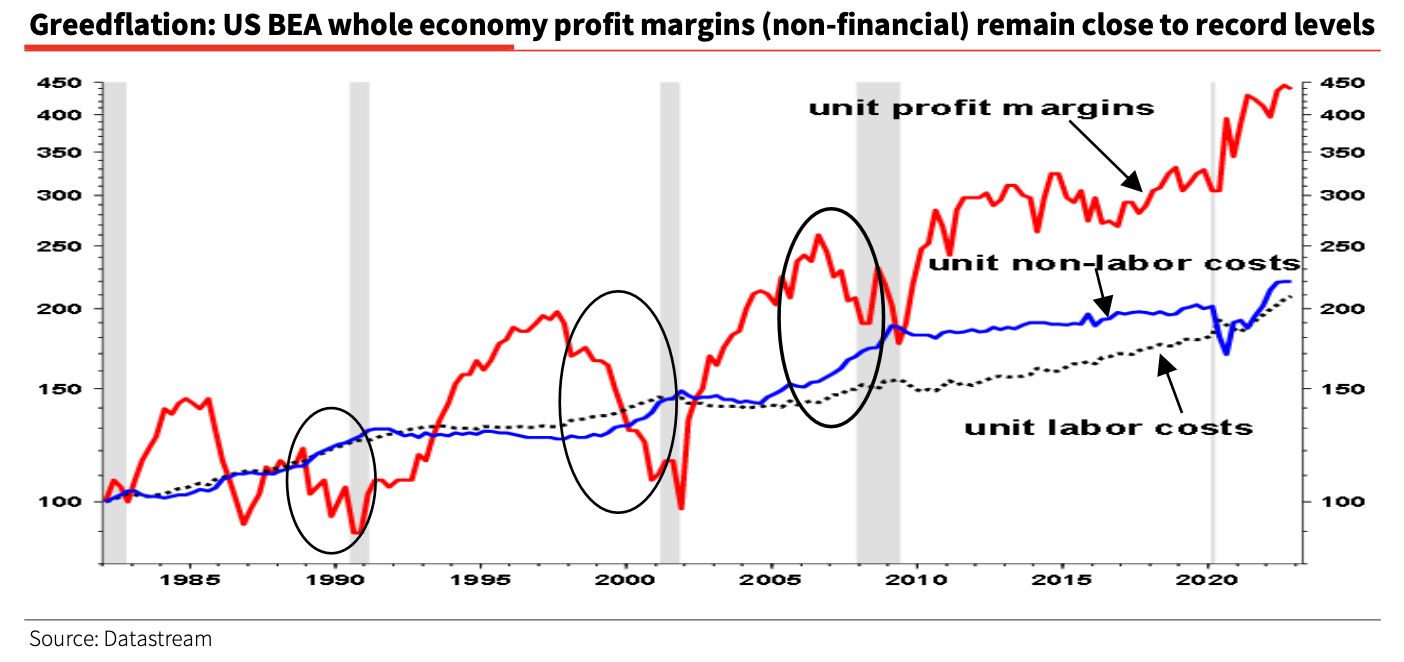
Furthermore, Edwards wrote, in the Tuesday edition of his Global Strategy Weekly, after four decades of working in finance, he’s never seen anything like the “unprecedented” and “astonishing” levels of corporate Greedflation in this economic cycle. To his point, a January study from the Federal Reserve Bank of Kansas City found that “markup growth”—the increase in the ratio between the price a firm charges and its cost of production—was a far more important factor driving inflation in 2021 than it has been throughout economic history.
Typically, higher commodity prices and labor costs squeeze corporate margins, especially if the economy is slowing. But Edwards pointed to data released by the Bureau of Economic Analysis (BEA) last week that showed profit margins still near a record high relative to costs in the fourth quarter. The strategist said he assumed margins would have “declined sharply” at the end of last year as the economy slowed, but instead, “How wrong I was!”
Edwards added that he fears the “super-normal profit margins” of corporations in the U.S. and abroad could eventually “inflame social unrest” if consumers continue to struggle with inflation.
“The end of Greedflation must surely come. Otherwise, we may be looking at the end of capitalism,” he warned. “This is a big issue for policymakers that simply cannot be ignored any longer.”
Edwards’s note could be significant in bringing a viewpoint that has thus far lived on the progressive fringe into the mainstream. For instance, a debate over Greedflation broke out last month, during former Daily Show host Jon Stewart’s interview with Larry Summers on his new Apple TV show, The Problem. As Stewart and Summers debated whether the Fed was right to pressure wages to fall by raising interest rates in its inflation fight, Stewart pivoted: “Why aren’t we attacking corporate profit in any way? Because that’s been estimated to be 30% of inflation, 40% of inflation?”
Summers was quick to respond that he didn’t think it was “a tenable view that all of a sudden corporations became greedy.” Edwards seems to be saying that it actually is quite tenable.
Time to control prices?
Edwards proposed a controversial solution to fix the rise of Greedflation, which he said reflects his “weakening confidence” in the capitalist system itself. In a once unthinkable twist to “those of us who lived through the failed prices and incomes policies of the 1970s,” Edwards said there is a tool for this kind of problem, and it’s from that same decade: price controls.
Price controls—or when a government mandates the prices businesses are allowed to charge consumers—have been blamed for everything from the fall of the first Babylonian Empire in 1595 BC to the long lines at the gas pump of the Nixon and Carter administrations in the ’70s. One of the most common stories about the supposed folly of price controls comes from the Roman emperor Diocletian, who enacted an “edict on maximum prices” for labor, commodities, and more to combat rampant inflation in AD 301. But the edict, which included a death penalty for anyone who broke it, eventually backfired, creating a scarcity of goods and reliance on government wheat that led to its repeal.
Edwards noted that many of his colleagues are “less sympathetic to the use of price controls” because of this history, but he argues their use may be warranted because “something seems to have broken with capitalism.”
The strategist referenced a paper by University of Massachusetts Amherst economists Isabella Weber and Evan Wasner, titled, “Sellers’ Inflation, Profits and Conflict: Why Can Large Firms Hike Prices in an Emergency?” which found that corporations engaged in “price gouging” during the pandemic and argued temporary price controls may be the only way to prevent the “inflationary spirals” that could come as a result of this gouging.
“Looking at their conclusions on how to deal with Greedflation, price controls seem to emerge as a favorite method of control,” Edwards argued.