• Home
  • News
  • Fortune 500
  • Tech
  • Finance
  • Leadership
  • Lifestyle
  • Rankings
  • Multimedia
Personal Financepay

Surprise: The pandemic significantly shrank America’s wage inequality, and the trend may continue

Geoff Colvin
By
Geoff Colvin
Geoff Colvin
Senior Editor-at-Large
Down Arrow Button Icon
Geoff Colvin
By
Geoff Colvin
Geoff Colvin
Senior Editor-at-Large
Down Arrow Button Icon
March 17, 2023, 11:27 AM ET
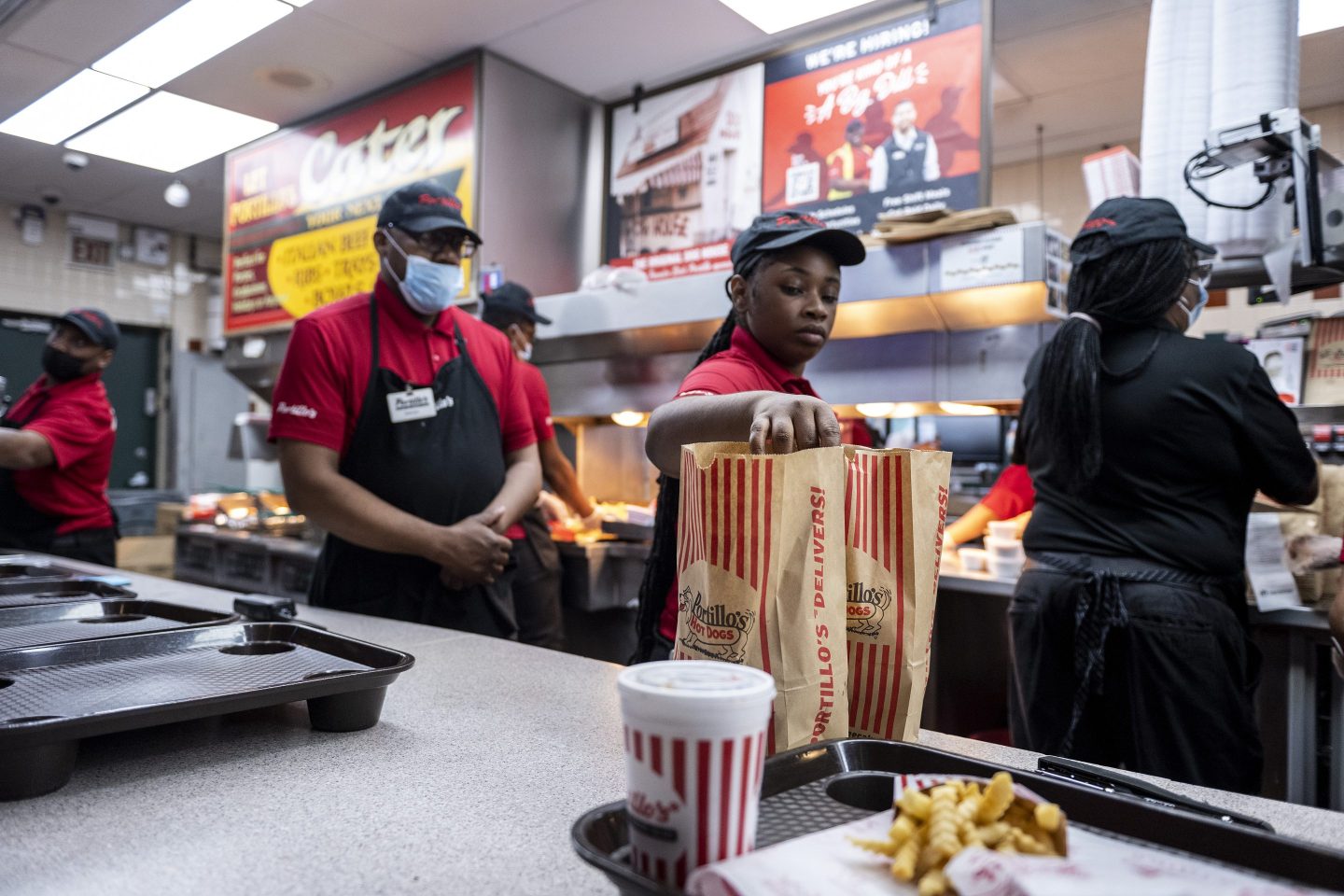
The pandemic reversed 40 years of a widening wage gap.
The pandemic reversed 40 years of a widening wage gap. Christopher Dilts—Bloomberg/Getty Images

The gulf between America’s highest-paid and lowest-paid workers has widened for 40 years—that is, until the pandemic struck. In a surprising twist, the gap narrowed dramatically during the pandemic and its immediate aftermath, reversing about one-quarter of the wage inequality that had built up over the previous four decades. Now, even in today’s inflationary, slow-growth, post-pandemic economy, the latter trend may well continue.

The unexpected discovery arrives in a paper by David Autor of MIT and Arindrajit Dube and Annie McGrew of the University of Massachusetts. Among the most noteworthy findings:

  • Compared with pre-pandemic pay, wages of the lowest-paid workers increased, while wages of the highest-paid workers decreased.
  • Wages of the least educated workers increased more than the wages of the most educated workers, reducing the college wage premium. 
  • Similarly, the youngest workers did better than older workers. 
  • Wages of female workers held up better than wages of male workers. 
  • Black and Hispanic workers’ wages went up, while non-Hispanic white workers’ wages went down.

Across those dimensions, wage inequality decreased thanks to a combination of pandemic-related effects. Pre-pandemic, low-wage workers hesitated to leave their jobs because they often couldn’t go a week without a paycheck and feared that a new job might not work out. Employers took advantage of that market imperfection, enabling them “to mark down wages below competitive levels,” says the new paper, citing many previous studies.

Fast-forward to the pandemic, businesses that employed large concentrations of low-wage workers—such as restaurants, hair salons, stores, hotels, and childcare centers—shut down in vast swaths. “If those workers ever had employer loyalty or connection to the employer, that was severed,” says Autor. Inadvertently, they became more willing to seek new jobs.

At the same time, unprecedented government stimulus payments meant that “those workers, for the first time in a long time, had some household liquidity,” says Autor, making it easier for them to move around and take time finding the best new job. Then, as the pandemic subsided, low-wage industries became the hotbed of the greatest surge of post-pandemic worker demand, with Americans indulging in revenge tourism and dining out.

The result was a suddenly different market for low-wage labor. Unemployed low-wage workers faced abundant new opportunities, and workers with jobs found they could jump directly to a new job more easily than in past years. This low-friction job-to-job movement was especially significant in raising wages because employers had to beat the applicant’s current pay.

For the first time in decades, low-wage workers were in the driver’s seat. Employers now had to hire quickly in a transformed, intensely competitive labor market. Result: By mid-2022, workers in the 10th percentile by pay were making much more money, even after adjusting for inflation, than before the pandemic; workers in the 90th percentile were making less. The 40-year polarization of the labor market was moving backward.

The new research doesn’t address the prospect of this trend continuing, but Autor believes the odds are good. He notes that the crucial element of the recent trend is a tight labor market. “Anything that makes the labor market really tight effectively causes low-wage workers to be much more likely to quit than high-wage workers,” he says. “Because why would you quit a highly paid job?” 

Today, he says, “We’re in a structurally tight labor market. We have small entering cohorts, low fertility, massively artificially reduced immigration, and a rapidly growing retired population.” Those trends aren’t new—the labor market has been tightening for years. In 2016, the unemployment rate fell below 5%, once regarded as full employment, and stayed there until the brief spike in the pandemic. It’s now 3.6%. Combine all those factors, Autor says, and he thinks the tight labor market will persist.

That should be welcome news to America’s low-paid workers. Their economic prospects remain challenging, but just maybe they’re finally improving.


Subscribe to Well Adjusted, our newsletter full of simple strategies to work smarter and live better, from the Fortune Well team. Sign up today.
About the Author
Geoff Colvin
By Geoff ColvinSenior Editor-at-Large
LinkedIn iconTwitter icon

Geoff Colvin is a senior editor-at-large at Fortune, covering leadership, globalization, wealth creation, the infotech revolution, and related issues.

See full bioRight Arrow Button Icon

Latest in Personal Finance

Personal FinanceCertificates of Deposit (CDs)
Best certificates of deposit (CDs) for December 2025
By Glen Luke FlanaganDecember 4, 2025
8 hours ago
The Fifth Third Bank logo on a blue and purple layered background.
Personal Financechecking accounts
Fifth Third Bank review 2025: Full-service bank with unique perks (but lackluster APYs)
By Joseph HostetlerDecember 4, 2025
8 hours ago
The outside of a Dollar General store, at night
Retaildollar stores
Rich people are flooding dollar stores as Americans navigate a crushing affordability crisis
By Dave SmithDecember 4, 2025
10 hours ago
Personal Financechecking accounts
Best checking accounts for December 2025
By Glen Luke FlanaganDecember 4, 2025
10 hours ago
Mother tying shoelace of daughter sitting on wheelchair at home
Personal FinanceHealth
‘I don’t know how people are going to live’: ACA enrollees brace for massive premium hikes as subsidies expire
By Amelia Thomson-Deveaux, Ali Swenson, Linley Sanders and The Associated PressDecember 4, 2025
13 hours ago
SuccessWealth
Meet Luana Lopes Lara: The 29-year-old ex-ballerina spent summers working for Ray Dalio and Ken Griffin—now she’s the youngest female self-made billionaire
By Orianna Rosa RoyleDecember 4, 2025
14 hours ago

Most Popular

placeholder alt text
Economy
Two months into the new fiscal year and the U.S. government is already spending more than $10 billion a week servicing national debt
By Eleanor PringleDecember 4, 2025
17 hours ago
placeholder alt text
Success
‘Godfather of AI’ says Bill Gates and Elon Musk are right about the future of work—but he predicts mass unemployment is on its way
By Preston ForeDecember 4, 2025
13 hours ago
placeholder alt text
North America
Jeff Bezos and Lauren Sánchez Bezos commit $102.5 million to organizations combating homelessness across the U.S.: ‘This is just the beginning’
By Sydney LakeDecember 2, 2025
3 days ago
placeholder alt text
Success
Nearly 4 million new manufacturing jobs are coming to America as boomers retire—but it's the one trade job Gen Z doesn't want
By Emma BurleighDecember 4, 2025
13 hours ago
placeholder alt text
Success
Nvidia CEO Jensen Huang admits he works 7 days a week, including holidays, in a constant 'state of anxiety' out of fear of going bankrupt
By Jessica CoacciDecember 4, 2025
12 hours ago
placeholder alt text
Health
Bill Gates decries ‘significant reversal in child deaths’ as nearly 5 million kids will die before they turn 5 this year
By Nick LichtenbergDecember 4, 2025
1 day ago
Rankings
  • 100 Best Companies
  • Fortune 500
  • Global 500
  • Fortune 500 Europe
  • Most Powerful Women
  • Future 50
  • World’s Most Admired Companies
  • See All Rankings
Sections
  • Finance
  • Leadership
  • Success
  • Tech
  • Asia
  • Europe
  • Environment
  • Fortune Crypto
  • Health
  • Retail
  • Lifestyle
  • Politics
  • Newsletters
  • Magazine
  • Features
  • Commentary
  • Mpw
  • CEO Initiative
  • Conferences
  • Personal Finance
  • Education
Customer Support
  • Frequently Asked Questions
  • Customer Service Portal
  • Privacy Policy
  • Terms Of Use
  • Single Issues For Purchase
  • International Print
Commercial Services
  • Advertising
  • Fortune Brand Studio
  • Fortune Analytics
  • Fortune Conferences
  • Business Development
About Us
  • About Us
  • Editorial Calendar
  • Press Center
  • Work At Fortune
  • Diversity And Inclusion
  • Terms And Conditions
  • Site Map

© 2025 Fortune Media IP Limited. All Rights Reserved. Use of this site constitutes acceptance of our Terms of Use and Privacy Policy | CA Notice at Collection and Privacy Notice | Do Not Sell/Share My Personal Information
FORTUNE is a trademark of Fortune Media IP Limited, registered in the U.S. and other countries. FORTUNE may receive compensation for some links to products and services on this website. Offers may be subject to change without notice.