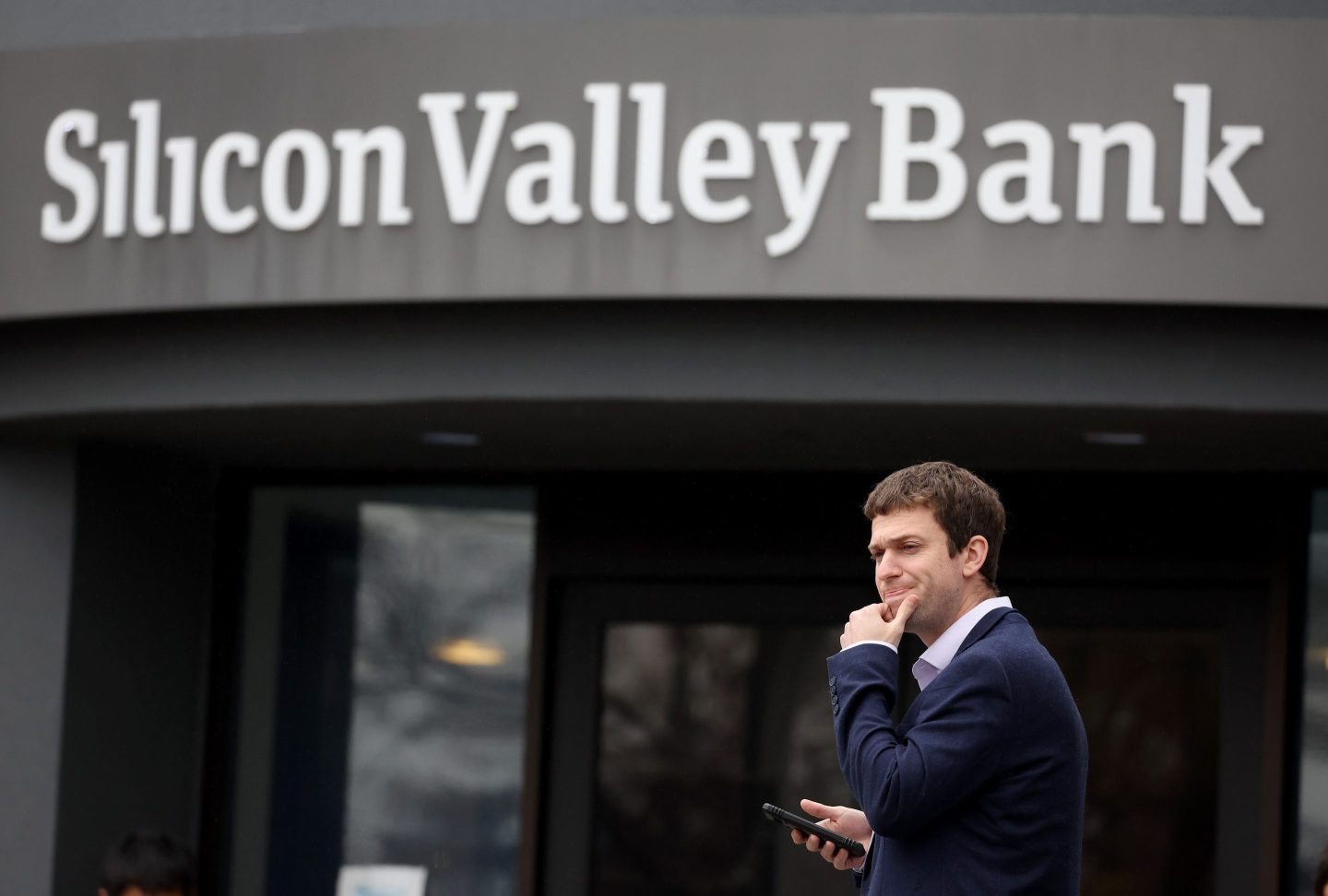
Following a head-spinning several days in the saga of the Silicon Valley Bank collapse, here’s where things stand today, for customers in various affected countries:
—Having failed to find a buyer for the stricken bank, the U.S. Federal Deposit Insurance Corporation (FDIC) has created a “bridge bank” under the leadership of former Fannie Mae CEO Tim Mayopoulos. SVB’s U.S. depositors and borrowers are now customers of Silicon Valley Bank, N.A., and can access their funds and make payments.
—The U.K. government has arranged the sale of SVB’s local branch to Europe’s largest bank, HSBC, for a token £1 ($1.21)—more on that below. Customers’ deposits are now safe, and business can theoretically continue as usual. HSBC said the operation had loans of around $6.6 billion and deposits of around $8.1 billion.
—Canada’s Office of the Superintendent of Financial Institutions (OSFI) has taken control of the local SVB unit—which did not take deposits—to protect its creditors.
—Germany’s Federal Financial Supervisory Authority (BaFin) has provisionally closed SVB’s German branch for business. Again, this unit did not take deposits. BaFin said the Frankfurt-based branch had total assets of around $841 million and told me SVB’s customers can and must continue making payments.
—Many tech startups in China have SVB accounts. The bank also has a joint venture with Shanghai Pudong Development Bank, which says the venture remains unaffected.
In the vibrant tech hub that is Ireland, many startups with U.S. investors, or those that have expanded into the U.S., are exposed to the SVB mothership. Some also had deposits with SVB U.K.—and are now HSBC customers.
“Silicon Valley Bank has been a great partner for the technology ecosystem, both in the U.S. and increasingly in Europe, over the years,” Brian Caulfield, a partner at Molten Ventures and chair of the startup advocacy nonprofit Scale Ireland, told me this morning. “It’s probably one of the very few banks anywhere that really understood technology and was happy to bank the technology sector, and more importantly to lend to the technology sector.”
And there’s the rub: Although he notes “an awful lot of people will certainly be breathing a huge sigh of relief” at the U.K. government’s swift brokering of the British unit’s sale, Caulfield is cautious about what it may be like for the tech industry to deal with relatively conservative HSBC.
“The hope for a lot of people is that [HSBC] will retain the Silicon Valley Bank theme and look to operate the business in broadly speaking [the same] way it has been operated to date, but benefiting obviously from a much larger, much more diverse balance sheet—so that is potentially a good outcome for the sector,” Caulfield said. “If, however, they were to adopt a more conventional approach to banking the sector, then it could be bad news in terms of the loss of a very good partner for the ecosystem.”
There are a number of smaller private debt providers in the market, he added, “but in terms of a scale player that really knew how to evaluate and underwrite the risks associated with technology businesses, there’s really nobody to touch Silicon Valley Bank.”
Startups and VCs in many countries—not least the U.S., where the other side of the “bridge bank” bridge remains hazy—will have similar concerns. The banking sector has more immediate worries, of course, and you can read our further coverage of the rapidly evolving situation here.
Want to send thoughts or suggestions to Data Sheet? Drop a line here.
David Meyer
Data Sheet’s daily news section was written and curated by Andrea Guzman.
NEWSWORTHY
Bard 2.0. After its chatbot underwhelmed viewers in a promotional video last month, Google is now working on another version of Bard, Insider reports. The so-called Big Bard was built on the same language model as the original Bard, but can reportedly provide chattier responses and cusses more.
Experts say Musk’s disability shaming wasn’t illegal. Elon Musk apologized to Haraldur Thorleifsson, a former Twitter employee, for publicly mocking his disability last week. Musk’s behavior was shocking, but it wasn’t technically a violation of the Americans With Disabilities Act, disability law experts tell Fortune. That’s because Thorleifsson disclosed the specifics of his disability. Still, it’s a case that reveals just how badly bosses can treat workers. “Seeing such a powerful person put those thoughts out there on such an accessible platform, it really represents so much that people with disabilities deal with in the workplace,” Katherine MacFarlane, a lawyer in Baton Rouge, said.
ChatGPT comes to Koo. India-based social media app and Twitter competitor Koo has integrated OpenAI’s ChatGPT so that users can draft posts, the company’s cofounder told Reuters. To compose posts using ChatGPT, users can either type or use Koo’s voice command feature. The company says it will consider adding labels that inform others if a post was made using ChatGPT. The feature is currently available only to verified Koo accounts and will be rolled out to all users later on.
THIS DAY IN TECH HISTORY
On March 13, 1986, a Seattle-based software company by the name of Microsoft went public. Shares of Microsoft’s stock began trading at $21 and quickly surged to as high as $35.50, before finishing the session at $31.25. The company raised $61 million in the IPO, and cofounder Bill Gates sold $1.6 million worth of shares in the offering. Today, 37 years later, Microsoft has a market cap of $1.9 trillion.
IN CASE YOU MISSED IT
An analysis of regulatory filings reveals that 1,074 firms—from Andreessen Horowitz to General Catalyst—were holding capital at Silicon Valley Bank in 2022, by Alexandra Sternlicht and Jessica Mathews
After Silicon Valley Bank failure ‘there’s going to be more,’ warns former FDIC Chair William Isaac, by Steve Mollman
A 3-step guide to filing for unemployment benefits if you’re laid off, by Jane Thier
Viral TikTok résumé ‘hack’ encourages job seekers to lie about working at Twitter after Musk’s spat with a disabled employee highlights potential loophole, by Eleanor Pringle
The first social media bank run? A newsletter popular with VCs may have been the domino that started the Silicon Valley Bank implosion, by Steve Mollman
BEFORE YOU GO
Academy Award–winning movies are using A.I. Everything Everywhere All at Once won big at the Oscars last night, taking home seven awards. The film follows a mother-daughter duo played by Michelle Yeoh and Stephanie Hsu as they travel through the multiverse and find themselves, in one universe, embodied in giant rocks. To get the visual effects of those moments just right, the team used artificial intelligence tools from software development company Runway to help remove the background. Visual effects artist Evan Halleck posted a video showing what the scenes looked like before editing in which the crew is seen using pulleys to move the rocks around. “I was cutting out the characters, placing them cleanly on a plate shot in minutes versus what takes half a day,” Halleck told Variety.
This is the web version of Data Sheet, a daily newsletter on the business of tech. Sign up to get it delivered free to your inbox.