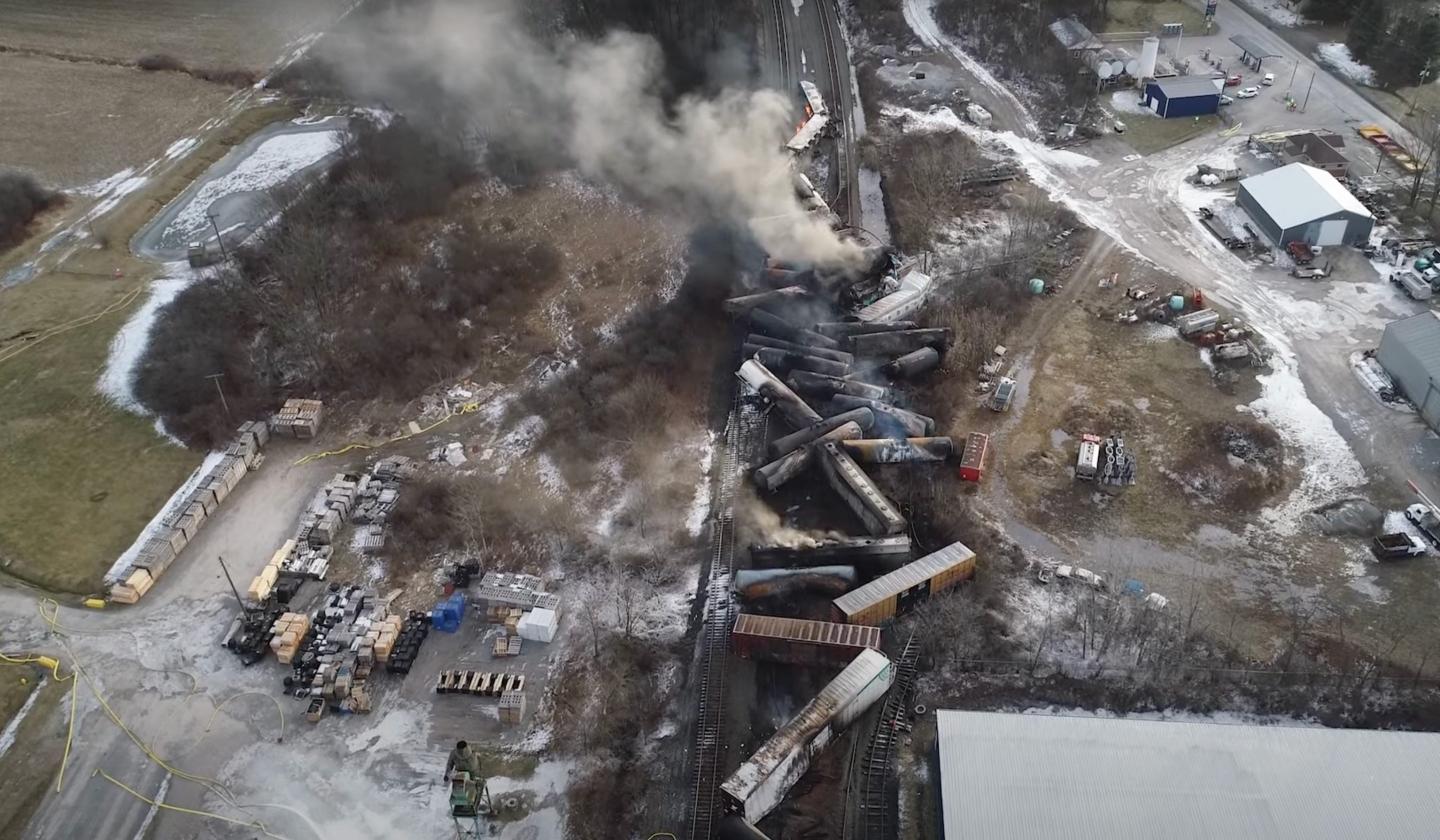
The Norfolk Southern freight train derailment in East Palestine, Ohio on Feb. 3, 2023, was an unmitigated disaster that inflicted tremendous harm on people’s health, safety, and our environment. It’s time our government serves the interests of our communities and stops cowering to the demands of the railway industry.
There are plenty of opportunities for the government to cast their vote in support of our environment, such as saying “no” to special permits for more hazardous substances transported by rail and “yes” to needed regulations.
Despite the devastating consequences resulting from train accidents, incidents, and derailments involving hazardous substances, and the known lack of critical protections to minimize or avoid these catastrophic consequences, the railway companies have been seeking special permits that will allow them to bring more hazardous substances by rail into our communities–including dangerously hazardous and flammable liquified natural gas and cryogenic ethane.
Special permit applications are currently under consideration at the Pipeline & Hazardous Materials Safety Administration (PHMSA) that would allow these additional dangerous substances to barrel through our communities on rail lines and under the primary oversight of the rail companies, not government officials. However, the rail companies have proven themselves untrustworthy–it’s literally like the fox guarding the henhouse. The Norfolk Southern derailment should give all in government pause–and at this critical juncture convince PHMSA that there must be no special permits for new or additional hazardous substances transported by rail.
At the very same time, the railway companies, including Norfolk Southern, have been forcefully opposing essential regulatory upgrades designed to protect local communities and the environment, including opposing regulations that would make the transportation of hazardous substances on our rail lines less dangerous.
Sadly, government decision-makers have been listening and either failed to put in place obvious and needed regulatory mandates to protect our communities and environments–or even rolled back existing protections. It’s time to turn that tide.
We know what protections are needed to improve the safety of transport by rail. Among the gaps in protection under the current regulatory scheme that may have prevented the devastating outcomes in East Palestine are:
- There are no requirements for electronically controlled pneumatic (ECP) brake systems that help multi-car trains brake more evenly, quickly, successfully, and safely.
- There is no obligation for rail lines to join any unified command formed in response to a catastrophic event that joins the rail company response with emergency responders and government leaders so they can jointly assess the impacts, threats, and most appropriate safety precautions for both people and the environment–and more effectively put those decisions into action.
- There is no obligation to immediately notify all responsible government agencies and entities when an incident or accident has occurred, including providing full and accurate information on any dangerous substances or conditions involved.
- There is no obligation to work with communities and first responders across their system to create and practice emergency response plans, including sharing basic information on the hazardous substances emergency responders need to be prepared to deal with.
- Rail workers lack basic protections that better support optimal performance, such as paid sick leave and sufficient staffing to carry out essential safety checks, which are becoming ever more important as the rail lines continue running longer and heavier trains with an increasing number of cars carrying a multitude of dangerous chemicals and substances.
All of this sounds like basic common sense, doesn’t it? As Norfolk Southern and other rail line catastrophes have demonstrated, unless these kinds of basic and common-sense protections for communities and the environment are codified as legal mandates, the companies will never implement them, even if it ensures public safety
The rail companies are certainly not the only industry transporting hazardous substances where catastrophic events inflict devastating harm. What sets them apart is their unilateral decision-making authority in the face of a disaster–and unwillingness to coordinate with first responders and government agencies to protect the greater good. These problems are largely unique to the rail companies’ operating standards.
The value of mandatory reporting, advance emergency planning, ongoing preparedness, obligatory coordination as part of a unified command, and basic advance safety precautions is well demonstrated when it comes to shipping tankers on the water.
For example, when the Athos I oil spill discharged 265,000 gallons of crude oil into the Delaware River, the mechanisms in place allowed for the proper response in terms of containment and cleanup, as well as public safety and information. This included the mandate for full participation by all responsible parties in a unified command structure, including an established pathway of communication between all parties and with the public, the obligation of immediate and ongoing notifications and information-sharing by the company responsible for the spill, advance emergency planning and regular drills practicing appropriate response for when the inevitable catastrophic accident does occur, well-developed relationships among government and emergency response personnel, strategically placed and accessible emergency gear, and response personnel assured by the industry through membership in an entity like the Delaware Bay and River Cooperative.
The collaboration allowed for a swift and comprehensive emergency response with regular pathways of communication to the impacted and concerned public. This comprehensive, experienced, and well-rehearsed response action was not unique to the Athos I spill–it is a reflection of the regulatory mandates and clear lines of responsibility enshrined in law for catastrophic spill events on our nation’s navigable waterways.
Certainly, communities and the environment suffer when there is an on-water catastrophe like an oil spill. However, the kind of misinformed chaos where the responsible industry is given almost carte blanche to hide information and undertake a self-serving response is not the norm across industries. It’s only the norm when it comes to railway companies.
Norfolk Southern representatives have said: “We are going to learn from this terrible accident and work with regulators and elected officials to improve railroad safety.”
“From day one I’ve made the commitment that Norfolk Southern is going to remediate the site,” CEO Alan Shaw asserted. “We’re going to do it through continuous long-term air and water monitoring. We’re going to help the residents of this community recover and we’re going to invest in the long-term health of this community and we’re going to make Norfolk Southern a safer railroad.”
Independent government assessments of the company’s response make it hard to give such claims much credence. In a Feb. 14 correspondence addressed to Shaw, Pennsylvania Governor Josh Shapiro characterized the company’s response as giving “inaccurate information and conflicting modeling” that made protective action more difficult, that it was unwilling to work with government agencies and first responders in ways that made them less able to respond effectively. He went so far as to characterize the company as being driven by “corporate greed, incompetence and lack of care for … residents.”
Given the industry’s proactive efforts and investment in preventing essential protective regulatory protections that could have avoided the harm, the promise of support for improved safety mandates moving forward rings hollow–and at the very least is way too little given way too late.
After the devastation inflicted on the communities and environments of East Palestine, Ohio and Beaver County, Pennsylvania, it’s time for stronger regulatory protections with regard to the rail lines traversing the communities of our nation. The authorities should reject all requested special permits that would allow additional hazardous substances–such as the liquified natural gas and/or cryogenic ethane permit application currently under consideration by PHMSA.
For those interested in learning more or taking action to challenge plans to transport more LNG by rail, you can learn more and act here.
Maya van Rossum, the Delaware Riverkeeper, is the leader of the regional (4-state) Delaware Riverkeeper Network, and founder of the national Green Amendments For The Generations.
The opinions expressed in Fortune.com commentary pieces are solely the views of their authors and do not necessarily reflect the opinions and beliefs of Fortune.
More must-read commentary published by Fortune:
- The return to the office could be the real reason for the slump in productivity. Here’s the data to prove it
- Overconfident tech CEOs have overpaid for ‘box tickers’ and ‘taskmasters.’ Here’s why the real ‘creators’ will survive the mass layoffs
- How the Russian economy self-immolated in the year since Putin invaded Ukraine
- I am a DoorDash driver who’s been elected to the Colorado State House. Food delivery companies are gamifying your tips and making it harder for drivers to earn a living wage. Here’s what you can do about it
Learn how to navigate and strengthen trust in your business with The Trust Factor, a weekly newsletter examining what leaders need to succeed. Sign up here.